LOOKING THROUGH THE ROOM
Blood of Revenge (Tai Katō, 1965).
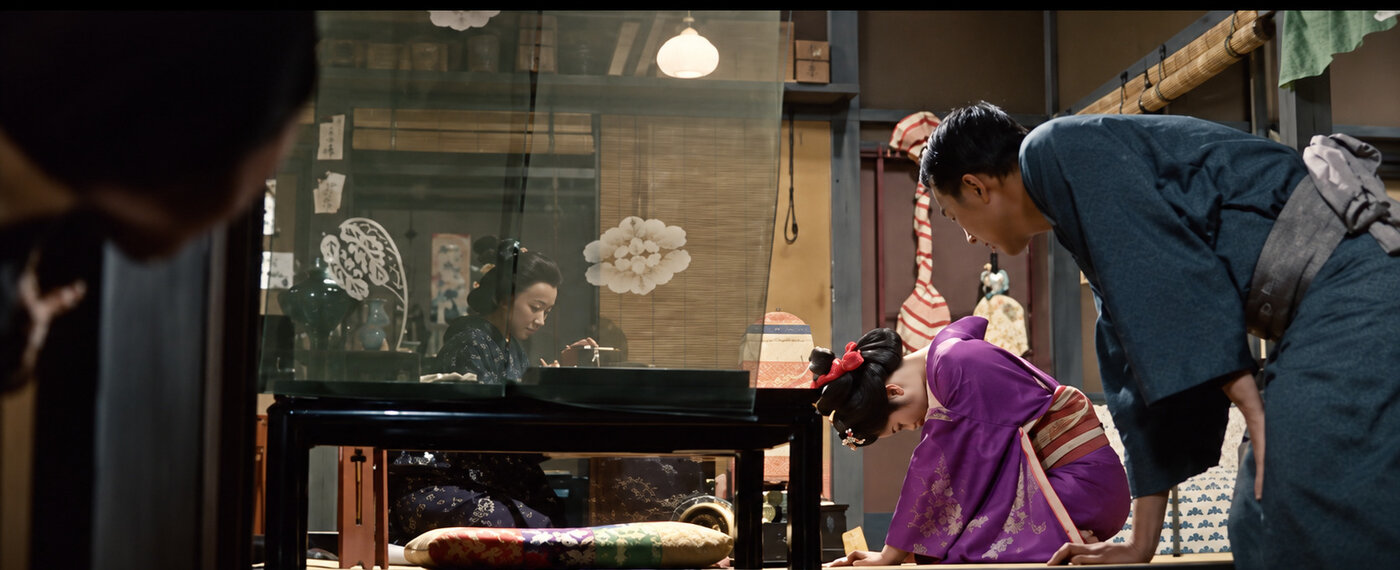
In Blood of Revenge (1965), Hatsue, a young woman bound by contract to a pleasure house, wants to see her dying father. Wearing violet, she bows low to the floor and begs Okatsu, who manages the house, for permission to leave. Okatsu reminds her that she has already been “bought and paid for” and is no longer free to leave on her own.
The film’s director, Tai Katō, does not frame the plea as a simple exchange between two people. Hatsue is fully in view, but Okatsu sits deeper in the room, partly screened by translucent fabric. A man leans into the frame from the right. On the left, a woman is just visible in the shadows. She then crosses the foreground, briefly obscuring much of the action while the dialogue continues. For an instant, she is a spectator within the scene. A second later, her body becomes an obstacle to our own view.
Katō does not organize the image around a single center. Four characters occupy different parts of the frame, and our attention keeps shifting from one to another. The action remains clear, but no figure dominates it.
We see the exchange through several layers. Bodies obstruct the frame, translucent fabric filters another figure, and some of the action remains hidden. Katō is best known, especially in Japan and among specialists, for his low camera positions, but they are only one of the ways he complicates our view. Objects, architecture, darkness, and blurriness can all come between us and the action.
TAI KATŌ IN THE STUDIO SYSTEM
Tai Katō in 1971. Courtesy of Kobe Planet Film Archive.
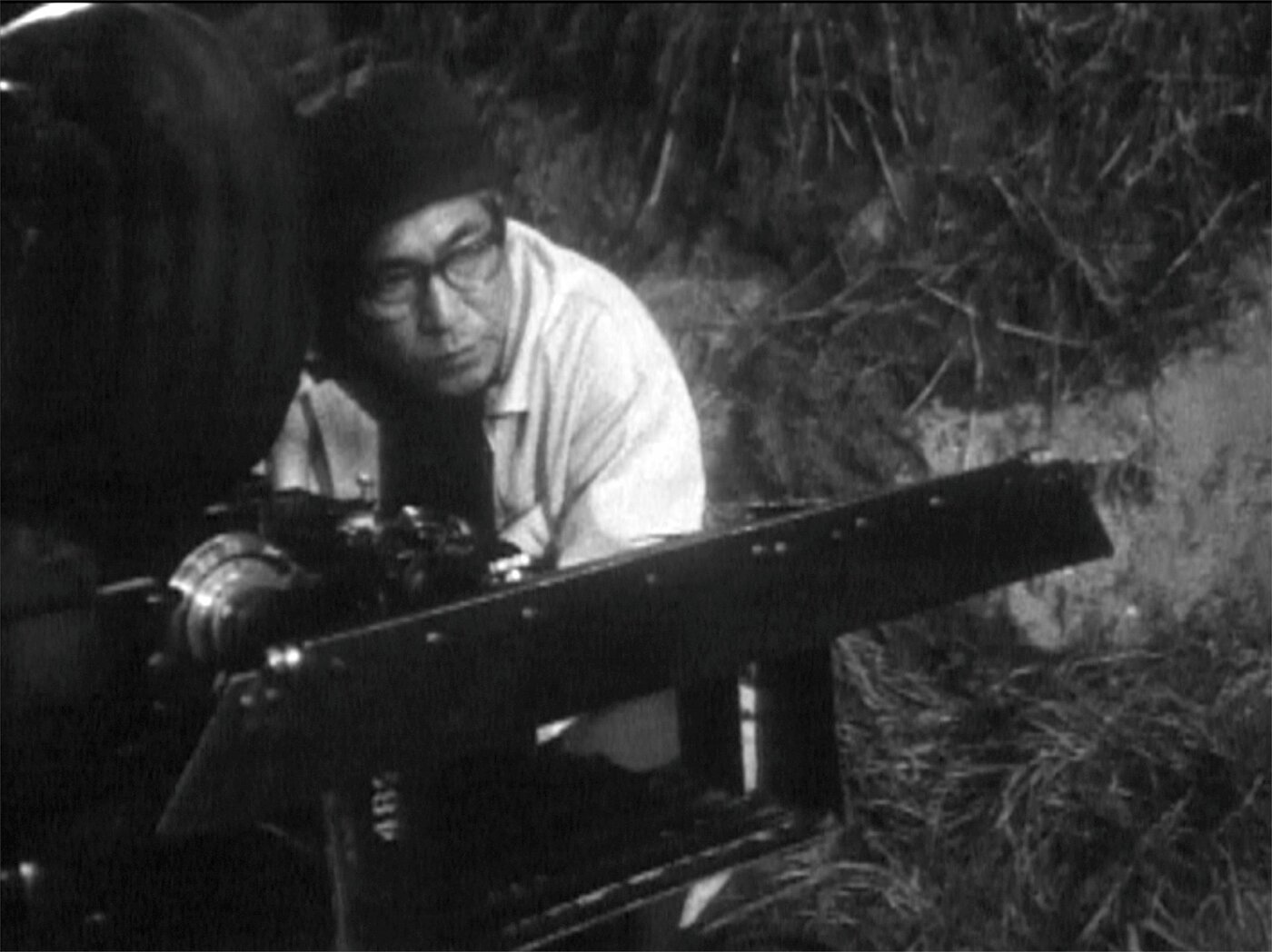
Tai Katō made his feature directing debut in 1951 at the independent Takara Productions. He joined the Kyoto studio of the production company Toei in 1956, initially as an assistant director, and resumed directing the following year. It was at Toei that he gradually developed a mise-en-scène that would become unmistakably his own. He worked largely within the popular forms in which the studio specialized. These included jidaigeki (period films) and chanbara (sword-fighting films). His first widescreen film, Genji Kurō Sassōki: Nuregami Nitōryū (1957), was made in the 2:1 SuperScope process.
The wider frame became central to his style. Katō divided it, layered it, and populated it, giving unusual weight to foreground and background, to the edges of the image and to the spaces between figures. Low camera positions and long takes became part of the same way of organizing space.
During the 1960s, as Toei increasingly turned to ninkyō eiga, the chivalric yakuza film, Katō adapted this visual language to new dramatic forms. The codes of loyalty, obligation, and violence gave him another framework within which to explore relations between characters. Within the widescreen, the distance between bodies could itself become dramatic information. It matters who stands close, who is separated, and who is pushed toward the edge of the frame.
His roots, however, reached back to an earlier Japanese cinema. Katō was the nephew of Sadao Yamanaka, one of the major directors of prewar jidaigeki. He entered Toho’s studio as an assistant in 1937, working with Mikio Naruse, and later with Daisuke Itō, a major figure in Japanese period cinema. In 1950, he was an assistant director to Akira Kurosawa on Rashōmon. His own formal experiments thus emerged from traditions he had encountered at close range rather than from a rejection of them.
Katō occupied an unusual place in the cinema of the 1960s. His films could be as formally audacious as those associated with the Japanese New Wave, yet he remained firmly rooted in popular genre cinema. Where Masahiro Shinoda, a leading figure of the New Wave, increasingly used modernist form to challenge established modes of representation, Katō worked through the conventions of chanbara, melodrama, and the yakuza film. In this respect, he was closer to directors such as Yasuzō Masumura or Seijun Suzuki, who also found radical visual possibilities within commercial cinema. Katō’s experiments with framing, depth, obstruction, and widescreen space did not reject genre conventions. They transformed them from within.
Outside Japan, however, Katō remained largely unknown for decades. A retrospective at the Locarno Film Festival in 1997 was one of the first significant attempts to introduce his work to an international audience. A major centenary retrospective followed at Tokyo’s National Film Center in 2016. Yet his films are still rarely seen outside Japan. The Cinémathèque française is now devoting a major retrospective to him from October 14 to November 26, 2026, which will hopefully broaden the recognition of his work.
LOWERING THE IMAGE
Blood of Revenge (Tai Katō, 1965).
What happens to an image when Katō lowers the camera? The position inevitably recalls a signature style of Yasujiro Ozu, another filmmaker closely associated with a camera placed near floor level. In Ozu, the low camera occupies a discreet place within the domestic world, observing the relations unfolding around it. Katō uses the position differently. He gives floors, thresholds and intervening objects a new prominence, so that our eye has to cross them before reaching the characters.
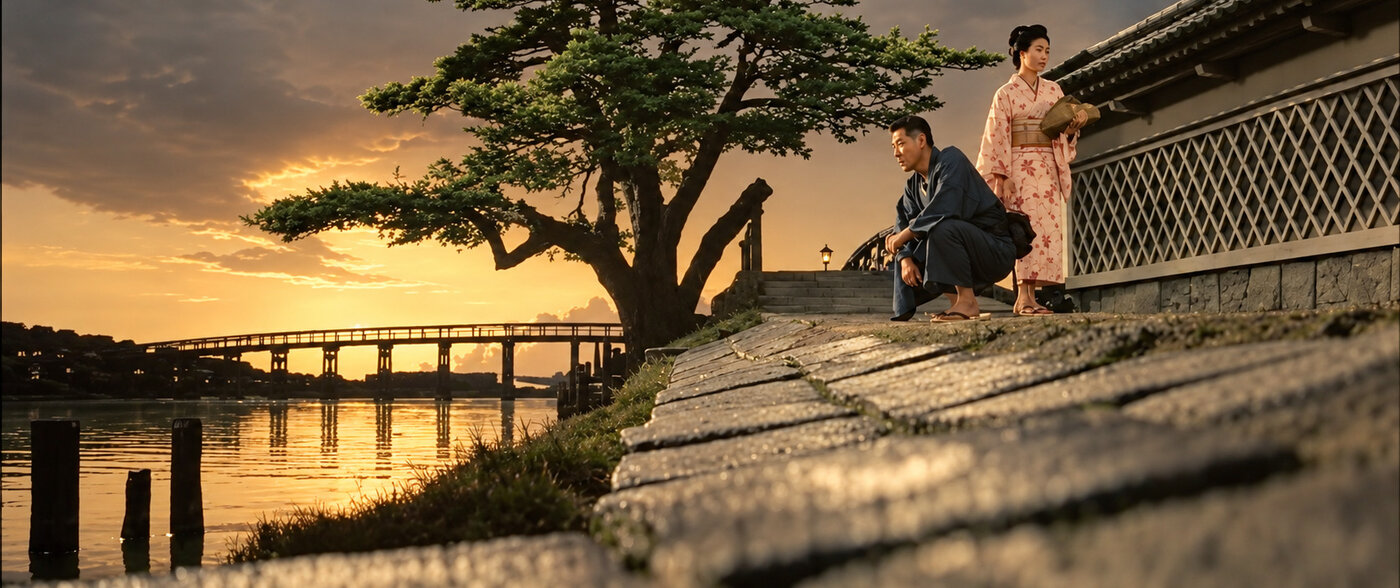
One scene in Blood of Revenge makes the effect of Katō’s low camera particularly clear. Asajirō, a trusted man of the Kiyatatsu clan who has helped Hatsue leave the pleasure house to visit her dying father, is now with her by the river. Their conversation gradually reveals the feelings developing between them. The camera is again close to the ground, but a sloping stone bank dominates the foreground. Asajirō and Hatsue occupy the upper right of the frame. The broad stone surfaces draw the eye before the people do, falling diagonally toward the river while a bridge and a tree open the frame to the left. The landscape is no longer simply a setting for their encounter. Its lines and surfaces determine how small the two figures appear within it.
Katō’s low camera therefore does more than provide an unusual angle. By giving unusual weight to the foreground and to the distances within the frame, it makes space itself organize the shot. The distance between the characters matters. So does the distance separating them from us, and the architecture or landscape they inhabit. Space does not simply contain the drama. It makes relationships visible.
BLOCKING THE VIEW
By a Man's Face Shall You Know Him (Tai Katō, 1966).
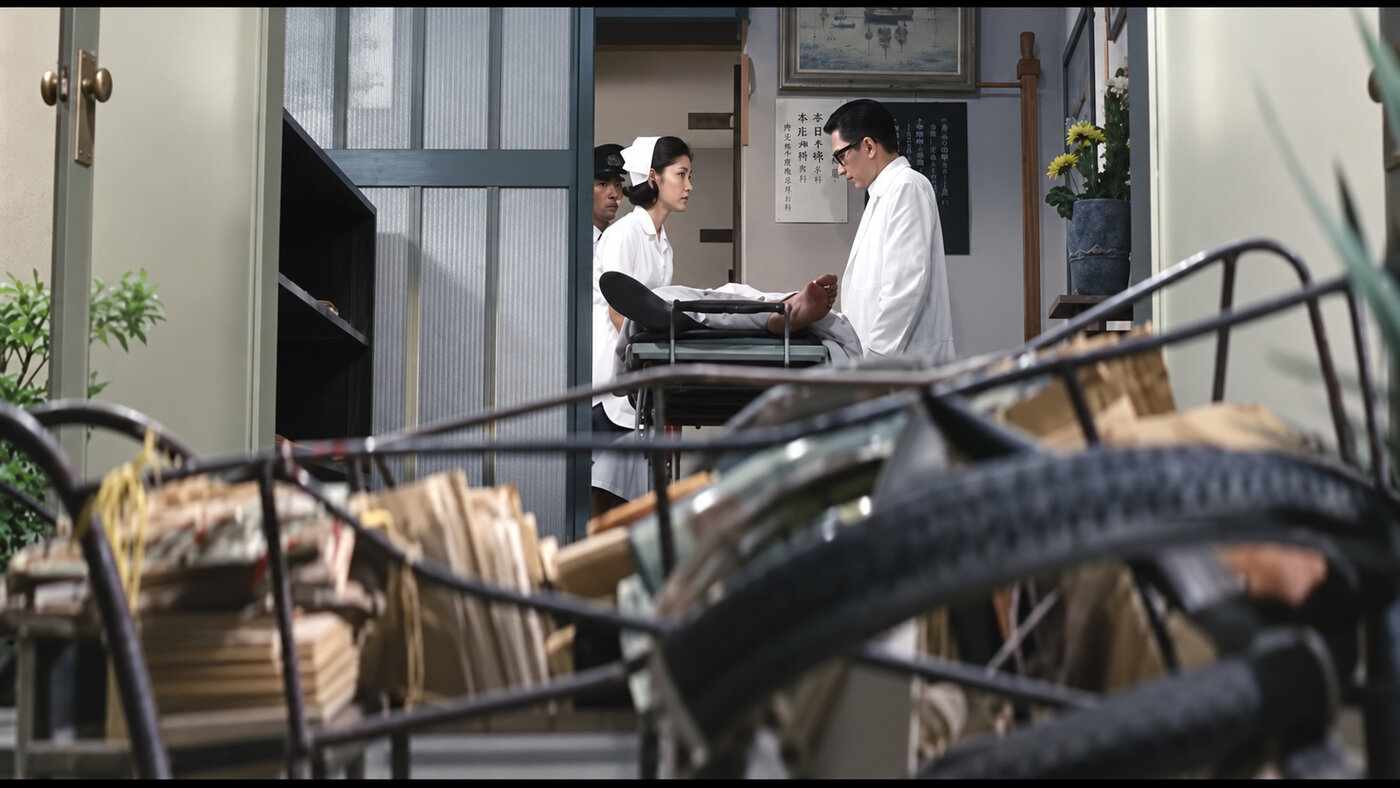
In By a Man’s Face Shall You Know Him (1966), Dr. Amamiya is treating an injured man brought to his clinic when he recognizes someone from his past. The encounter leads back to the violent conflicts of postwar Japan, where rival communities struggled for control of a local market.
Katō places something between us and the person we are trying to see. The Japanese title, Otoko no kao wa rirekisho, literally means “A man’s face is his résumé.” Yet Katō rarely gives us a face directly. A doorway, a passing body, a pane of glass, or a car can come between us and the person we are looking at.
In the film’s opening scene at the clinic, the wounded man lies deep in the room, framed by a doorway. Metal structures and equipment fill much of the foreground. The stretcher, nurse, and doctor can still be picked out. They are never isolated from the clutter around them. White-coated figures pass close to the camera and briefly hide part of the action. The scene never becomes unclear. Katō simply refuses to clear the space for us. Bodies and objects keep interrupting our sightline to the event.
A similar obstruction appears near the end of Miyamoto Musashi (1973), Katō’s dark account of the legendary swordsman. Otsu, a young woman in love with Musashi, returns to her village and is attacked by an elderly woman who blames her for her son’s disappearance.
The woman suddenly collapses and dies. Moments later, a traveling monk arrives with news that Musashi is about to fight his final duel.
Otsu and the monk carry the crucial exchange, yet Katō places them deep in the background, where we might expect them to dominate the image. Otsu stands near the center, her face slightly out of focus between two vertical bars. The monk remains to the right, also partly obscured.
The foreground belongs instead to the chickens, the wooden bars, and the body of the elderly woman who has just died. The chickens barely move, except for small jerks of the head. The bars and supports divide the image into narrow sections. Katō thus reverses the usual hierarchy of the shot. The characters who matter most dramatically occupy the least immediate part of the image. To reach them, our gaze has to pass through everything the scene has left behind.
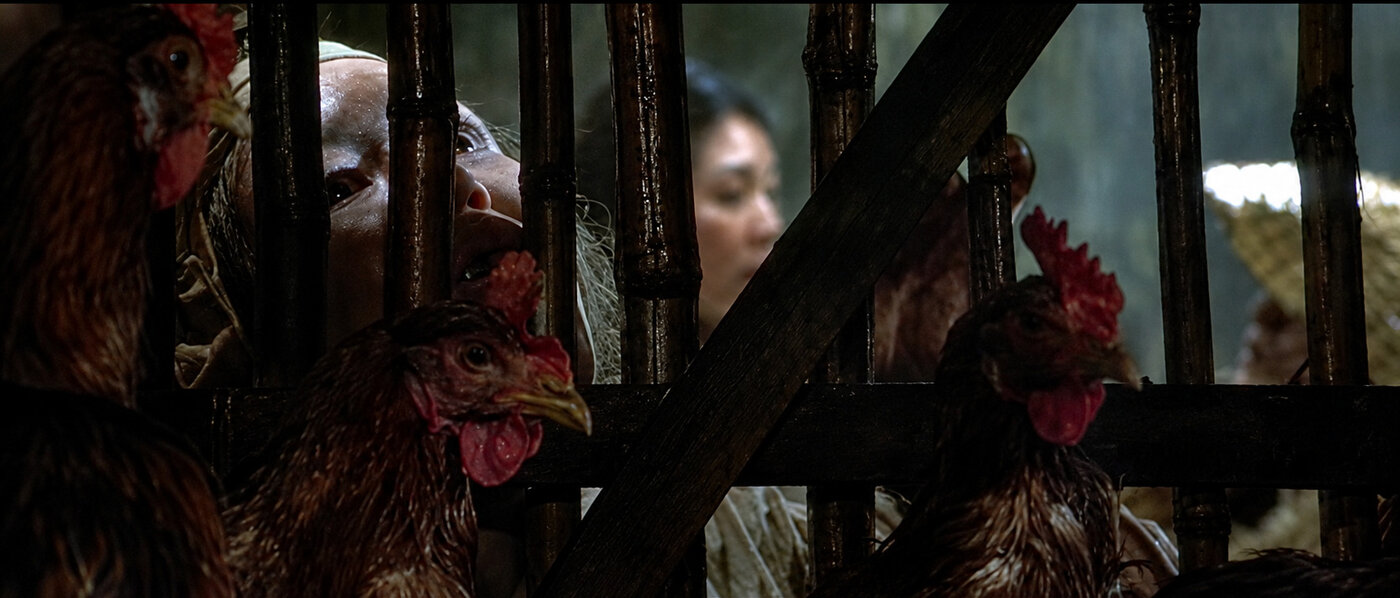
Miyamoto Musashi (Tai Katō, 1973).
Sound adds another layer of obstruction. Rain pours down. A shrill score forces the speakers to raise their voices. We have to search for them through the image while their voices struggle to emerge from the layers of sound. Katō obstructs not only our view of the conversation, but our access to it as well.
In both films, the image works like a puzzle made of fragments. Bodies, objects, and architectural elements divide the frame and shift our attention from foreground to background, from one figure to another, and from the figures to the space around them. The scene remains intelligible. Katō makes us connect what remains visible—a face between bars, a movement in the distance—with what we can hear. The spectator reconstructs the relations between these fragments instead of receiving a single unobstructed view of the whole.
BREAKING THE FACE
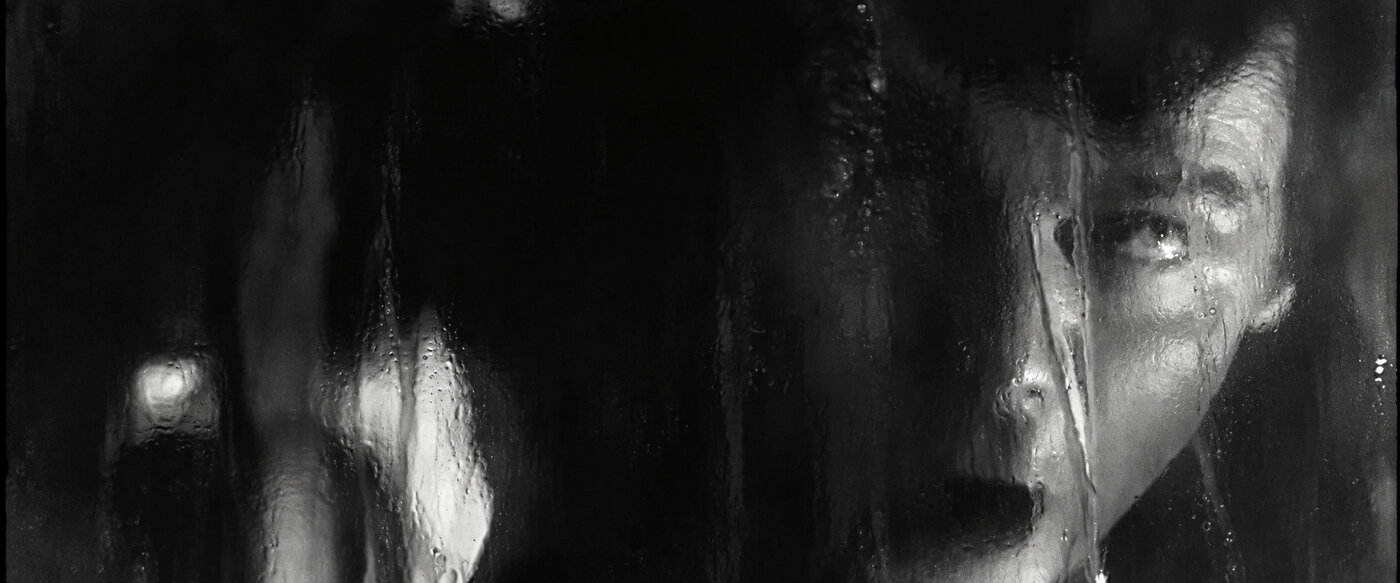
I, the Executioner (Tai Katō, 1968).
In I, the Executioner (1968), Kawashima, a wanted killer hiding under an assumed identity, sets out to avenge the suicide of a young laundry worker by murdering the women he holds responsible for his death. As he confronts the last of them, Katō moves partial vision from the surrounding space to the face itself.
Most of the frame is dark. On the right, part of Kawashima’s face appears through water. We see one eye, part of the nose and the curve of the cheek. The moving surface distorts these fragments without ever allowing the face to become whole. Beside him, a dark shape fills the center of the frame. Everything else disappears into shadow.
Katō gives us very little, yet it is enough to recognize Kawashima. His eye remains visible, but the face itself becomes unstable, transformed by the water through which we see it. The water does not simply conceal part of the face. It prevents that face from settling into a complete and stable image.
We are no longer simply trying to look past an obstacle. We have to piece together a face from fragments. For a man already living under an assumed identity, the effect is especially striking. Katō brings us close enough to recognize him, but never gives us a complete image of him. Nor does the fragmented face reveal some hidden “true” Kawashima behind the identity he has assumed. The face can identify the man, but it cannot define him completely.
A LATE IMAGE
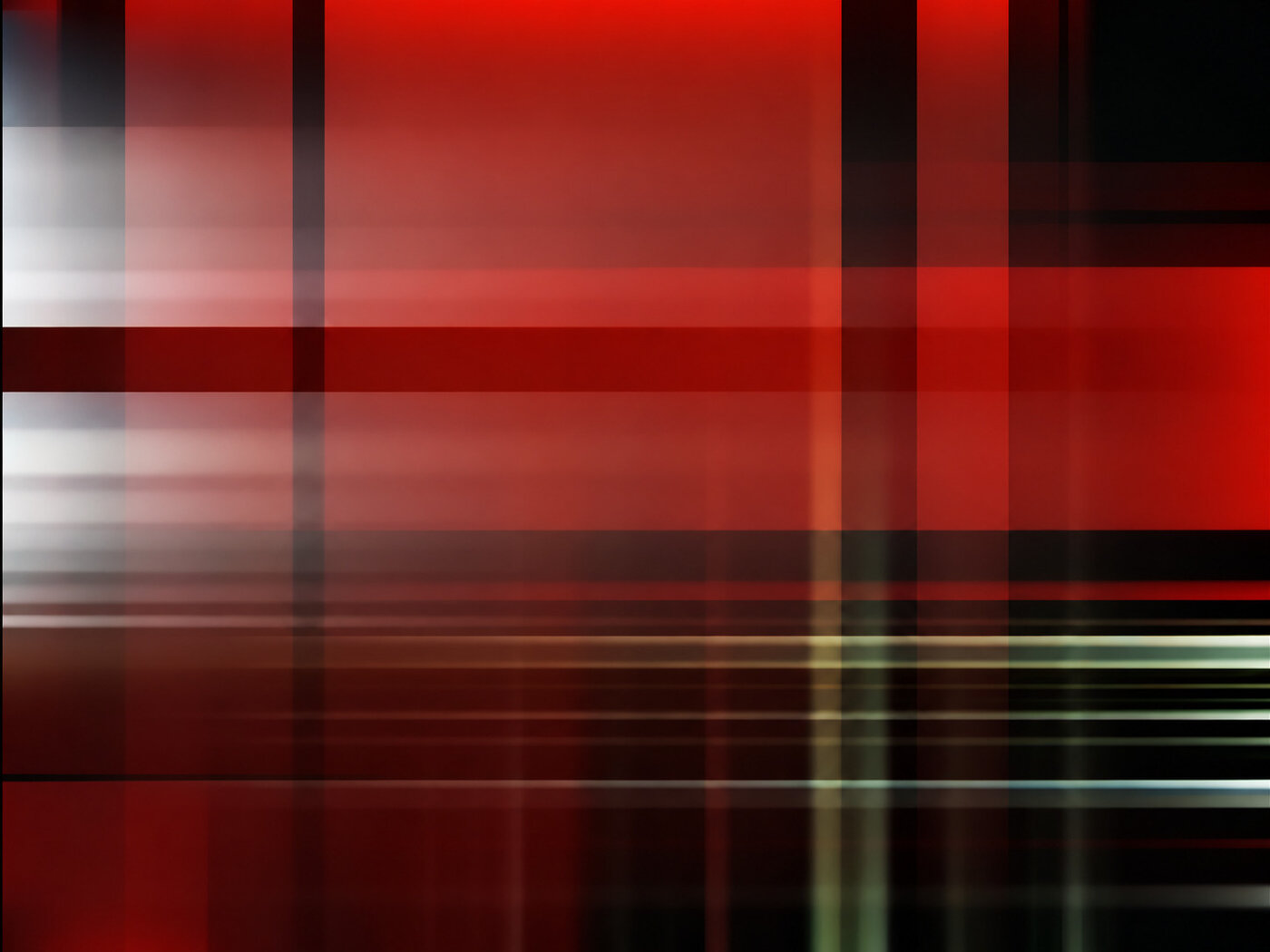
Beast in the Shadows (Tai Katō, 1977).
In Beast in the Shadows (1977), mystery writer Samukawa investigates a series of threats and murders surrounding Shizuko, a married woman who claims to be threatened by the mysterious crime writer Oe Shundei. After following a trail of false identities and misleading clues, Samukawa becomes convinced that Shizuko herself is Shundei. He believes that she has transformed her plots into real crimes.
In the final sequence, Samukawa takes Shizuko to a room he has rented. There, he reconstructs the mystery for her. At first, both figures are clearly visible. Then their bodies disappear behind a thin fabric screen. Katō sustains the obstruction for seven long minutes. What was once an obstacle within the image now takes over the image itself. The fabric becomes its dominant surface. Its color shifts from pale tones to deep reds as Samukawa’s reconstruction grows ever more precise.
The audacity of the sequence recalls experiments more readily associated with contemporary art cinema. In Michelangelo Antonioni’s The Passenger (1975), the celebrated final shot also unfolds over almost seven minutes. The protagonist’s death is withheld from our view. Alain Resnais pursued another kind of uncertainty in Last Year at Marienbad (1961). There, an increasingly confident reconstruction of the past is never confirmed by the images.
Katō brings a comparable instability into the heart of a mainstream genre film. The more precisely Samukawa explains Shizuko, the less clearly we are allowed to see her. He explains the murders and lays out how the deception worked. The image remains filtered, softened, almost dissolved by the screen in front of them.
Then his certainty begins to give way. Samukawa tells Shizuko that she has defeated and manipulated him. His questions become less forensic and more personal. The reconstruction of a crime gradually turns into a confession of love. Katō leaves the veil in place. Its color continues to shift. What is said and what can be seen remain apart.
Katō could hardly have pushed this principle of visual obstruction any further. Then, in barely seven seconds, the film breaks into a rapid series of very brief shots. Shizuko repeatedly enters the frame upside down from above. Her body falls into the image. After being withheld from view for so long, she returns only in flashes, unstable and inverted. Abruptly, the screen cuts to black, and the words “THE END” appear.
Seeing no longer means uncovering a clear truth behind the veil. Shizuko remains impossible to grasp fully. Like Samukawa, we are left trying to make sense of what we see.
PARTIAL VISION: THE LIMITS OF SEEING
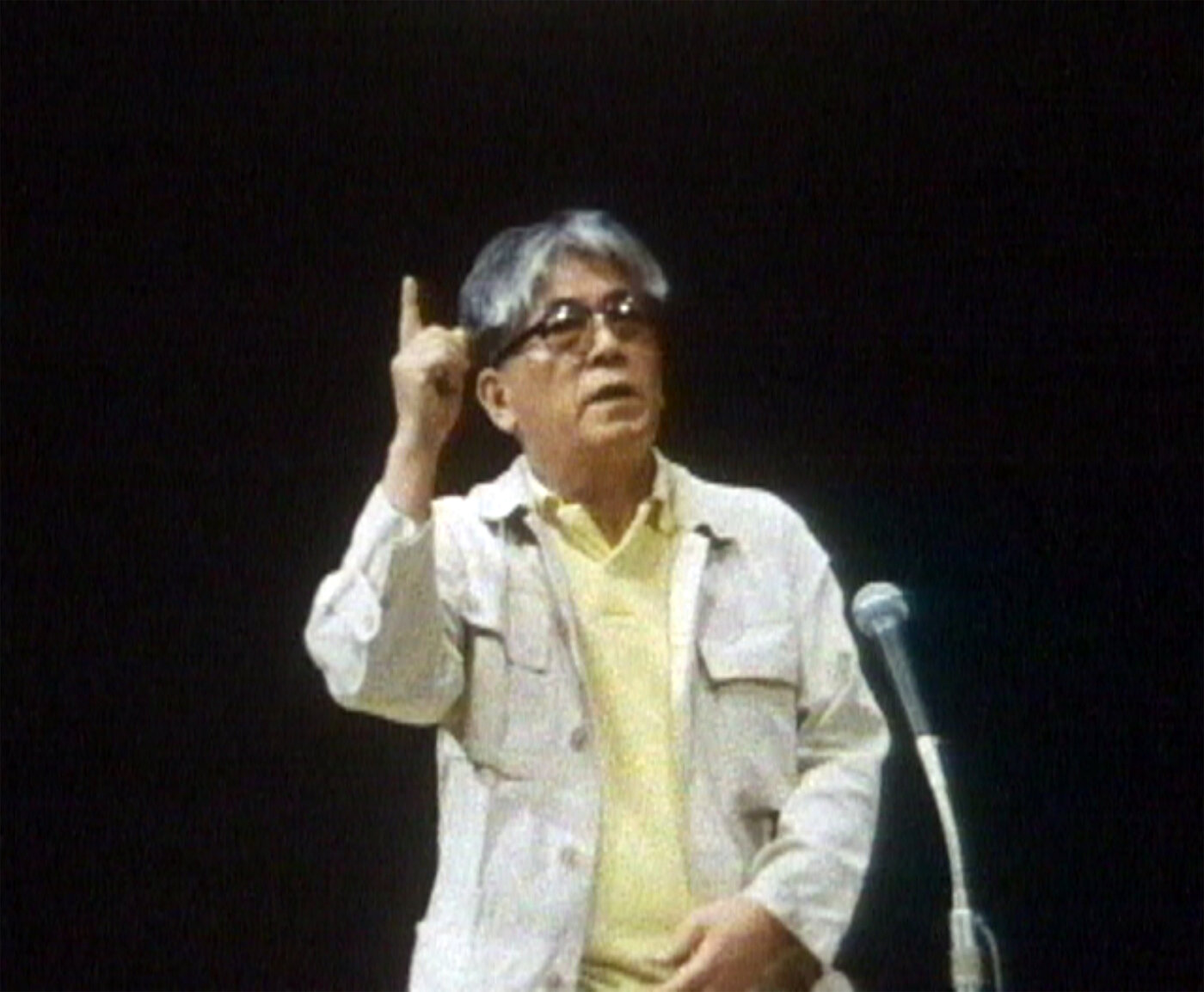
Tai Katō in 1982. Courtesy of Kobe Planet Film Archive.
Across these films, partial vision becomes more than a way of organizing space. Katō’s characters are often already defined by a name, a role, a code, or a legend. Yet these definitions never seem to exhaust the person. The images behave in a similar way. A character may be recognizable without becoming entirely available to us. A face may identify someone without defining them completely.
What is hidden, blocked or fragmented does not reveal a truer self waiting behind the image. Katō does not replace one identity with another. He leaves something unresolved. We can follow the action, recognize the characters and understand their relationships. Yet the image never gives us everything at once. Partial vision is not obscurity. It sets a limit on what we can see, and perhaps on what we can know of the person within the image.
Katō pushed this question even further in his final films. Like a Flame (1981) returns to a legendary swordsmith, Aizu no Kotetsu. Yet Katō does not give that legend a stable image. Discontinuous cuts and abrupt changes of light unsettle the image. Exaggerated expressions and ungainly violence do the same. The legendary name remains, while Katō keeps bringing us back to the man and his relations with the people around him. Once again, the man exceeds the role that history and genre have prepared for him.
Za Ondekoza, completed in 1982 but not released until 1994, goes further still. Fictional characters and genre identities largely disappear. Katō turns instead to bodies running, training and striking drums. He attends to the sounds they produce together and to the spaces through which they move. At a preview of the completed film, he is said to have described it as “the first film in which I was able to do exactly what I wanted.”
The question is no longer simply how an image can reveal a person without defining them. Katō seems to move toward what comes before definition. Bodies, movement, sound and space are present before they become character or legend.
Tai Katō may therefore belong to a different history of Japanese modernism. He moved from the classical studio system toward increasingly radical forms without abandoning popular cinema along the way. The filmmaker Shinji Aoyama and the critic Shigehiko Hasumi would later become prominent admirers of his work. Seen from this perspective, Katō is not simply an overlooked studio craftsman. His films show how modern cinema could emerge from inside the very genres and production system it is often said to have left behind.
Tai Katō runs October 14 – November 26, 2026 at la Cinémathèque française in Paris.