
The Action Scene explores the form, history, and visceral power of action cinema through its set pieces
This column was occasioned by Issue 7 of Notebook magazine as part of a broader exploration of the unfilmable. The magazine is available via direct subscription or in select stores around the world.
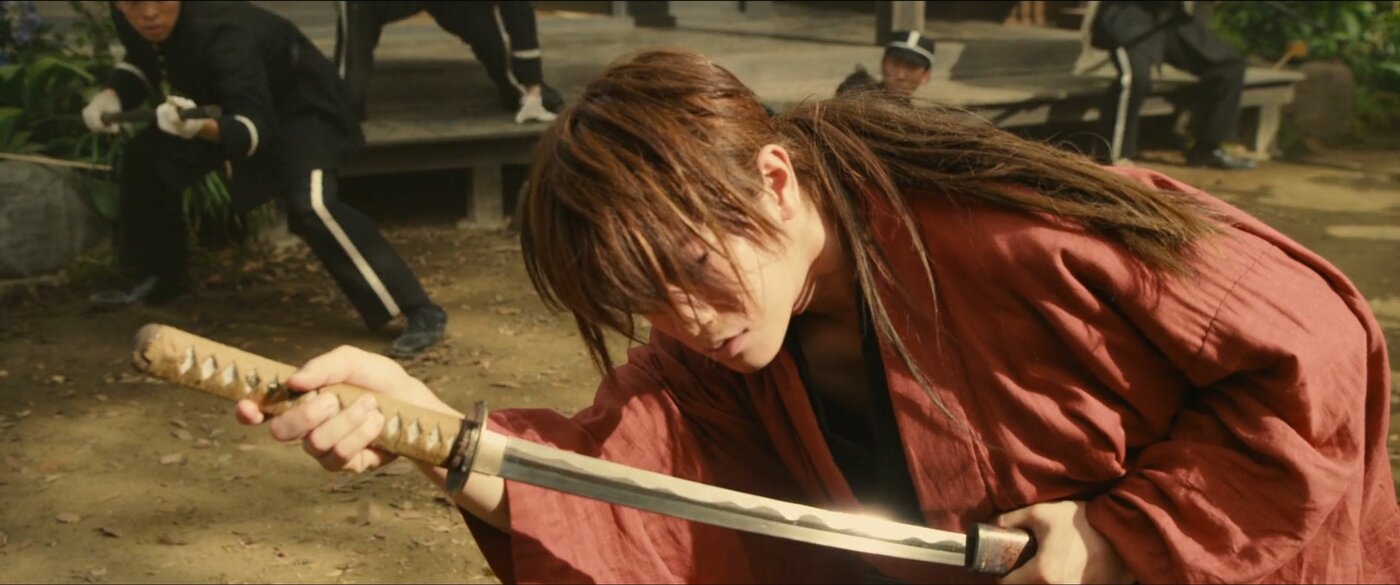
Rurouni Kenshin: The Legend Ends (Keishi Otomo, 2014).
Unlike the wuxia warrior who soars to rafters and treetops, the fighters in the Rurouni Kenshin films (2012–21) move low and fast. Rather than immaculate choreography immaculately framed—the meat and potatoes of golden-age Hong Kong martial arts cinema—their swordplay is less studied, a quicksilver flow of action and reactions. And unlike the conventional samurai standoff, in which opponents take their time sizing each other up from a distance, the action is pure, intimate bedlam. Blades clash everywhere, from tip to hilt, bringing combatants up close; when an attack is dodged, it misses by mere inches. Some of the most iconic moments involve the hero, Himura Kenshin (Takeru Satoh), weaving tightly through a throng of opponents, whacking left and right with his reverse-blade katana—which, being nonlethal, only heightens the chaos, replacing the single, decisive slash with a battery of battering that leaves enemies bruised and viewers breathless.
The mastermind behind the mayhem is Japanese action director Kenji Tanigaki, whose expansive role included everything from engineering stunts to editing fights to coordinating time-saving strategies with the props and costume departments (expediting prep work allowed for more takes). Tanigaki was raised on Jackie Chan movies and mentored by Yasuaki Kurata, a Japanese actor and martial artist who worked extensively in the Hong Kong film industry. His action-design career took off when he moved to Hong Kong himself in 1993, and especially after he started collaborating with Donnie Yen. Soon thereafter, Yen began experimenting with the mixed-martial-arts-inspired, close-quarters action for which he would become famous, roughening up the stagier aesthetic of 1980s and ’90s Hong Kong choreography. Tanigaki played an integral role, helping to choreograph films like S.P.L. (2005) and Flash Point (2007), both of which deliver some of the most pulverizing dustups in contemporary action cinema. Yen’s style of screen combat influenced Rurouni Kenshin, but the latter is also its own beast, presenting new innovations to the feel and flow of the cinematic swordfight.
In between the five Rurouni Kenshin titles, adapted from a hit manga series, Tanigaki has worked on a steady stream of projects: Special ID (2013), Raging Fire (2021), and Sakra (2023) showcased Yen’s physicality and star charisma; the G.I. Joe entry Snake Eyes (2021) grew Tanigaki’s fame in the West; the Chinese direct-to-video actioner Fierce Cop (2022) was shot around the production demands of COVID; and Twilight of the Warriors: Walled In (2024) saw him working with the Soi Cheang on what would become Hong Kong’s third-highest-grossing film of all time. His highly anticipated latest outing as director, The Furious (2025), will make its debut at the Toronto International Film Festival next month, featuring action design by Kensuke Sonomura (Baby Assassins, 2021–24) and a murderers’ row of screen-fighting luminaries: Joe Taslim and Yayan Ruhian (The Raid, 2011), JeeJa Yanin (Chocolate, 2008), Xie Miao (Eye for an Eye, 2022–24; Fight Against Evil, 2021–23), and self-taught stuntman Brian Le, who, with his brother Andy, choreographed and performed action for Everything Everywhere All at Once (2022).
For a feature in the latest print issue of Notebook, we asked various film practitioners, including Tanigaki, how they’ve pushed their craft forward. For this online expansion, we spoke at greater length with Tanigaki about sequences he’s directed that might once have seemed impossible.
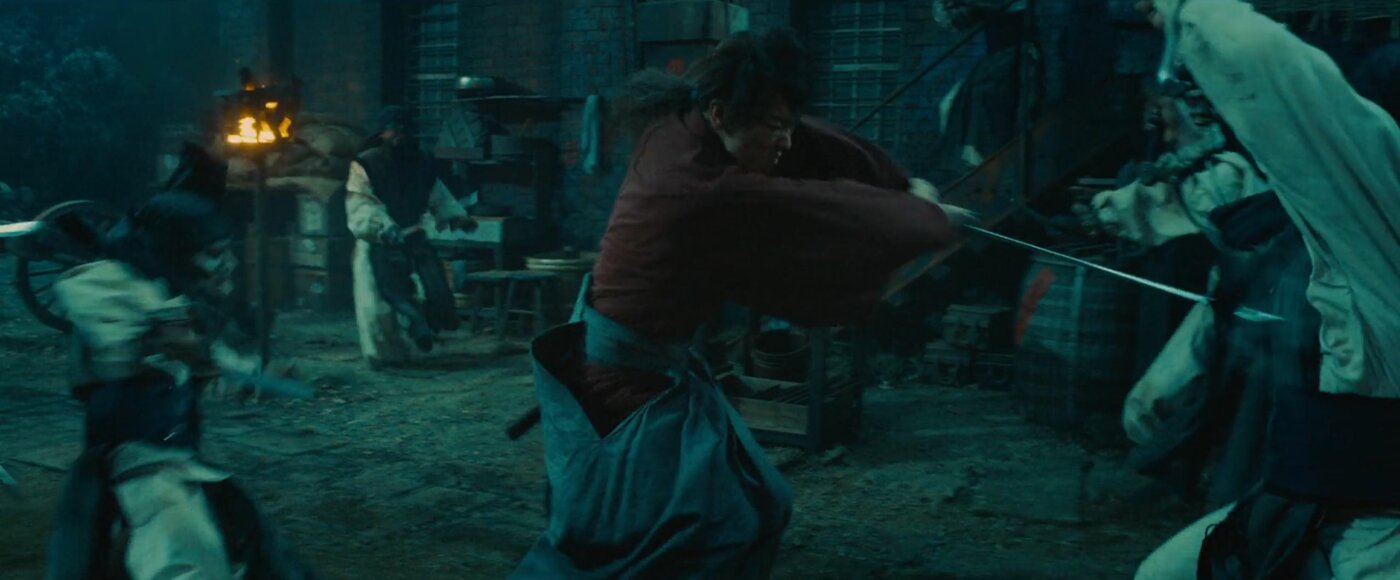
Rurouni Kenshin: The Final (Keishi Otomo, 2021).
NOTEBOOK: How did you first become interested in action cinema and martial arts?
KENJI TANIGAKI: I was born in Japan in 1970 and grew up in Nara, next to Osaka. We were the so-called Jackie Chan generation, because we, all the boys and girls, watched Jackie Chan movies growing up. Many people in other places, like Hong Kong or Taiwan or Thailand, had the same childhood. I loved Jackie Chan movies first, and then I loved Hong Kong movies. I also loved to watch action movies from all over the world, including those starring Buster Keaton, or Harold Lloyd, or Jean-Paul Belmondo. I moved to Tokyo with my family, and there was a nice place to train, to do gymnastics and other things. Me and other friends, after watching Jackie Chan and other kung fu movies, would try this combination, and then we would try to backflip like this, just playing around.
After high school, we learned some Shorinji Kempo, a system that came from China and was developed in Japan. The goho technique is like karate, punch-and-kick striking, and juho is like aikido or jujitsu, this kind of grappling style. After this, I entered the Kurata Action School. Kurata Yasuaki is my master in Japan. He shot a lot of Hong Kong movies in the ’70s, so he had a lot of techniques. We started with some acrobatic basics, and then striking, punching, and kicking, and some Japanese sword techniques. The most important part was the reactions. Reactions are, you know, a punch [mimics getting punched], and then some reaction [makes circular hand motion to suggest a spinning fall]. And we tried to learn timing. Shooting action movies is not just sword technique, not just backflips, not just throwing punches and kicks. We are mutually communicating with other guys. When we fight, if the background boys are just standing around and watching, it’s not so good. So we try to act, try to attack and then evade, try to attack again but this time, do a reaction. That kind of thing is very, very hard to adapt from other martial arts, because martial arts is basically just beating up the opponent, but action movies are totally different. Everything is pretend, but must look real.
In the early 1990s, there weren’t many jobs in Japan, especially in action movies. So at 22, I decided to move to Hong Kong and got to know many mentors, including Donnie Yen. Because of The Matrix [1999] and Charlie’s Angels [2000], other countries needed people to add some so-called Hong Kong–style action to their films, so we had a lot of opportunities to work in other countries, in addition to our work in Hong Kong. In the beginning of the 2000s, I moved back to Japan, but I was still shooting Hong Kong movies, along with Japanese movies like Rurouni Kenshin.
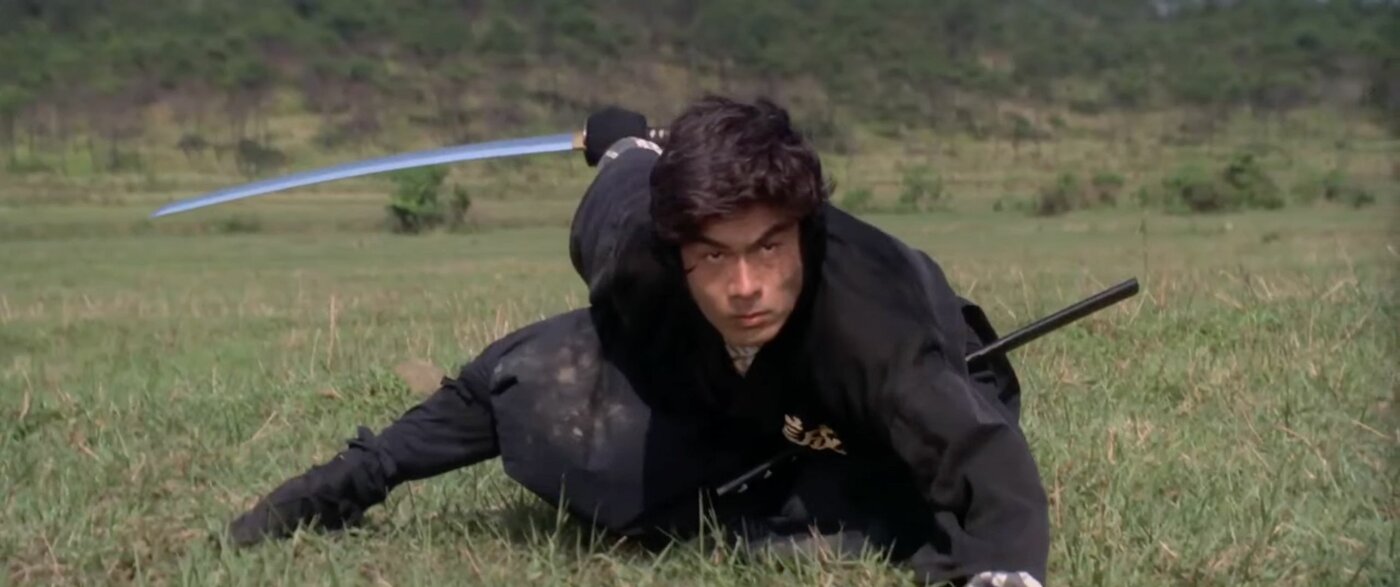
Yasuaki Kurata in Heroes of the East (Lau Kar-leung, 1978).
NOTEBOOK: When you began practicing martial arts, did you know you wanted to go into movies?
TANIGAKI: Yes, because I'm not a violent guy. I've never fought in the street. So my dream was to be in the action-movie industry. I was not sure what kind of occupation [I wanted]—stunt coordinator, or stuntperson, or actor, or director. It was very abstract. But my goal was to work in the Hong Kong film industry. That's why I chose to practice Shorinji Kempo. Shorinji Kempo is not striking or beating up other people. It’s like gymnastics or Chinese wushu. It’s not about who beats up whom. They will be judged based on the harmony of how they fight.
Afterwards, I entered the Kurata Action School. Kurata sensei had learned Shitoryu karate, aikido, and judo, but we didn’t really learn those kinds of things as his students, just some part here, some part there. As a stuntperson or stunt coordinator, I cannot learn everything. It takes one’s whole life. I call myself a fake martial artist. I pick up something for one character, then something else for another. The most important thing is we must learn the martial-art specialty of a character as quickly as possible, which is different from that of real martial artists.
NOTEBOOK: What was the action scene like in Japan in the ’80s and ’90s?
TANIGAKI: In 1989, while I was going to university, I started to train as a stuntman. At that time, there was a big difference in standards between Hong Kong and Japanese action movies. In Hong Kong, the standard was very high. Kurata sensei and other foreign actors like Richard Norton, Benny Urquidez, and Cynthia Rothrock did a great job in Hong Kong movies. But once they went back to their own countries, and we watched their new movies, we went, “What’s this? It’s totally different!” So I started to think that maybe it wasn’t the performer’s problem. Maybe there was some secret in Hong Kong about how to make the performer look good. I wanted to know this secret.
When I went to Hong Kong, I noticed the biggest difference was the relationship between the action director and the filmmaker. The filmmaker knows how to make the performer look good: some camera position, or some editing point, or some choreography. It was not just one secret—it’s a whole system. Sometimes in Hong Kong, action directors will choreograph. And after they choreograph, they judge how to shoot—camera angle, frame rate, everything. After this they will edit, and then they give the film back to their director. Of course, nowadays, everybody does this all over the world, but at that time in Japan, I didn’t know this kind of system. In Hong Kong, I believe everybody used this system. That was a very revolutionary, special system.
If you want to cook some food, you go to the market, and then you cook; you put in salt, pepper, or MSG, and then you can make the best possible ramen, right? But in Japan, this guy goes to the market and then passes the materials to other people, and then those people cook, and keep passing it on to other people. So I think, even if the performer is very good and they do a great job, if something is off—the camera position, or the timing, or if they don’t shoot well—it ruins their performance. Especially in action movies, editing can ruin everything.
In 1996, I went to shoot Mortal Kombat: Annihilation [1997], which was my first American production. And the performers were very good, like Ray Park (who later played Darth Maul), and Tony Jaa, and J. J. Perry—the best performers. But, somehow, they couldn’t deliver their real talent to the screen. But now everybody knows how to shoot, and everybody knows how to make a previs. Of course, previs creates some other problems now, I think. But now everybody knows how to make a good action film, a good martial-arts film. At least, the audience has taste, knows what is bad, what is good.
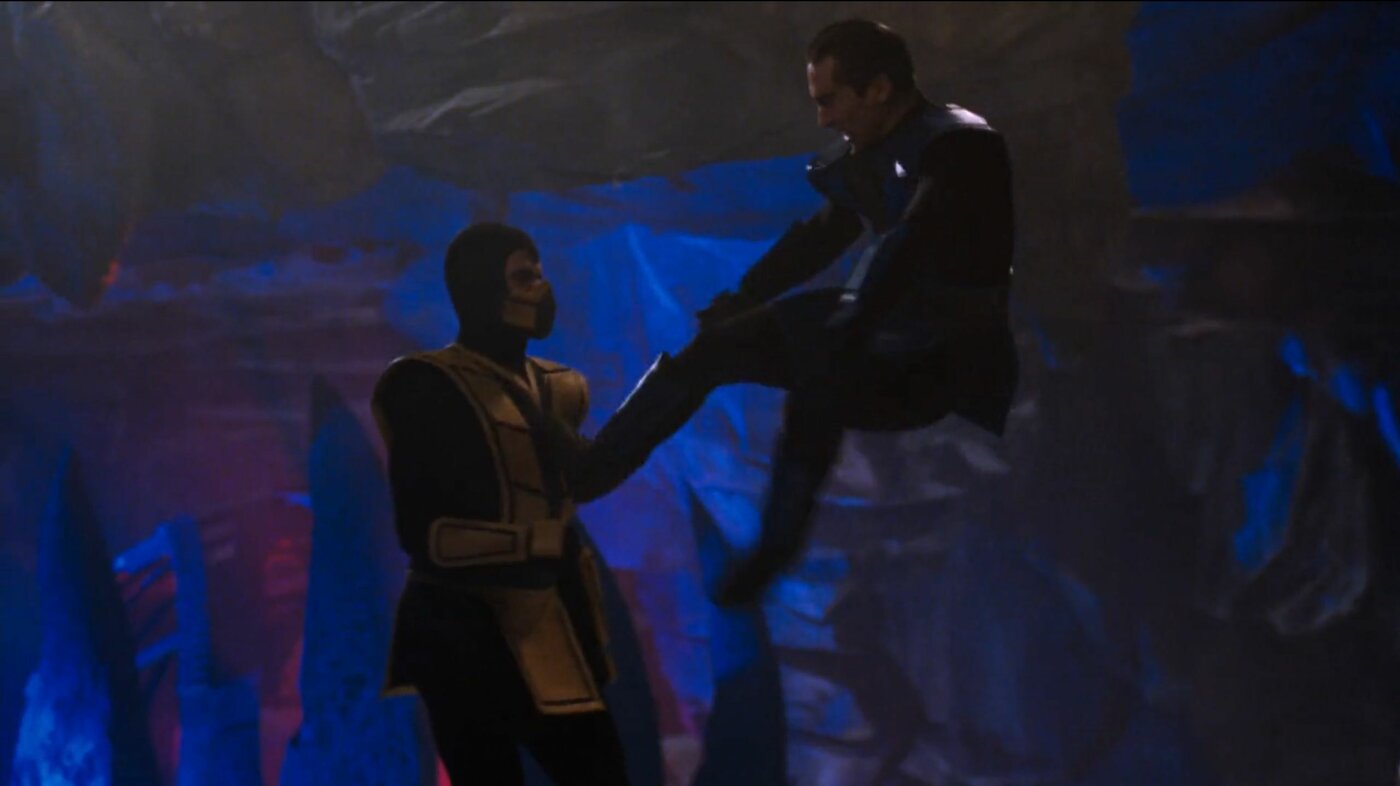
Mortal Kombat: Annihilation (John R. Leonetti, 1997).
NOTEBOOK: What problems does previs create?
TANIGAKI: Previs is now, I feel, a very independent department. Sometimes they don't care about the story or the characters; there’s less communication with the director or actors. Of course this is case by case. If Chad Stahelski makes a previs, it's very good. But if a person doesn't have any experience as an action director or stunt coordinator, even if the action scene is very good, the sequence may not be related to the drama or story or character. Sometimes I’ll hear the stunt department say, “That director isn’t following our previs. They don't know how to shoot action movies.” And then I watch that previs: “Oh yeah. That’s very bad.” I wouldn’t want to follow this previs, because they don't know the ability of their actors or the location. In the ’90s, the problem was that our department had no power in Japan or in other countries. But now, everybody knows how important the action department, the stunt department, is, so they can make a previs and then say, “They don't follow our previs.”
Please don't misunderstand: I’m not saying that previs is not good, but it must come from the director’s thoughts, or what the script is like, and we must consider each actor’s ability, because at the end of the day, they must do this action. Of course, we can use a stunt double or other techniques, but anyway, they must do it. I don't want to tell the actor, “Hey, our previs is like this. You must learn this choreography.” And then the actor just blindly learns this choreography [without being able to] give some input themselves. That's a very bad situation.
I think previs is just the first step to get everyone on the same page. I also will make a previs, but I don't say, “DP, you must follow this angle.” No, no, no. I just say, action-wise, maybe I think this angle is better, but you can put in other angles. I think communication on the set is very important.
NOTEBOOK: What was one of the most challenging action scenes you've directed?
TANIGAKI: I think every movie has challenges—even today, I must face some of the results of a test screening for my movie. We must face everything, every challenge. The challenge which made the most innovative stuff happen on set was Rurouni Kenshin [2012]. It’s a very famous manga in Japan, and the cartoon was also very popular at that time. So my first question was how to do an adaptation from manga or animation, because everybody knew that feeling [of reading the manga and watching the anime]. I didn’t want to make it like wuxia movies in China, because it’s an old Japanese story. I didn’t want to copy some wuxia film, because it wouldn’t be coming from me. So I tried to make something special, but, at the same time, I didn’t want to just follow the manga feeling, but it's very hard to bring that kind of action to live action.
First of all, we had to change the system of the Japanese action movie set, because, traditionally, in Japanese costume plays, or jidaigeki, they of course don’t use real swords, but they do use wooden swords. And they wear very traditional kimonos. It's very hard to do choreography with these costumes and props. The first thing we changed was the sword: we changed it to a rubber sword because I needed more close combat. At that time, I had just finished Flash Point [2007], Donnie Yen's movie, where we brought some MMA feeling to the screen, very close combat. At baseline, action scenes need to be filmed at a safe distance. Sometimes a punch would be meant to come here [mimics a punch coming toward his face] and I would try to aim here [moves fist about three inches to the left of his head]. But now, with MMA or that kind of martial art, it’s more this distance [sweeps arm tightly over his head]. It’s closer than before, very dangerous. If you miss one punch or one kick, you’re knocked out. That's why, when we shot Flash Point, we invented rubber gloves—we called it special makeup—a kind of fake hand to wrap around the actor’s real knuckles, and then we shot the action scenes.
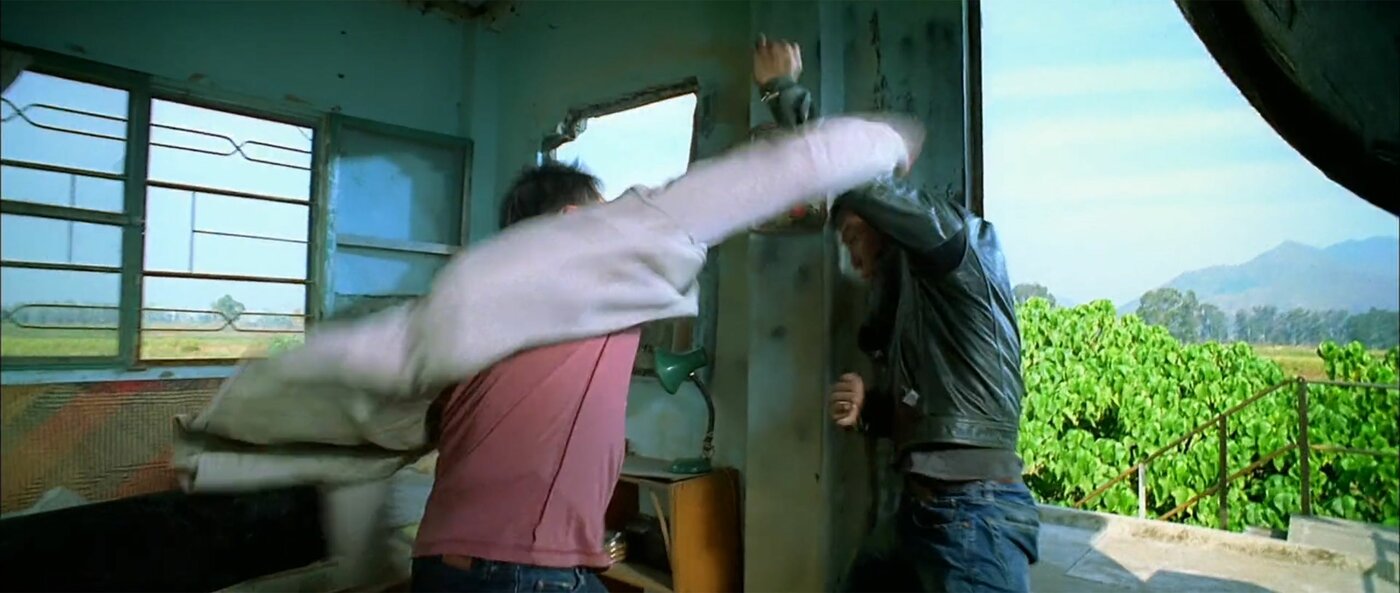
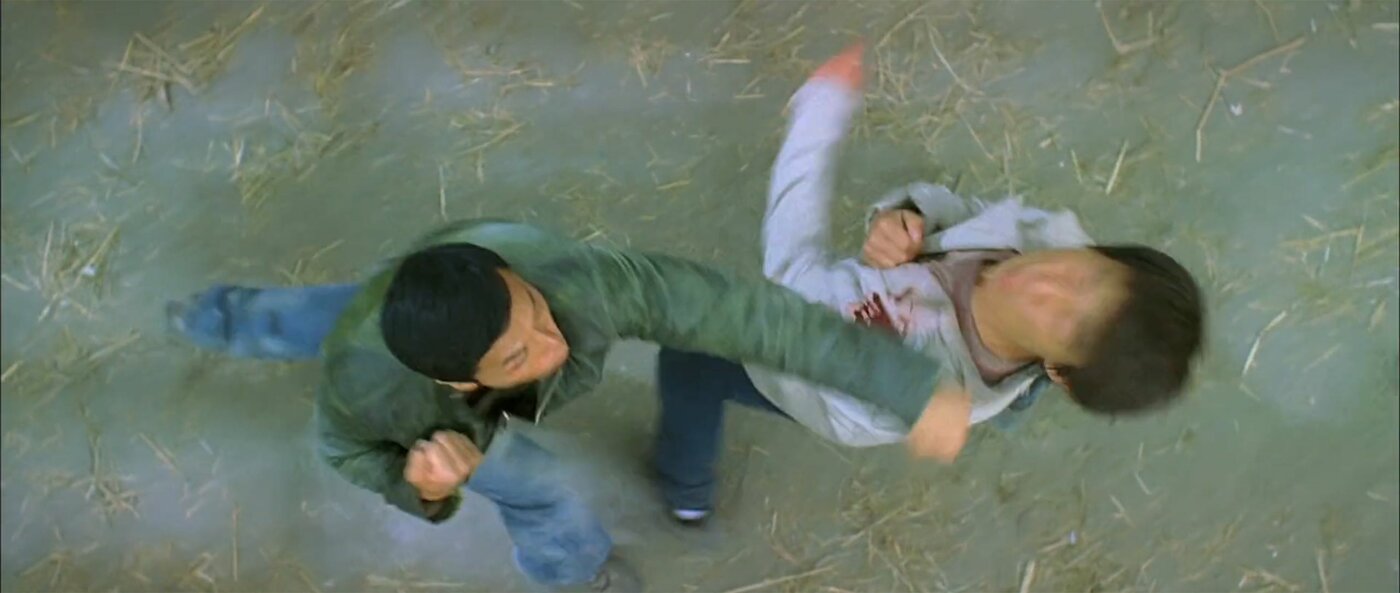
Close combat in Flash Point (Wilson Yip, 2007).
In Rurouni Kenshin, we wanted to make a sword which we could play with safely. If you're the performer [mimics sword striking head], a wooden sword is very dangerous; you cannot go into close distance. But with rubber swords—of course, if they hit you, it’s a bit painful, but it's okay. It's fine. Rubber swords changed everything for us. With the wooden sword, we would’ve had to find some camera angle to hide the gap between fighters. Before, shooting this kind of thing was very limited; no top shots, no side shots. But after we made the rubber sword, we had a lot of freedom to shoot, because we had no gap to hide. We were really hitting. The whole choreography was changed by this invention.
Even the actors felt good, because they were able to mess up. Say you are the lead actor and you must hit Tom Cruise with a wooden sword. Tom says, “You must hit me.” But if you use a wooden sword, how would you dare hit Tom Cruise? But with a rubber sword, you can hit. It’s much better investment-wise and psychology-wise: You're comfortable, because your character must beat him. But if you used a wooden sword, it wouldn’t help you to act like this. Some promotion for Rurouni Kenshin said everything we used was real; no stunt doubles, real weapons. Sometimes, to be realistic, everything real is good. But if you used a real sword to attack some guy, the sword would look real, but your acting wouldn’t be so good or real. With the rubber sword, it would not look as real, but in your acting, you would be able to go for real, because even if something happened, he’d be okay. I think realism is very important, but you either need a realism of appearances, or you need a realism of acting. I need the second one.
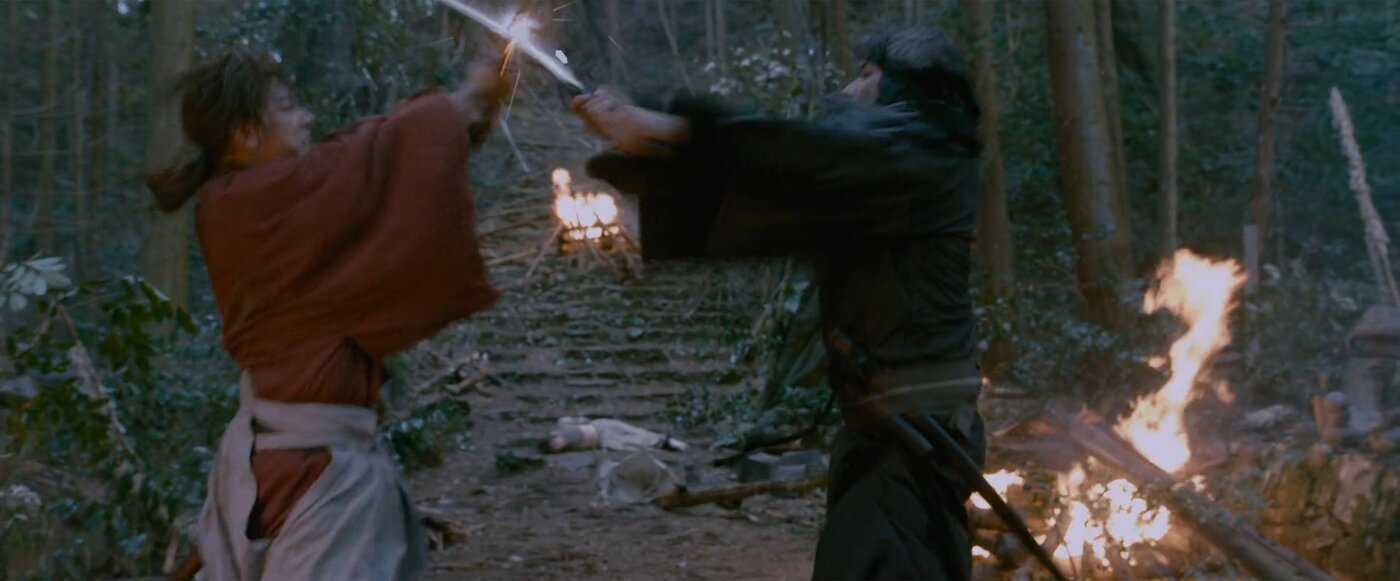
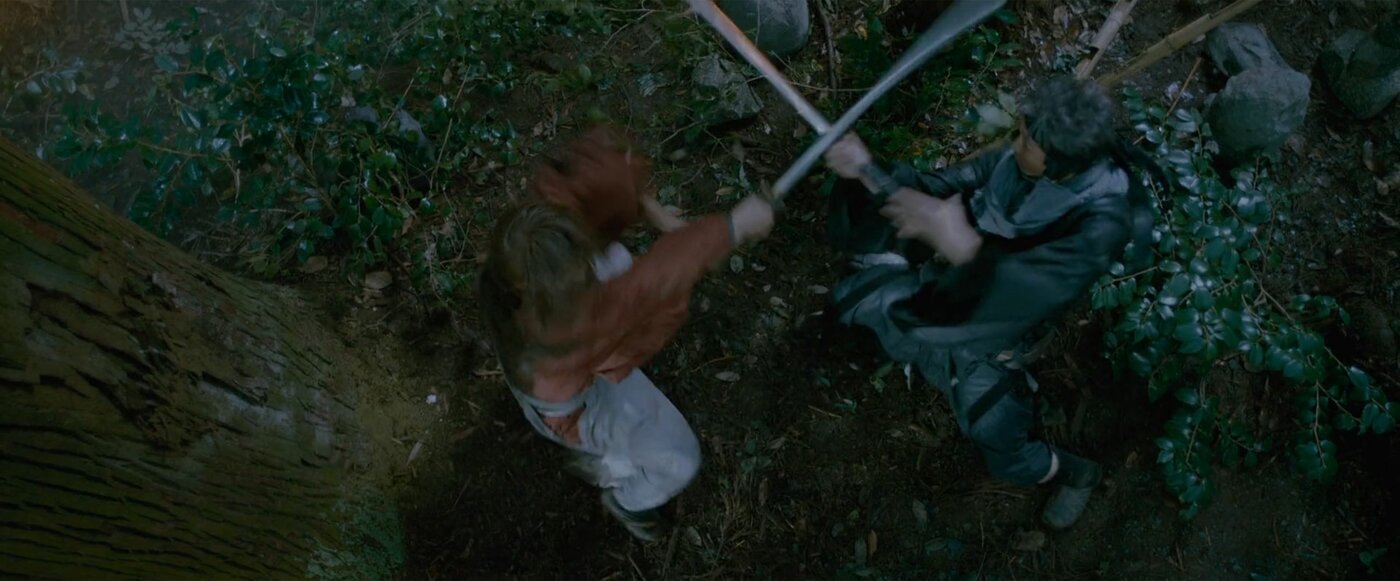
Rubber swords afforded more dynamic camera angle and full-contact choreography in Rurouni Kenshin Part I: Origins (Keishi Otomo, 2012).
NOTEBOOK: Could you say more about how the choreography for the Rurouni Kenshin films developed? It’s very unique.
TANIGAKI: In our story, the character uses a reverse sword. It cannot kill people, just hit. Because the sharp edge faces the wielder. It’s reversed. So our choreography is hitting more than slicing. With hitting, we can hit an opponent many times. If you use a traditional Japanese sword to slice people, and if I slice many times, the audience will say, “Oh, you're stupid, because you don't have to slice so many times.” But we can hit many times, knocking out the opponent; it makes a different rhythm. Instead of [imitates a single slash and the body falling over], our hits are [makes a ratatat sound to indicate a rapid succession of blows]. It's more unique, and it allows the whole action scene to have more variety and be more rich.
The other thing is, I didn’t want to copy wuxia films in China. Why? Because many people are very good at shooting characters flying and jumping around, some butterfly twists. I cannot shoot this better than them, but I also don't have to shoot like this. Many people treat me like a practitioner of Hong Kong action. Actually, I would say it’s Donnie Yen action, because there are many different styles, even in Hong Kong action films, like Jackie Chan style, Sammo Hung style, Ching Siu-Tung style, Donnie Yen style. To Western audiences, it all looks the same, but to us, it’s totally different. Our Donnie Yen style, physically, must be “reasonable.” For example, before a character jumps, we might shoot a close-up of the foot pushing off the ground. Our ideal is to make everything look reasonable. If you don't have to fly, don't fly. Just be more settled to the ground. In Rurouni Kenshin, if he needs to jump high, okay, jump high. But many times he’ll stay lower, in a stance that is more fixed. We used a lot of ground techniques.
NOTEBOOK: What are some of the ground techniques that you developed? There are some really striking examples, like moments where Kenshin skids around the ground in a circle, slashing opponents in the process.
TANIGAKI: If we weren’t going to fly high, we needed something special. This move is one of the signatures of the Kenshin style. In baseball, running from first base to second base is like this, right? [Imitates a player’s body tilting as they run in a circle, like Kenshin does in the scene.] Speed skating, too. Everybody can understand that kind of [centripetal] power. We use a wire so the characters can lean even more than they could in real life. And then, at the same time, he attacks, he beats up a lot of people. Not many people have had the experience of flying high, but many people have had the experience of running fast. In this case, it’s exaggerated, but everybody can understand that kind of power. This makes the live-action version of Rurouni Kenshin different from the manga or cartoon.
At that time, we made a lot of innovations. What I am trying to say is—you probably understand, “Oh, that’s wire rigging.” But some people believe that's a real guy, and he’s actually running like this. So it’s between “this is very real” and “a little fake.” It’s in the middle level of realism. That’s very cinematic, I think. And to shoot this scene—Japanese tabi, traditional Japanese shoes, are very hard to move in. They’re not sneakers. And our movements were not just front to back, but sometimes side to side, many different directions. If we used traditional Japanese tabi, it would’ve been very hard. We found tabi with air, like Nike Air. They put an air cushion in the tabi, so it was very good for action. But once you started running at an angle, the air tabi didn’t work well, because it was very hard to keep on the ground without slipping. On that day, we rehearsed many times, but it didn’t look good. Then somebody told me, “Hey, I saw a spiked tabi in a DIY store near here.” They were like baseball shoes or football shoes. They had spikes on the bottom of the sneaker, keeping the shoes on the ground.
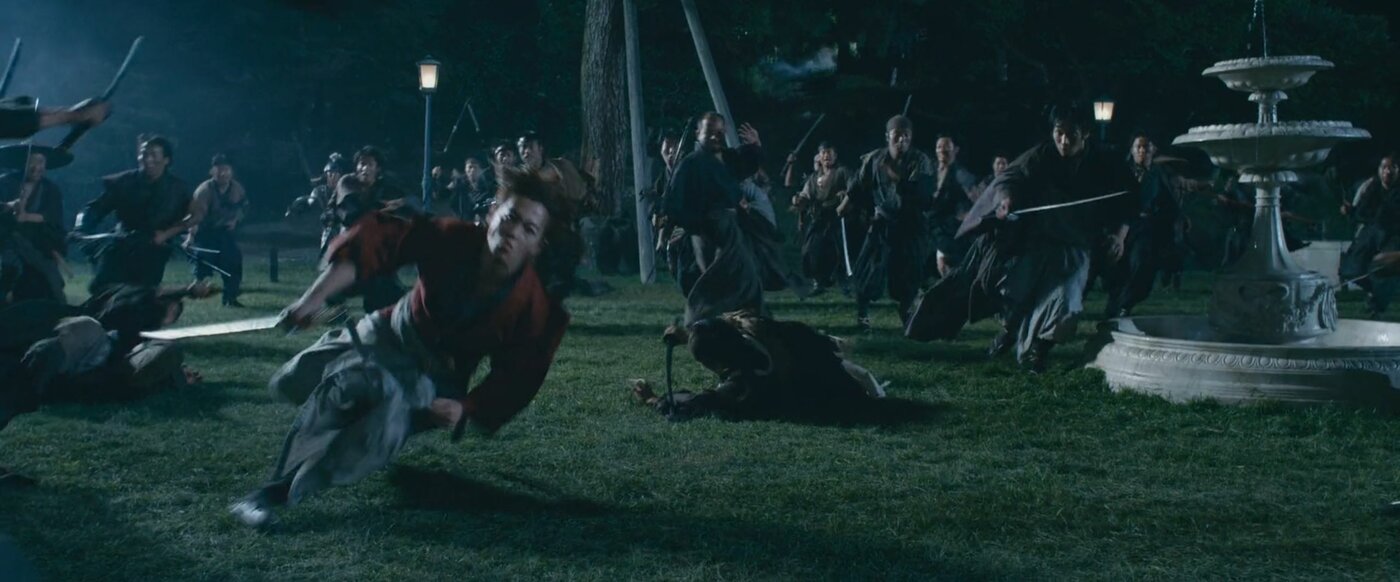
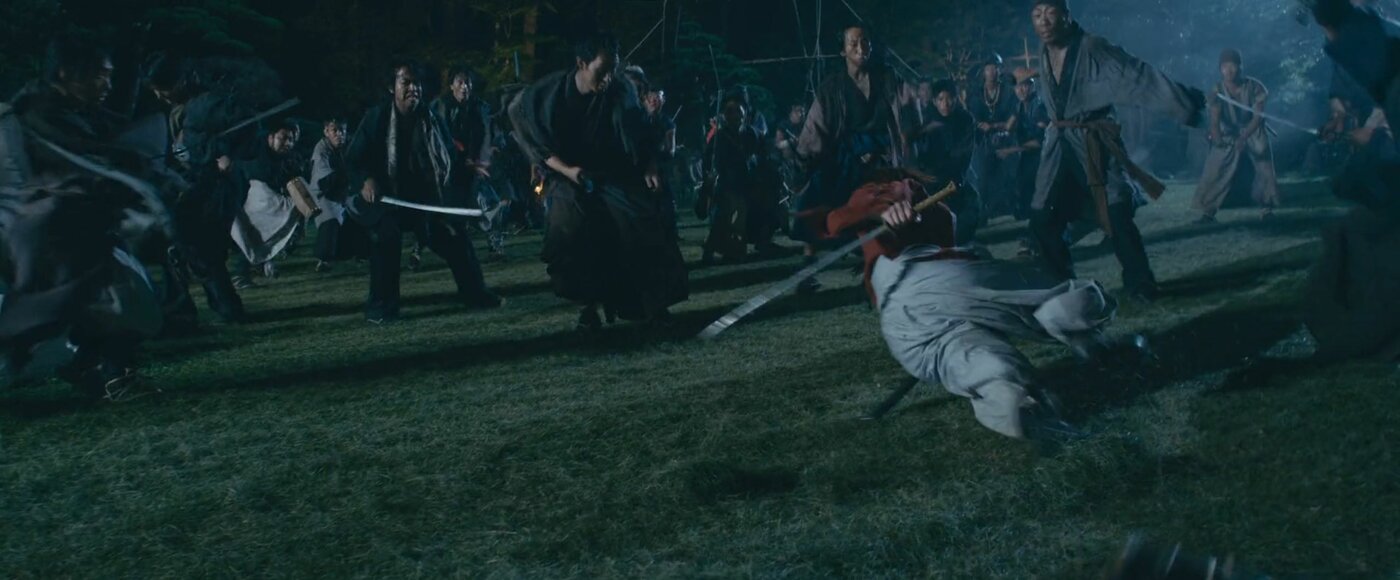
Spiked tabi and wire work allowed for Kenshin’s circular running, one of the franchise’ most distinctive action design elements. Above: Rurouni Kenshin Part I: Origins (Keishi Otomo, 2012).
NOTEBOOK: Costumes and props clearly played an integral role in the development of Rurouni Kenshin’s action. Could you share more about your collaboration with other departments?
Sometimes, a wire pick-up point [the place where the wire attaches to the body] takes time to set up. For example, if we put the wire harness on the actor’s upper torso, there would be a lot of pickup points here [points up and down his side]. But wire harnesses must be worn under the clothes. We would have to make a hole in the shirt to connect to the pickup points. I asked the costume department, “Do you have any way to save time?” So they made a whole zipper line [down the side of what appears to be a traditional Japanese kimono]. They opened up the stitch line beneath the sleeves and replaced it with a zipper. It made more sense because you didn’t have to take the time to make a hole. It didn’t have to take five minutes or ten minutes. Just five seconds. And the obi, the Japanese kimono belt, it’s so annoying, it takes five minutes to tie on. So we just used magic tape [like a velcro strap]. Three seconds. Of course, this was not an innovation of stunt technique, but communication with other departments saved time. It allowed us to shoot more ambitious shots, to shoot five more takes, six more takes, and that saved our stunts, even our lives.
Communication with other departments is very important. We tried to make the action look as real as possible, but sometimes it didn’t look good. That's why I asked our DP to make the shutter angle 90 degrees. Normally, when we shoot a movie, we use a shutter angle of 180 degrees, but when we changed it to 90 degrees, the image looked more blackened. Three-fourths of the screen time was black, unexposed, so the image looked very sharp. It made the rubber sword look sharper than when we shot with 180 degrees. With Saving Private Ryan [1998], every shot is not smooth. With the Normandy scene, I believe they used a shutter angle of 60 or 45 degrees. That was too much for our movie. A lot of people have asked me, “Did you speed up in the action scenes?” Most of the action scenes we didn't speed up, but we used a shutter angle of 90 degrees, which we found was the best for our action scenes. It makes the whole scene look sharper and faster, but not undercranked like a silent film.
NOTEBOOK: I'm curious about any trends you may have noticed in Japanese action that were maybe inspired by the Rurouni Kenshin series. It feels a little messy, but in a good way. I think of Hong Kong and American films as involving big hits and big impacts. Rurouni Kenshin seemed to me like a bunch of smaller hits, and then there’s a big impact at the end. So there’s an interesting rhythm. I’m thinking of Kensuke Sonomura’s films too, which have a kind of messiness to the action. Do you think Japanese action is going in that direction, possibly influenced by your films?
TANIGAKI: I think it's more or less our resource issue, because we don't have enough time to shoot perfection. Do you remember in the ’80s, Jackie Chan and Sammo Hung used a lot of resources to shoot their films? On the other hand, Donnie Yen and Yuen Woo-ping, their companies didn’t have many resources. So one day, Donnie discussed with Yuen Woo-ping how to make something unique, different from other action films. They rewatched The Young Master [1980], the Jackie Chan movie, where the main villain is Hwang In-shik—a very good kicker, almost perfect. But their opinion was, it was too perfect. We know that when we do a real fight, it’s very messy. Sometimes, if every shot is perfect, the audience gets very tired and bored. It’s like a kung fu exhibition. It doesn't look like drama, it doesn't look like acting. That's why, when we shot S.P.L., we were thinking, How do we deliver a real taste to action cinema? But [on the other hand], if everything was real, everything would be messy. If you called two actors and had them fight each other, no choreography, it would be real messy; wouldn’t look good. Bruce Lee said, “staged, unstaged.” So our motto was: choreograph the unchoreographed. Not to choreograph “one, punch; two, avoid; three, kick”—not like this. Some messiness, some unchoreographed feeling, but which itself is choreographed. We started this experiment when we shot S.P.L. Many people said, “Oh, that's a real fight. They didn’t choreograph, they’re just fighting each other.” No, no, no. Who can fight without choreography? But we delivered some kind of way to let the audience feel, “Oh, that’s unchoreographed, that’s real.”
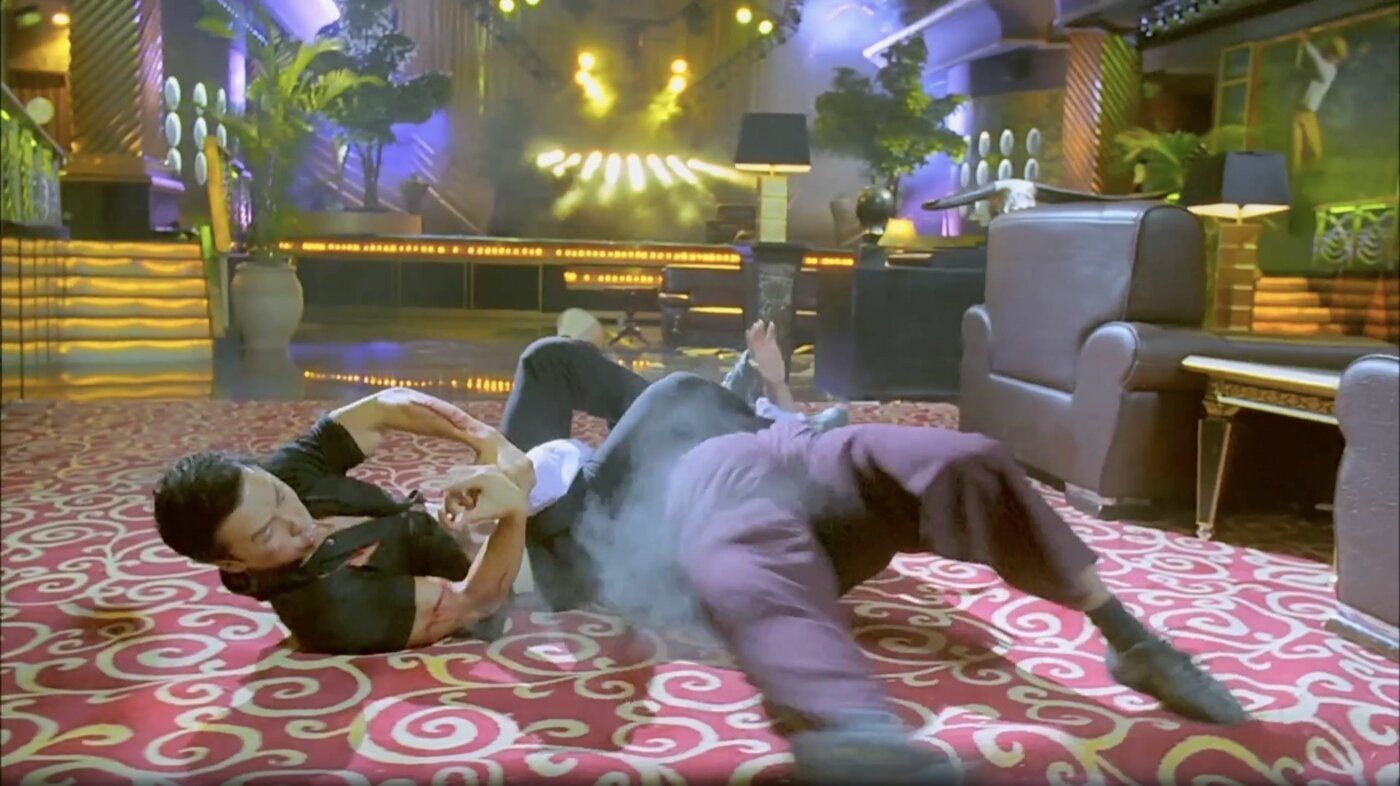
S.P.L.: Kill Zone (Wilson Yip, 2005).
After Flash Point, when we started to shoot Rurouni Kenshin, of course we didn't have many resources like Hong Kong movies. So we filmed master shots. Sometimes the timing was off, but sometimes it looked real; it looked good. In Hong Kong movies, in many cases, they shoot in order—it looks good, but sometimes it can be very mechanical. And it's a good way to shoot kung fu movies, because kung fu movies were originally very mechanical, especially the [ones featuring] Southern kung fu styles, like Hung Chuan, like Wing Chun. This mechanical choreography really fits this fighting style. I thought that a modern film or Rurouni Kenshin didn’t fit this feeling, so we shot the master shot first. And of course, the master shot loses a lot of the essence, a lot of elements of the action, but sometimes, I love all this messiness. This guy's timing is off! But I love that, because it’s very real.
Sometimes, as you said, we are very messy, in a good way. And then you want to make some parts perfect and so return to shoot some pick-ups. It's a combination of perfection and messiness. That was my experience when we shot Rurouni Kenshin. Kensuke Sonomura, he’s a little bit different. He will make the messiness part of his choreography. When he choreographs, he already choreographs that messiness. I prefer the messiness to happen on set. I think both [approaches] are good. By the way, Sonomura is the stunt coordinator, the action director of my next film, which I directed. So we work together. And the stunt boys which work with me and work with him are the same guys, the same group. So we have a lot of fun. And we can combine our strong points.
NOTEBOOK: So the limitations of fewer resources and fewer shooting days produced something that was really new and refreshing.
TANIGAKI: Yeah, limitations push us to find some solutions. The rubber sword was fake, so we had to find a solution using the camera. In Japan, it's very normal to use a rubber sword nowadays, and to use a kimono with a zipper. So I think one movie made a lot of innovations, and now they have become very normal. If it’s a good innovation, we can share everything. I think every challenge makes people invent many techniques, which change to become the standard of filmmaking.
NOTEBOOK: I’m curious about the film Snake Eyes [2021], how you got to work on that, what the process was like working back in Hollywood again after Mortal Kombat: Annihilation, and if there were any challenges shifting to that industry.
TANIGAKI: Jonathan Eusebio, who recently directed Love Hurts [2025], and the guys from 87Eleven, because Chad Stahelski and I had a good relationship—they introduced me to Snake Eyes, a very good opportunity to do something in American film again. We learned a lot of things about the American system. Many Asian people say, “Oh, the Hollywood system is very bad. They don't allow you to even move their props or move some table.” I don't think so. The other second unit director [on Snake Eyes] was James Madigan, who recently directed Fight or Flight [2025]. On day one [of shooting], I was the stunt coordinator and he was the second unit director. Day one, he took the camera, “Hey, let me shoot!” and then he shot around. And I thought, “Oh, now it’s like this!” Because in our minds, only the DP and the camera department guys could pick up the camera. We now have more freedom to make a good action film, and it’s a different generation from the Mortal Kombat era. That process, to me, is very fun, and I got to know a lot of cool guys, stunt guys in Vancouver, because their technique is very good, and their experience. Even the actor was very cool.
But if you asked me, do you really understand American culture? Do you really understand the taste of American audiences? I must say no. I know Japanese audiences’ taste, but American audiences… That's why I must listen. I must listen to people; maybe they don't like this kind of thing. I'm still learning, but I think Snake Eyes was a very good learning process for me.
NOTEBOOK: I think, if they haven't seen your films, they can also expand their taste. They can change, too. There’s a film I haven't seen talked about that much, for which you directed action: the mainland Chinese movie Fierce Cop, with Richie Jen. I really like the action in that one. What was that experience like?
TANIGAKI: That was a very interesting process, because we shot that movie during the COVID period. Even going to China was an issue, because, you know, vaccines, some visa requirements, every country was shut down. I could not bring any Japanese stunt boys, so I just went there and met up with the local stunt team. The director, Chan Tai-Lee, is my good friend, and he needed my help, so I just went there. The film wasn’t released on the big screen, just on some platform, some Chinese network. We could do many things, and we had a lot of freedom. I think it was fun. We didn’t have much shooting time, I think around 30 days. That’s much more than some other films, but, of course, not as much as the films we normally join. But I really enjoyed shooting at Xishuangbanna, a very special place, and working with Richie Jen, he’s fun.
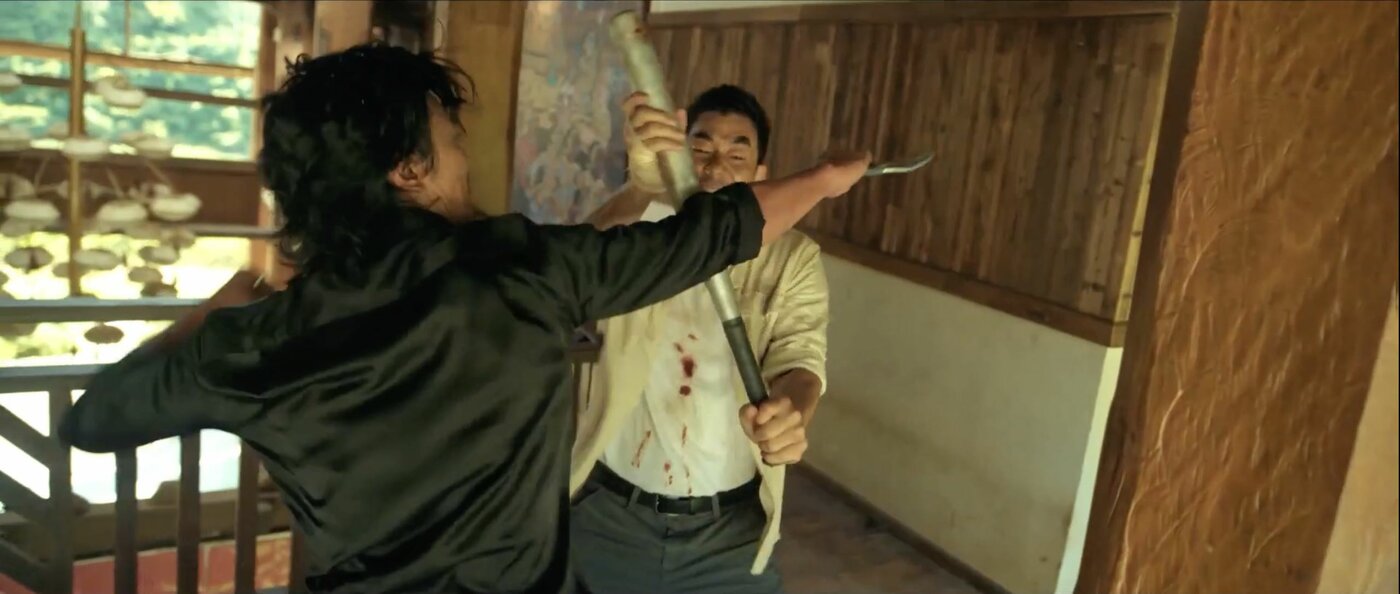
Fierce Cop (Chan Tai-Lee, 2022).
NOTEBOOK: Have you watched any of those direct-to-video, lower-budget Chinese films, like Eye for an Eye [2022]and Eye for an Eye 2 [2024], Fight Against Evil 2 [2023], The Bodyguard [2024], or Blade of Fury [2024]? A lot of people have recently started talking about them. I think there's some really exciting action in these films, and Fierce Cop is my favorite one so far.
TANIGAKI: These filmmakers love to use a wider lens. It looks very wide. I need a more standard lens, but I think a wider lens and very exaggerated action—Chinese audiences have a taste for this kind of thing. And, of course, I love Eye for an Eye, parts one and two. I think most of the films you mentioned were directed by Qin Pengfei. He's one of my good friends. We worked together in 2015 on one film—for some reason, I had to leave halfway through and let him finish the shoot. His team is very strong. When I shoot in China or Hong Kong, I will bring some Japanese stunt boys. And then I will ask Qin Pengfei to deliver some Chinese stuntmen. And then we work together. So like with Sakra [2023] or Fierce Cop and even Twilight of the Warriors, I used stunt guys from his team. The leading actor, Xie Miao from Eye for an Eye and North East Police Story [a.k.a. Fight Against Evil 2, 2021], is the lead actor for my next film. Eye for an Eye, I know they shot for around 23 days or 24 days, and they can bring that quality. That's very good.
NOTEBOOK: We’ve talked about Donnie Yen. Working with him all these years, do you feel like your collaboration or working style has evolved and changed at all, or has it been pretty similar to when you first started working together?
TANIGAKI: I think it depends on the project. When my team and I work in Japan or other countries, the lead actor is not Donnie Yen, so it’s different. When we work with Donnie, of course, everything is up to him, what he wants to do, and I help him to shoot. Maybe you could find some [shared] specialty [across my films], because I edit the action by myself. Perhaps the way my action scenes start with a wider shot and then move to the details. Maybe I automatically bring this kind of feeling to every film. Sometimes, like with Rurouni Kenshin or Twilight of the Warriors, we put in a lot of entertaining elements, like big stunts or very fast-paced choreography, or some wire stuff. This is one style. For The Furious, the next film I’m working on with Sonomura, it’s more… If Twilight of the Warriors is an orchestra, The Furious is more like unplugged music, like an acoustic guitar, with less wirework, concentrating on choreography, the basics. So it's different. When we work with Donnie Yen, people want to watch the Donnie Yen style, so we try to deliver it, but in a way that is a little bit different every time.. For example, Sakra is a wuxia movie. I really enjoyed figuring out how to make a new kind of wuxia style. Because, as I said before, I didn’t want characters to fly around, but, for this genre we more or less needed to have some flying around. So we tried to add some more realistic things, some more reasonable things. I really enjoyed that process.
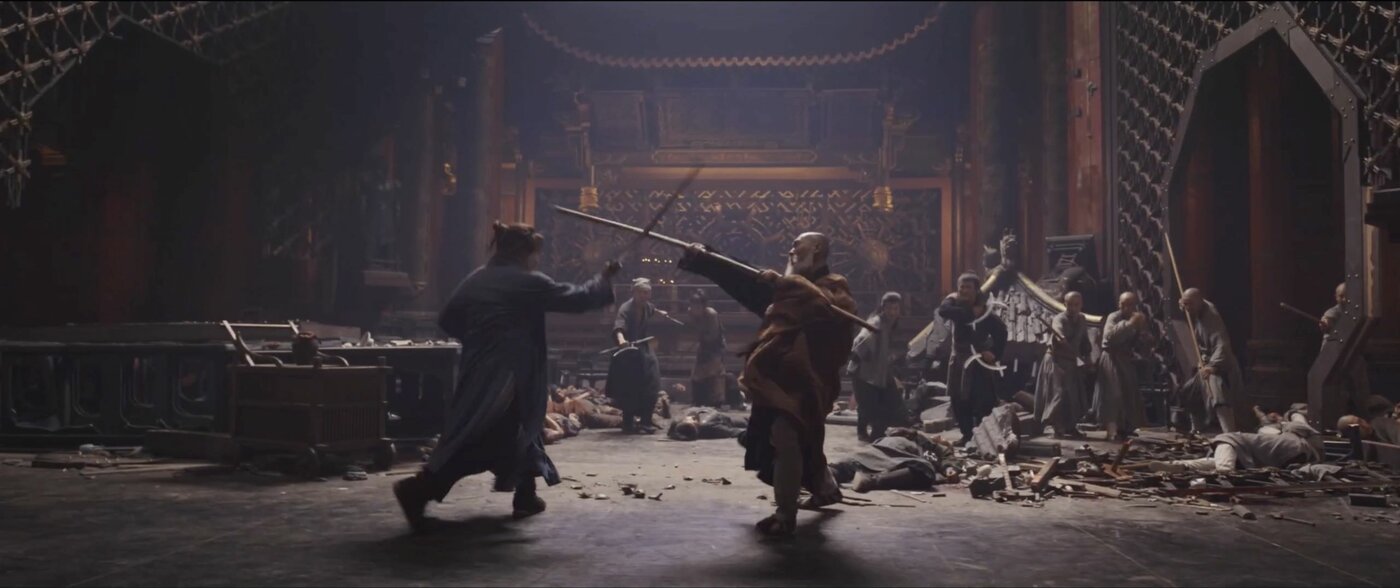
Sakra (Donnie Yen and Kam Ka-wai, 2023).
NOTEBOOK: I remember watching Twilight of the Warriors and noticing somebody perform a sliding, circular, wire-assisted movement that reminded me of Rurouni Kenshin. And I was like, “Oh, that's a Kenji Tanigaki trademark!” It seems you've left your stylistic imprint on many films, even if the choreography is very different.
TANIGAKI: Maybe this year we’ll change!
NOTEBOOK: I'm very excited for that. Do you have any other, final thoughts about Rurouni Kenshin or your career, any advice for people who want to be stunt performers, or ways we could think about action cinema differently?
TANIGAKI: Just one thing. Now, many Japanese stunt performers have worked with Donnie Yen, because, after we worked together in Germany to shoot the TV series The Puma [1999–2000], he asked me to bring some Japanese stuntmen. So I introduced him to Yûji Shimomura, who Donnie Yen loved. He’s another big action director in Japan. We trained together in the same school. And then, on other projects, I would try to bring some Japanese stuntperson. Maybe that first time in Germany, I brought just one person. And then maybe the next time, two, three, four, five, six, seven. For Donnie Yen’s The Prosecutor [2024], action director Takahito Ôuchi brought fourteen or fifteen stunt boys from Japan. They learned a lot from Donnie Yen and on his set. He has very high standards, and he has a reputation for this kind of thing. They had a hard time on the set. But after going back to Japan, they realized how much they learned.
Donnie Yen has shared a lot of his filmmaking knowledge with these Japanese stunt boys, and of course with Chinese stuntpeople too. I think that kind of thing is very nice, because, now, the whole Hong Kong action movie industry is changing, and the outlook is not optimistic. So where does the Hong Kong action movie go next? Sometimes our style is not the Hong Kong style, but it’s a combination. Our origin is Hong Kong action and Donnie’s action, but, sometimes, like with Rurouni Kenshin or other Japanese films like the Kingdom series [2019–24] or Alice in Borderland [2020–], they have the basics, and then they change them. Even with John Wick [2014], Chad had worked with Yuen Woo-ping before, and they delivered some of the taste [of Hong Kong action style], and then changed it to fit an American action film.
It’s like Chinatown. Many Chinese go to other countries and make Chinatowns; we are one of the Chinatowns. How Hong Kong action will change, where it will go—I'm not sure. But I'm sure there will be more and more Chinatowns. Many Chinese people came from Shanghai to Hong Kong to develop the Hong Kong action industry, the Hong Kong movie industry. And then some of these people emigrated to other countries, but they still enjoy the Chinatowns of each country. So I'm also just a branch of the Hong Kong movie industry. And even if I shoot an American movie, or an Indian movie, or a Japanese movie, I would keep that kind of essence, more or less. And then it combines with the styles of each country. And I think that's very beautiful.
Continue reading selections from Issue 7’s exploration of the unfilmable.