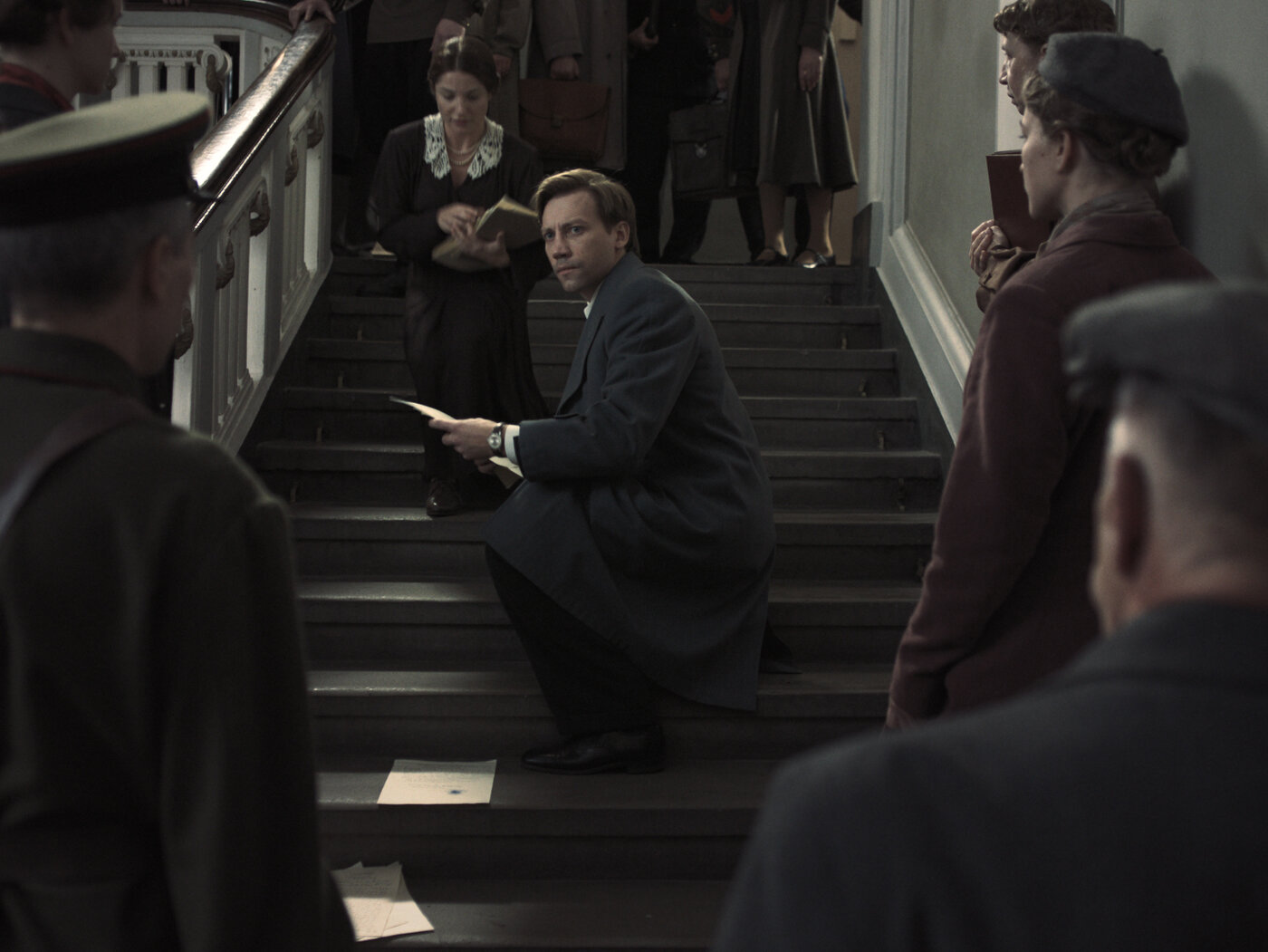
Two Prosecutors (Sergei Loznitsa, 2025).
To dive into the cinema of Sergei Loznitsa is to experience a curious kind of vertigo. Even as his films draw from the horrors of Soviet Russia—as his archive-based documentaries have often done—his work all seems designed to scramble your coordinates, shrinking the distance from bygone decades and far-flung places to remind you that things that happened once may happen again. Loznitsa isn’t an archaeologist surveying some mummified relics but a genealogist committed to locating vestiges of the twentieth-century and its barbarities in today’s late-stage capitalism. Past and present exist on the same continuum, where history isn’t inert but something that’s always contested, rewritten, and reappropriated.
Based on a 1969 novella by Georgy Demidov, a Soviet physicist who spent 14 years in a Siberian labor camp after being convicted as a Trotskyist in the late 1930s, Two Prosecutors (2025) is a political thriller in the vein of Costa-Gavras’s Z (1969). Which is to say it’s principally a story about “truth”: who gets to control the state’s official narratives, and what happens to those who challenge them. The year is 1937, the city, Bryansk, some 200 miles southwest of Moscow; as Stalin’s purges wreak havoc across Russia, Kornev (Alexander Kuznetsov), a twenty-something prosecutor just out of university, is summoned to the local prison by an old Bolshevik who’s managed to smuggle a call for help from behind bars. It takes about an hour—half the film’s runtime—for Kornev to persuade the wardens to let him meet the man, and for Loznitsa to kick the plot into gear. The starved, flayed inmate has a secret to pass on: Stalin’s secret police, the all-powerful NKVD, has metastasized into a parallel state, systematically arresting loyal party members like him and torturing them into confessing crimes they never committed.
Anyone familiar with Loznitsa’s work will remember that practice from The Trial (2018), a documentary pieced together from footage of the infamous 1937 Industrial Party Trial, in which affluent members of the country’s elite publicly owned up to misdeeds they weren’t responsible for and received death sentences in return. Two Prosecutors, in dialog with that earlier film, is an inquiry into the circumstances that made those ludicrous confessions possible. Loznitsa captures Russia as a putrefying corpse, and young idealists like Kornev as outliers destined to either fall in line with Stalin’s orders or pay the ultimate price for questioning them. Incensed by the convict’s revelation, Kornev travels to Moscow to relay the secret to Chief Prosecutor Andrey Vyshinsky (Anatoliy Beliy), certain that the country’s top jurist will want to cleanse the Party of its rotten apples. That things don’t exactly play out that way isn’t much of a spoiler, but Kornev’s journey is no less incendiary for being predictable. Filmed by Loznitsa’s longtime cinematographer Oleg Mutu through static shots and framed in a boxy Academy ratio, Two Prosecutors radiates a stifling claustrophobia as well as an omnipresent dread. Austere as the film may be, everything about it feels premonitory, from the prison guards’ jibes at political rivals to a few surreal encounters that turn Kornev’s Moscow expedition into the stuff of nightmares. Shooting entirely in Riga, Loznitsa cast actors from different corners of the former USSR—including some, like Kuznetsov, who fled Russia after the war on Ukraine broke out in 2022, and have been living in exile ever since.
The conflict hovers ominously over Two Prosecutors: watching Kornev resist an establishment hellbent on annihilating all dissenters, it can be difficult to avoid drawing parallels between Stalin’s Russia and Putin’s own. But that’s of a piece with Loznitsa’s design. Like many of its predecessors, his latest is a period piece that refuses to treat the past as some distant realm but works to narrow its distance from the present, making Kornev’s quest and the anxieties surrounding it all the more vivid. “Where’s the way out?” a man, looking lost and terrified inside a maze of offices and corridors in Moscow, asks the young prosecutor. It is a testament to the film’s power that his fear, by the end, is ours too.
I met Loznitsa as Two Prosecutors premiered in competition in Cannes last year, and we spoke again ahead of its US theatrical release. Many thanks to co-producer and casting director Maria Baker-Choustova for her help translating the chat.
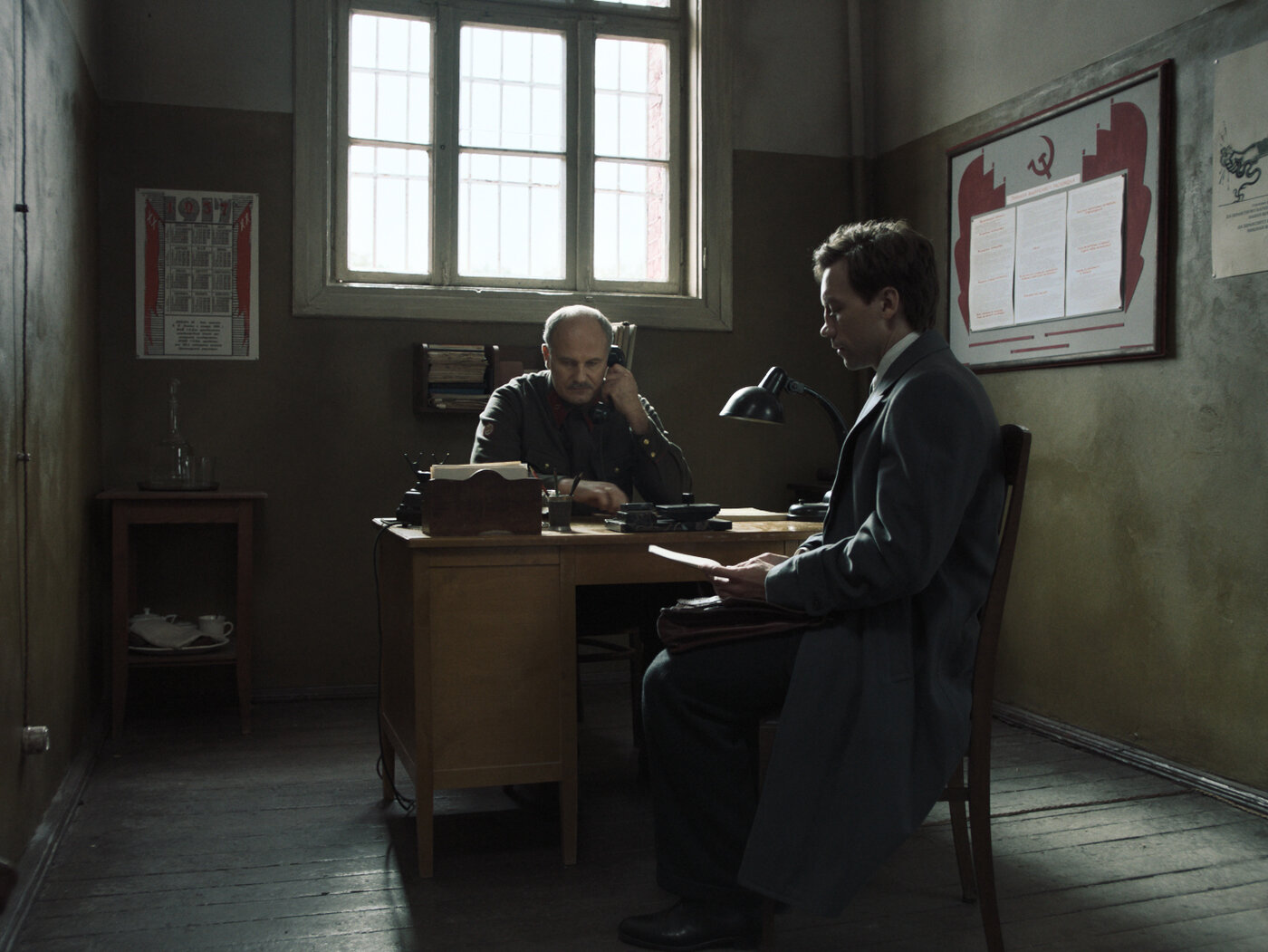
Two Prosecutors (Sergei Loznitsa, 2025).
NOTEBOOK: A few years ago, fielding questions about your archival documentaries, you said their main purpose was “to portray the past as if it were the present,” and make history so tangible people “can touch it with their skin.” Granted, Two Prosecutors is not an archive film, but I wonder if you think it answers a similar call.
SERGEI LOZNITSA: Absolutely, yes. I would even argue that it's an example of immersive cinema, that the film is designed to plunge the viewer into that state. But the immersion happens gradually. At first there is obviously some distance between viewers and story, and only slowly are we sucked into it.
NOTEBOOK: I was asking because Two Prosecutors seems concerned with what’s perhaps your overarching preoccupation: the manipulation of truth.
LOZNITSA: Yes, but I’d rather use the word perception, not truth. I’m reminded of Kurosawa’s Rashomon [1950], but also of the kind of experiments in early twentieth-century physics, when scientists were trying to determine the exact position of a particle. As we now know, the position of an electron, say, depends on the observer—on who observes it, how, and from where. And this holds true in our day-to-day life, too: everything depends on how one looks at a certain thing. To go a little deeper, physicists distinguish between reversible and irreversible processes. A process is irreversible when it cannot be undone—death, for instance. It is reversible when it can be modified. Like a statement: you can say something and later deny or retract your own words.
Now, you can only meaningfully talk about truth in the context of irreversible processes, that is when something is a fact. But everything else escapes that definition and becomes a matter of interpretation. That’s what we do when we engage with cinema. Take State Funeral [2019]. When the camera turns to the masses of people crying over Stalin, it’s impossible to tell exactly which among them are in tears because they’re actually mourning and which ones are crying because they know they’re expected to. We can only guess. That’s the principle on which I based that film. And the cinematic language I use allows me to distance myself from the situation, but also to introduce an element of irony into it. My point of view manifests itself in the structure of the film as well as the ending; still, the only truth in that film is that Stalin is dead.
NOTEBOOK: Did you read Demidov’s scientific publications too as part of your research? I’m quite fascinated by this connection you’re drawing between the film and early twentieth-century advances in physics.
LOZNITSA: No, I haven’t read Demidov’s scientific works. But the novella I adapted feels very autobiographical. You can tell that Demidov is describing his own life; the young prosecutor’s naivety is the writer’s own. But is it really naivety, I wonder? Of course if you were to look at it today his behavior might feel naive. But the decisions he makes throughout the film are very consistent with the kind of education he received and the general mentality of the people of the time. One of life’s paradoxes is that, though the world around us constantly changes, we never register those transformations as they happen, and make decisions without their knowledge; only afterwards, in retrospect, do we discover what was going on, but by then it’s all too late. That’s basically the dilemma the two Soviet officers illustrate to Kornev on his way home from Moscow. What are we to do if a crime hasn’t happened yet, but we have the criminal already? You can’t act before the crime has been committed, but you obviously can’t prevent it after it’s done. This in physics is described as a superposition—the possibility of two outcomes existing simultaneously, like Schrodinger’s cat. Everything depends on the moment they are being perceived. Two Prosecutors presents a legal dilemma with no solution, not unlike Lynne Ramsay’s We Need to Talk About Kevin [2011].
NOTEBOOK: What drew you to that novella, of all Demidov’s writings?
LOZNITSA: A while back, I made a documentary called The Trial, about one of the most important show trials ever held by Stalin, the Industrial Party Trial, during which the defendants were publicly confessing crimes they had never committed. Naturally the truth only came out a long time after they’d been convicted and sentenced to death. These were members of the Soviet industrial elite, well educated people who managed the country’s economy and had lived under Tsarist Russia—academics, professors, top managers… And there was a bizarre contrast between the crimes they were owning up to and the kinds of people they were; to think that men of such standing would engage in these sorts of activities was almost impossible. So what was the trial about, exactly? What drove these people to confess things they hadn’t done? I kept searching for answers, for a text that would reveal what happened to these people once they were arrested. And I chose this novella because it doesn’t only narrate the protagonist’s story but also presents a very concise and clear model of the Stalinist regime.
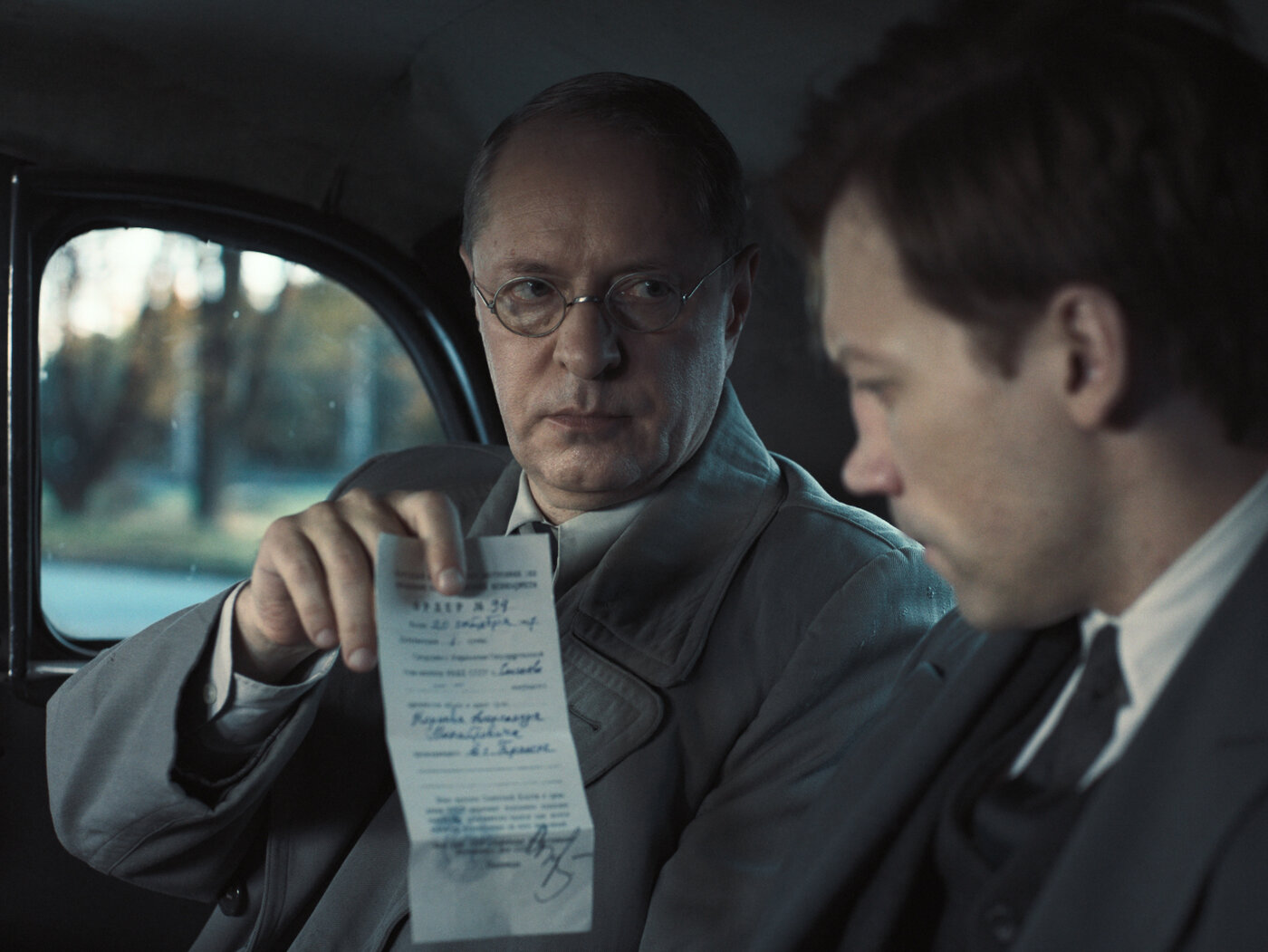
Two Prosecutors (Sergei Loznitsa, 2025).
NOTEBOOK: Does the film deviate much from the original text?
LOZNITSA: Well, for one thing, the novella doesn’t end when the film does. In Demidov’s story the protagonist confesses to crimes he never committed, signs his confession papers, and is finally sent to a gulag, where he dies. And there’s one episode in the film which I borrowed from Gogol’s Dead Souls, the story of Captain Kopeikin, which serves as a kind of intermezzo—both in my film and in Gogol’s book, in a way. It’s a story about injustice, and it speaks to the film’s main themes. It’s a grotesque reflection of the old prisoner Kornev visits in jail. And the last two scenes in the film, which the book dealt with in one or two sentences, I developed them into longer episodes and wrote dialogues for them.
NOTEBOOK: One of the film’s most fascinating aspects is the way it challenges traditional dramaturgy. It takes about an hour to understand what Kornev is after, and what the film’s central conceit might be. Why did you decide to withhold information that way?
LOZNITSA: It wasn’t my decision; it’s just how the story unfolds. Though I personally find it quite interesting to have to wait that long for the actual story to begin. Yet there is tension throughout, and I think the experience is really interesting from a formal point of view as well. The film consists of two parts: the first serves as the introduction and the second as the resolution. But things, events—the action, so to speak—take place in both. Kornev faces obstacles throughout the journey. There are all kinds of impediments; he’s always delayed or stopped. Yes, the structure might be very unconventional; traditional dramaturgy dictates that by the first ten minutes the film should introduce some kind of event that triggers the whole plot in motion. You might think the film’s climax is the conversation between Kornev and his superior in Moscow. But as it turns out that’s a fake climax too. In the end, Two Prosecutors suggests a kind of duplication at the level of dramaturgy: a fake dramaturgy and a real one hiding just beneath the surface.
NOTEBOOK: I wonder if all the bureaucratic hurdles and delays Kornev confronts influenced your editing choices. Two Prosecutors unfolds at a slow, almost glacial pace. Shots stretch a beat or two longer than they should, with the camera lingering even as people have vacated the frame, as if to suggest that Kornev’s world—Stalin’s USSR—is basically one big still life. Could you speak about the editing? What criteria did you follow when deciding how and when to cut between shots?
LOZNITSA: It's kind of difficult to explain, because a lot of it happens intuitively. By the time we started rehearsing the script with the actors I’d already divided the dialogues into parts and made notes on where we could cut, how we might edit them. And because the film is shot with static cameras and has some lengthy exchanges, every time we cut there had to be something happening. It’s not enough to move from one talking head to the other. There must be something else that makes it logical for you to cut. Which is why we shot some episodes with two cameras; to have more freedom in the editing. As for the actual length of some sequences, well, if a shot needed to be long it just did! [Laughs.] People need time to think and process information, one or two extra seconds just to reflect on what’s happening.
NOTEBOOK: Since you brought up the camerawork, I was curious to hear more about your collaboration with Oleg Mutu. This is not the first film of yours he’s shot, but it feels substantially different from your previous projects—it’s a far cry from the more kinetic Donbass [2018], for one. What informed your decision to rely on static shots here?
LOZNITSA: Well, Donbass was a carnival, to a certain extent. A bloody carnival. And that implies motion. Prison and the penitentiary system, on the other hand, suggest the opposite. It’s the end of the ride: there’s no action, no movement possible. Especially if we’re talking about the kind of conditions inmates suffered under Stalin’s Russia. That’s why we opted for static shots.
NOTEBOOK: More broadly, how do you two work together? Do you usually storyboard?
LOZNITSA: Yes, we always do. At first, when we begin discussing and thinking about the film, we’ll jot down some kind of sketch. Then, once I start rehearsing with the actors, I’ll take photos of the rehearsals and use those to build the film almost frame by frame. By the time the rehearsal period wraps the film will be hanging on the walls of my office. For Two Prosecutors, Oleg suggested we use a filter that would basically drain all colors, so as to make the images look dead, lifeless, and recommended very soft, unobtrusive lighting. And the aspect ratio, which heightens this claustrophobic feeling of being in a prison.
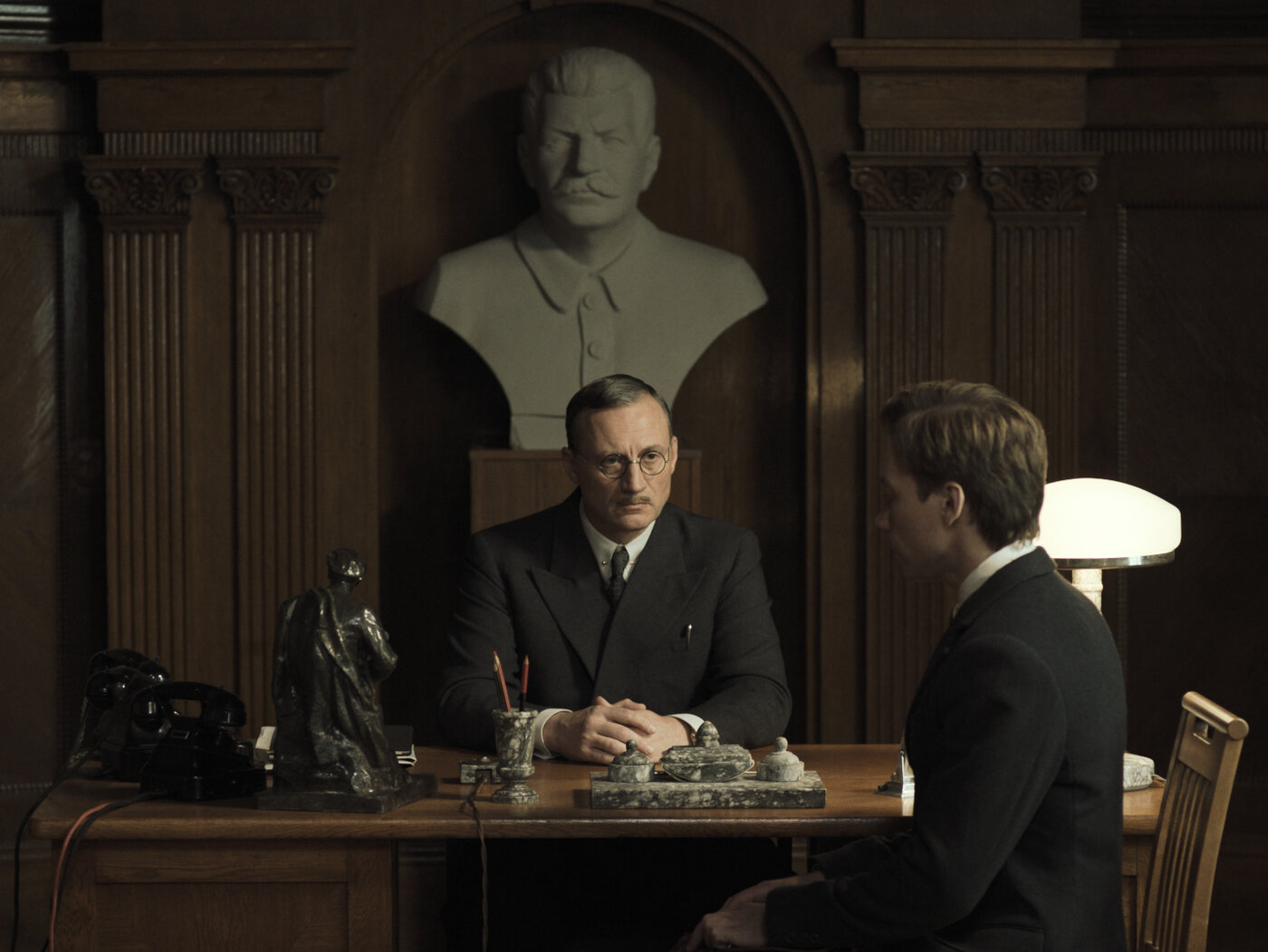
Two Prosecutors (Sergei Loznitsa, 2025).
NOTEBOOK: Did you discuss some visual references, too? I remember you listing Titian’s Flaying of Marsyas for State Funeral—did you borrow from other painters in Two Prosecutors?
LOZNITSA: Well, Oleg’s favorite is Vermeer… Which explains the harmonious, almost self-contained quality of the film’s compositions. That and the lighting, naturally. We had an abundance of references and materials from 1930s Russia. My entire office was littered with them—I don’t just mean photographs of people’s faces but also audiovisual footage from Soviet cinema of the decade. I wanted to familiarize myself with the way films from the era used to be shot, directed, composed.
NOTEBOOK: Was there ever a moment in which you thought you might weave those archives into the film, sort of what Pietro Marcello does with his fiction?
LOZNITSA: Absolutely. That was the initial idea, actually, to combine archive and fiction. My plan was to open the film with the defendants’ speeches from the Industrial Party Trial; we would have started with their false confessions and ended with fragments of another, absolutely crazy speech the real-life Andrey Vyshinsky gave at the 1938 trial of Nikolai Bukharin. That was all in the script. But then, once the film was shot and edited, the archival footage became redundant. I realized I’d already said everything I wanted to say through the fiction, and the inclusion of those excerpts felt unnecessary.
NOTEBOOK: Where many of your previous works looked at crowds as their subjects—State Funeral, yes, but also films as disparate as Maidan [2014], Austerlitz [2016], The Kiev Trial [2022]—Two Prosecutors instead zeroes in on the individual. Do you see a tension in the different focus?
LOZNITSA: Not exactly. Our protagonist’s fate is the same that befell millions of others after him, after all. In a way, his story is a kind of draft. A blueprint. And the message is very simple: if you ignore the situation you’re in, if you’re unaware of your present circumstances, you’re heading in for a tragedy. I tried to stress that through the song by Dmitri Shostakovich that you hear twice in the film—the first time it’s sung by a single man, a KGB agent, and the second by a choir. First a solo performance, then the whole country joining in.
NOTEBOOK: Could you speak about the casting? I was especially curious as to how and where you crossed paths with Alexander Kuznetsov, and what made you think he’d be perfect for the role.
LOZNITSA: I met him in Cannes in 2024, when I was looking for actors who could play Kornev. And I must confess I was captivated by his talents as much as his face. It just looks so fascinating, doesn’t it? We were all so entranced by it that no of us during the shoot realized that his ear was pierced! [Laughs.] We had to use CGI to cover that up in post-production. There were about 300 frames that had to be fixed! Of course, in the end it’s always a collaboration between director and actor; Alexander and I worked together to create his character. But shooting a film with Russian actors right now is incredibly difficult; we live in a very dramatic moment, and the war makes it impossible to access the talent still living in the country. Two Prosecutors is a film about restrictions, and we experienced lots of those as we worked on it—during the casting especially. We should be very grateful to Alexander for deciding to leave Russia the moment the war on Ukraine broke out, and to all the other Russian actors in the film; they condemned the war, left their homes, and have been living in exile ever since. You may not know that walking into the film, but it’s in their minds and souls, and I think it informs their acting, too.
NOTEBOOK: The parallels between 1930s Russia and life in the country under Putin are uncanny. Watching Kornev being punished for doing his job, I kept thinking of the lawyers who represented the late opposition leader Alexei Navalny—killed in prison in 2024—who were sent to jail on bogus charges in early 2025. This might be a little broad, but I wonder if you see your films as playing a pedagogical role as well, if they serve as a kind of warning.
LOZNITSA: “Everything that needs to be said has already been said,” to quote from André Gide. “But since no one was listening, everything must be said again.” We like to say that history repeats itself, that it comes in cycles. But if that’s true, it’s only because its lessons haven’t been learned. Because there is no analysis, no self-reflection, no attempt to dig up the past, to learn from what happened, and transform society. Until that happens, it’s worth telling these stories again and again.