Full Bloom is a series, written by Patrick Holzapfel and illustrated by Ivana Miloš, that reconsiders plants in cinema. Directors have given certain flowers, trees or herbs special attention for many different reasons. It’s time to give them the credit they deserve and highlight their contributions to cinema, in full bloom.
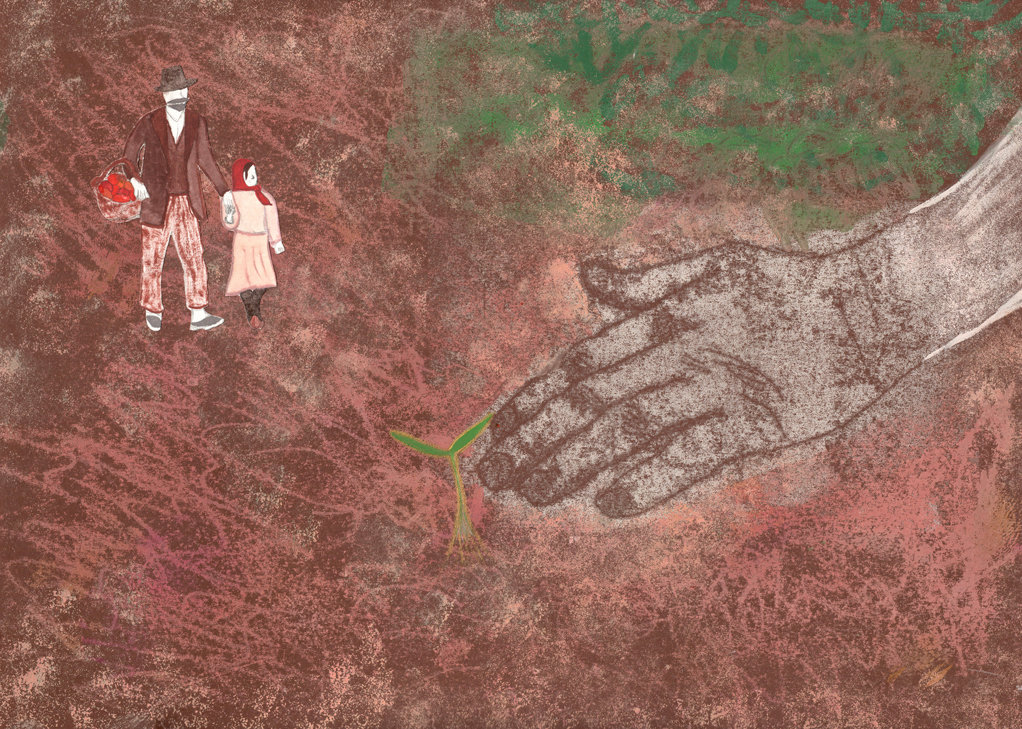
Ivana Miloš, Tomato Earth Seedling (2021), monotype, collage and gouache on paper, 33 x 24 cm
GROWING UNDER THE BED
“…the tomato, / star of earth, / recurrent / and fertile / star, / displays / its convolutions, / its canals, / its remarkable amplitude / and abundance, / no pit, / no husk, / no leaves or thorns, / the tomato offers / its gift / or fiery color / and cool completeness.“
—Pablo Neruda, “Ode to Tomatoes”
Flies approach. They always do. I suppose they are always hiding somewhere close to us, waiting for little cracks and smells to appear. Now they are everywhere, buzzing around the piles of tomatoes we’ve gathered from our garden. We laid them out across the table and the kitchen shelf. The berries of this vine plant originating in South and Central America came in all kinds of sizes and colors this year. Deep and light red, green, green with yellow stripes, yellow like the sun, orange, pink, and even golden, which gave them their Italian name pomodoro. What a beautiful round, oval or egg-shaped, long or slender, heart or pear-shaped delight! But the rain and cold stressed them throughout the summer and some have split open. Others are covered with a white fluid, traces of slugs, and disease. The appearance of the flies reminds me that everything warns of death. You can chase them away with your hands or use a glass of vinegar in which they’ll drown. My grandmother told me to do that. Then, if you feel safe, you pick up a tomato and you might discover life again.
Ermanno Olmi is a filmmaker to whom I turn if I need advice. More than anything else, his best films teach me humility and candor. In many ways, his work searches for lost connections between the natural world and humanity as well as the tensions between a longing for freedom and the demands of society and labor. His most celebrated film and 1978 Palme d’Or winner, The Tree of Wooden Clogs, is set in late nineteenth-century Lombardy, a large region in northern Italy. It deals with the life, poverty, and dignity of peasants working in the mezzadria system, the Italian form of sharecropping in which the farmers cultivate a piece of land for a proprietor and can only keep a percentage of what they produce. There is not much room for escape in Olmi’s sublime observations of work and suffering. Only sometimes do little joys occur, for example the changing of seasons or the jokes told at dinner tables.
A grandfather called Old Anselmo lives among the peasants. Throughout the film he plots a heart-touching tomato scheme in order to be able to sell ripe tomatoes earlier than anyone else, but also because he wants to teach his granddaughter about growing Solanum lycopersicum, as the tomato is known in botany. It all begins during the first night of snowfall, when he sneaks out of bed in the middle of the night to collect chicken droppings which he is going to use as a fertilizer. “They are hotter than cow manure,” he says, and they will thus help to prevent the ground from freezing. The reason for doing this work in the middle of the night is that he doesn’t want to be seen; it’s his secret.
This scheme aside, tomatoes could hardly be considered a secret, as they are something of a superstar in food growing. Mass-produced in circumstances that make me hesitant to call them tomatoes anymore, they were the world’s first genetically manipulated vegetable (although, biologically speaking, they are a fruit). While in their native environment, the tropical highlands, they grow berries no bigger than redcurrants and are actually perennials, tomato plants are mostly cultivated as annuals everywhere from Iceland to the Falkland Islands, and go through a cycle that leads to yearly death. In some greenhouses they can live a bit longer. However, this is not what we should eat. We should eat the local tomatoes of Old Anselmo.
Of course, his ideas about growing tomatoes faster than anyone else are based on capitalist ideas. It’s just that he won’t make money with it. He cultivates tomatoes on a modest scale with love for the harvest and takes pride in the comments of those admiring his achievements. His idea has less to do with profit, and more to do with knowledge. The former being the reason why millions of tomatoes taste like water with a bit of toothpaste mixed in, the latter bringing about tomatoes that taste like the sweetness of soil and the gaze of the sun. During the winter Anselmo brings his granddaughter to the shed and inaugurates her into his ways of planting tomatoes. He plants the tomato seeds in a tray and places the wooden container under the hay to keep it warm, so that the seeds can germinate. “They’ll sprout here even in the cold,” is what he tells his granddaughter, who observes everything with large, curious eyes.
Our own hay that keeps the tomato seeds warm and sprouting during the winter is the bathroom. We try not to open the window and water them every day with a spray bottle so that we won’t hurt the delicate seeds. Admittedly, this is a bit improvised, but it works. We use the dried seeds of tomatoes from a previous generation. This way, knowledge not only travels from one human generation to the next, like in the case of Anselmo and his granddaughter, or the other way around, when a young schoolboy tells his parents about little animals living in the water, it also connects different plant generations. Later, when he collects the ripe tomatoes, Anselmo enthusiastically describes the unfathomable story of these tiny seeds growing into large plants which grow up to 180cm. In a film of many small miracles, the growth of tomatoes counts among the greatest of them all.
Elderly people confiding their secrets to the young is a common theme in many of Olmi’s films. Take The Scavengers (1970), for example, a brilliant postwar drama initially produced for Italian television which follows a soldier who returns home and begins salvaging undetonated bomb leftovers for scrap metal. His mentor in the profession is an old, eccentric drunkard. He teaches the young man how to harvest the bombs, if you can forgive the blunt metaphor. Actually, Olmi makes the same connection, since the close-up of the old man’s hand digging for bombs in The Scavengers is almost exactly the same as that of Anselmo planting his tomatoes in The Tree of Wooden Clogs. Again, as in the case of the flies in our kitchen, I get a sense of the closeness of life and death. Bombs and seeds sleep next to each other under our feet. This intimacy is not unknown to the tomato, as it was considered poisonous or at least suspected of inflicting melancholic moods until the late sixteenth century. Today we know that the Lycopene in tomatoes lowers the risk of heart disease and certain forms of cancer. In Italy it was only in the 1880s that the tomato became a major crop following a crisis in grain prices. From then on, it was a success story related to canned products, pizza, pasta, and genetic manipulation.
When Anselmo takes his granddaughter to plant the seedlings outside he tells her to leave some soil around their roots. They plant them close to the wall of the shed because it’s warmer there and tomatoes need heat. Later, they collect them in a basket. Repeatedly, Anselmo speaks of nice and big and beautiful tomatoes. While they collect them, we can see and hear flies buzzing around the little garden, their presence being a reminder of the temporality of things. They are waiting for the cracks to appear, waylaying the smells and decay that transforms them into the useful harvesters of all that goes from life to death and vice versa. For the peasants in the film there is no life without dirt and dust, mud and cold, darkness and fear. Olmi, himself born in Lombardy with a strict Catholic upbringing and famously living far away from the city life for a large part of his career, has been accused of idealizing peasant life. These pointed fingers must have belonged to people who don’t know about the flies that ignored the incredible injustices and hardships shown in the film.
It’s just that Olmi is not interested in making a political statement. He wants to show what life was like for those people, he wants to give a sense of the places and spaces of Lombardy he knew so well, he wants us to hear the Bergamasque dialect in which he shot the film against all common rules in Italian cinema and, in a way, he wants the film to be like Old Anselmo, who teaches us about possible ways of living together, helping each other and protecting knowledge from one generation to the next. It’s maybe a bit out of fashion to turn to cinema for knowledge but it’s actually one of the art’s greatest powers. For plants and our life together with them, this kind of teaching, be it in cinema, literature or passed from person to person, is without alternative. Olmi’s cinema, and maybe even Old Anselmo, are like the Lamed Wufniks from Jorge Luis Borges’ The Book of Imaginary Beings:
“There are on earth, and always were, thirty-six righteous men whose mission is to justify the world before God. They are the Lamed Wufniks. They do not know each other and are very poor. If a man comes to the knowledge that he is a Lamed Wufnik, he immediately dies and somebody else, perhaps in another part of the world, takes his place. Lamed Wufniks are, without knowing it, the secret pillars of the universe. Were it not for them, God would annihilate the whole of mankind. Unawares, they are our saviors.“
“See how everyone is looking at our tomatoes,“ Anselmo says on the summer day he brings a basket full of tomatoes to the market two weeks before anyone else. Someone asks him how he can have tomatoes that early. He replies: “I grew them under my bed.“ His granddaughter knows better, as do we. Winter is approaching, and we can soon begin growing our tomatoes for next year. We have found a beautiful spot close to a wall. As for the flies, even if I sometimes loathe them, their presence is integral to the circle of life so perfectly put on the screen by Ermanno Olmi.