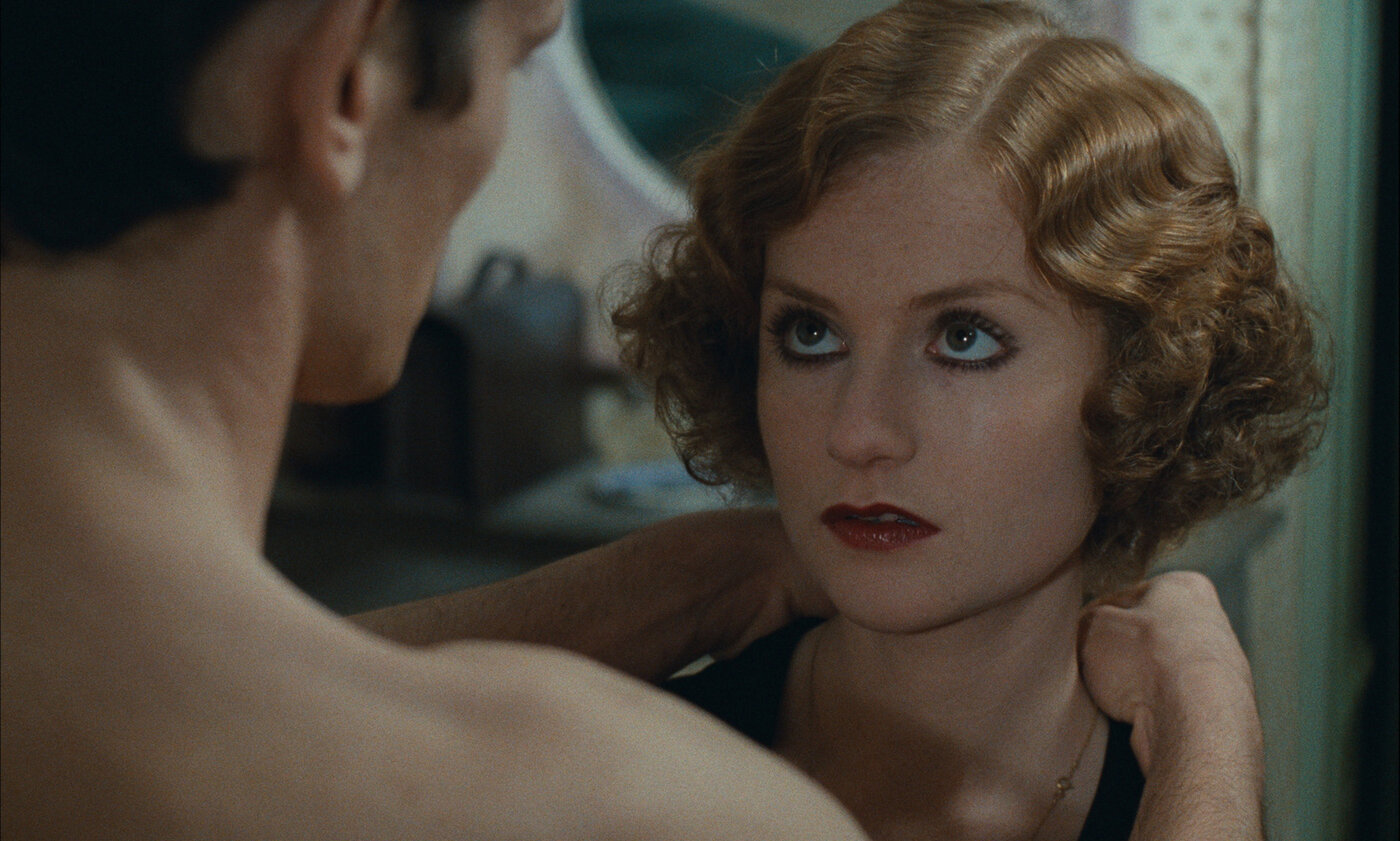
Violette Nozière (Claude Chabrol, 1978).
In 1978, Claude Chabrol and Isabelle Huppert made Violette Nozière, the first of seven collaborations over nearly 30 years. Chabrol was already two decades into a prolific career that, after his breakout early features Le beau Serge (1958), Les cousins (1959), and Les bonnes femmes (1960), had stalled in careerist assignments, before 1968’s Les biches firmly established him as a specialist in acidically funny thrillers whose plots were frequently starting prompts to anatomize the felonies and foibles of French bourgeois society.
If Chabrol was only a decade into his “classic era,” Huppert was just beginning her run as one of France’s preeminent actresses. Her first leading role in Violette is reminiscent of the actress’s breakout turn in Going Places (Bertrand Blier, 1974) where, towards the end of the film, she voluntarily abandons her abusive, repressive family to go off with Gérard Depardieu and Patrick Dewaere’s mindlessly transgressive criminal louts. The part established Huppert’s comfort with discomfort and penchant for abrasive characters with often unreadable interiorities; Chabrol’s films drew upon that talent, beginning with Violette, a film inspired by the true story of a teen sex worker who fatally poisons her family.
While the film won Huppert a best actress award at Cannes, it would be over a decade before she reunited with Chabrol, at which point their collaborations assumed a more regular cadence. Story of Women (1989) once again drew on a true story, this one about Marie-Louise Giraud, put to death after performing 27 abortions during the German occupation of France. Here, as so often, Chabrol makes use of the plot to indict the self-exculpating mores of French society, whose collaboration with the Nazis makes Giraud a convenient scapegoat to deflect their guilt. As part of the film, Huppert also sings, bringing expressive life to a character by drawing on her own fondness for music. (In a 1990 Los Angeles Times profile, Kevin Thomas noted that she had been studying opera for three years at that point—a characterization Huppert disputed in our conversation as a press-created fiction.)
After quickly reuniting for 1991’s Madame Bovary, Huppert and Chabrol made their most widelyacclaimed collaboration, 1995’s La cérémonie. The film was adapted directly from Ruth Rendell’s novel A Judgment in Stone, and was more indirectly inspired by another iconic story of French true crime—the murder of their employers by maids Christine and Léa Papin, which in turn inspired Jean Genet’s play The Maids. The film first introduces maid Sophie (Sandrine Bonnaire) and her bourgeois countryside employers; it’s well past the first-reel mark before Isabelle Huppert makes her entrance as an unnervingly offbeat post office employee. Akey early moment, when she takes the gum she’s chewing out of her mouth and parks it under the desk, nicely summarizes her disregard for polite society’s guidelines. Her action sets the quietly, escalatingly unnerving tone, whose point of view is directly articulated by paterfamilias Georges (Jean-Pierre Cassel) when he incongruously quotes Nietzsche at a family party: “There are aspects of good people I find loathsome, least of all the evil within them.”
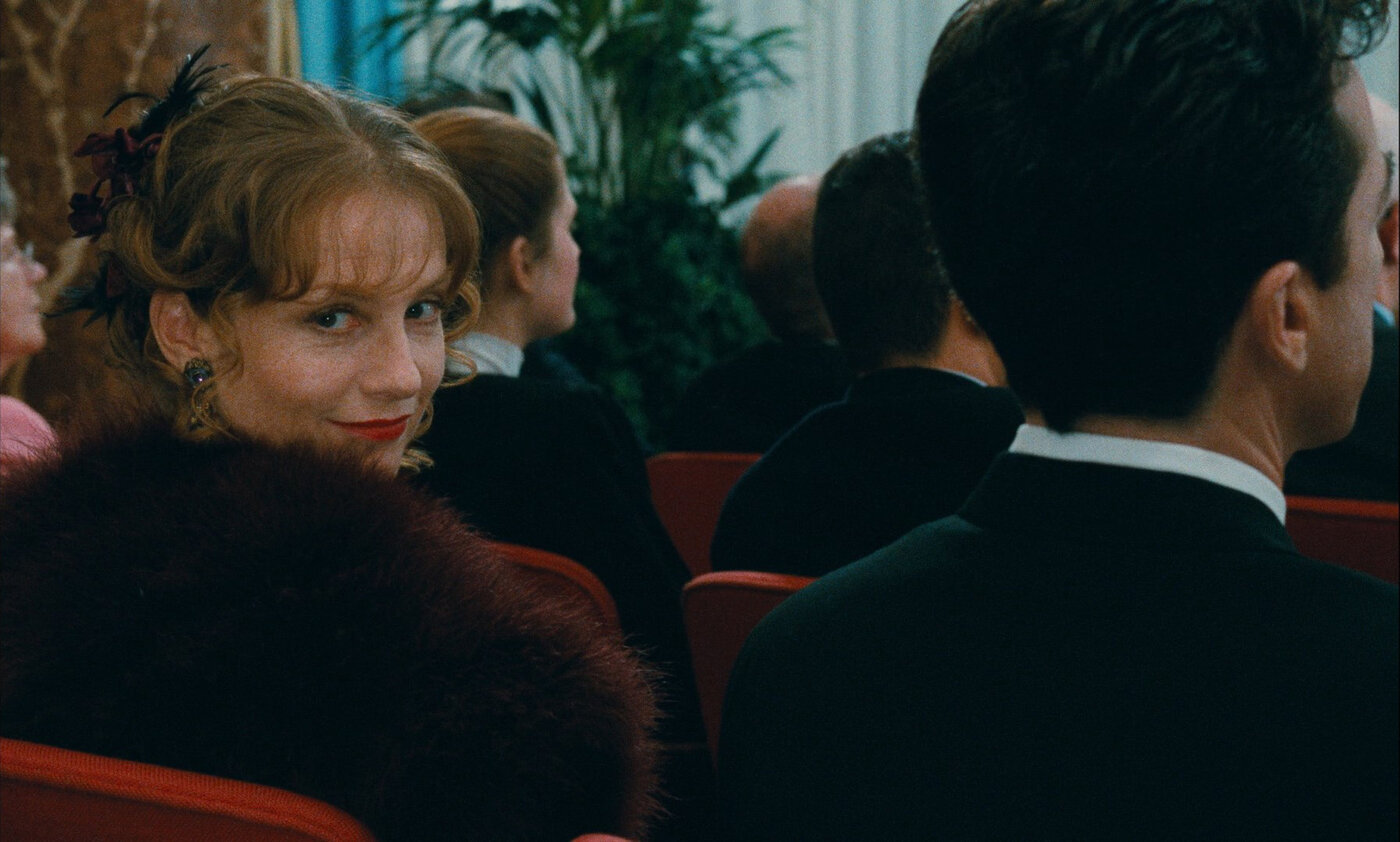
The Swindle (Claude Chabrol, 2000).
Chabrol and Huppert immediately reunited for The Swindle (2000), the first of two consecutive films to be shot in Switzerland and the only one of their collaborations not to be rooted in either a novel or a true-life incident. Here, Huppert is Betty, operating under the direction of Victor (Michel Serrault) to con gullible conference attendees. It’s a dazzlingly ambiguous portrait of a relationship in which the true relationship of both parties to each other—love? Mutual exploitation? A long con?—remains ambiguous until the very last shot. Huppert is even more unreadable in Merci pour le chocolat (2000), another bourgeois hothouse ensemble in a beautiful residence (all involved in the production seem to agree that it was owned by David Bowie at the time) that ends with a long, sustained close-up of her unreadable face, an appropriately enigmatic end for a film about a mother who may be poisoning her son for no clear reason. Their collaboration ended with the still-undervalued Comedy of Power (2006), a rare quasi-heroic turn for Huppert as an undeterrable public prosecutor rooting out corruption whose dedication imperils her family life; she’s once again unstoppable and frightening, but this time in service of the public.
In the middle of a busy travel itinerary and a retrospective at L’Alliance New York of six of her seven films with Chabrol, I spoke with Huppert about their collaboration.
NOTEBOOK: What was your first meeting with Chabrol like? Did you have a sense of his reputation as a filmmaker?
ISABELLE HUPPERT: Of course, but I don’t remember exactly when we first met physically. I think it was in an airport. Violette discussions had already started through our agents or whatever, and very quickly after that, production began. A book had just been published about that famous case in France—not so famous at the time, but when it happened it was famous because Violette Nozière was a well-known character, having been an inspiration for the surrealist poets. So, she was an iconic figure, and then this book was published about her to refresh people’s memories. Then, Claude and his producer[made the film]. The producer's name was Eugène Lépicier—which was a funny name for a producer, it would be like saying Eugène “The Grocer” [l’epicier]. I got best actress in Cannes, and the movie was a great success, but then we still waited another ten years before getting together again and doing Story of Women—again, from a book that had just been published about that case in France. That was not so famous as Violette Nozière but it was tragically interesting because she was the last woman executed after the war, when the death penalty was still in place.
NOTEBOOK: Was there any particular reason why you didn’t work together for a decade?
HUPPERT: Life just took us in different directions. I worked a lot after Violette:Heaven’s Gate, Loulou, Every Man for Himself. But we didn’t wait that long between each collaboration after that second time.
NOTEBOOK: For Story of Women, you suggested integrating the detail that she sings into the character.
HUPPERT: I just loved singing. There was an indication that she liked to sing in the script and I said to Claude, “Maybe we could emphasize this. I could have this moment when I sing, which becomes dramatically included in the storytelling.” He said, “If you want to sing, yes, of course.” Of course, we know how it’s going to end, so it’s like the singing is an indication of life, and you know this voice is going to become silent at some point.
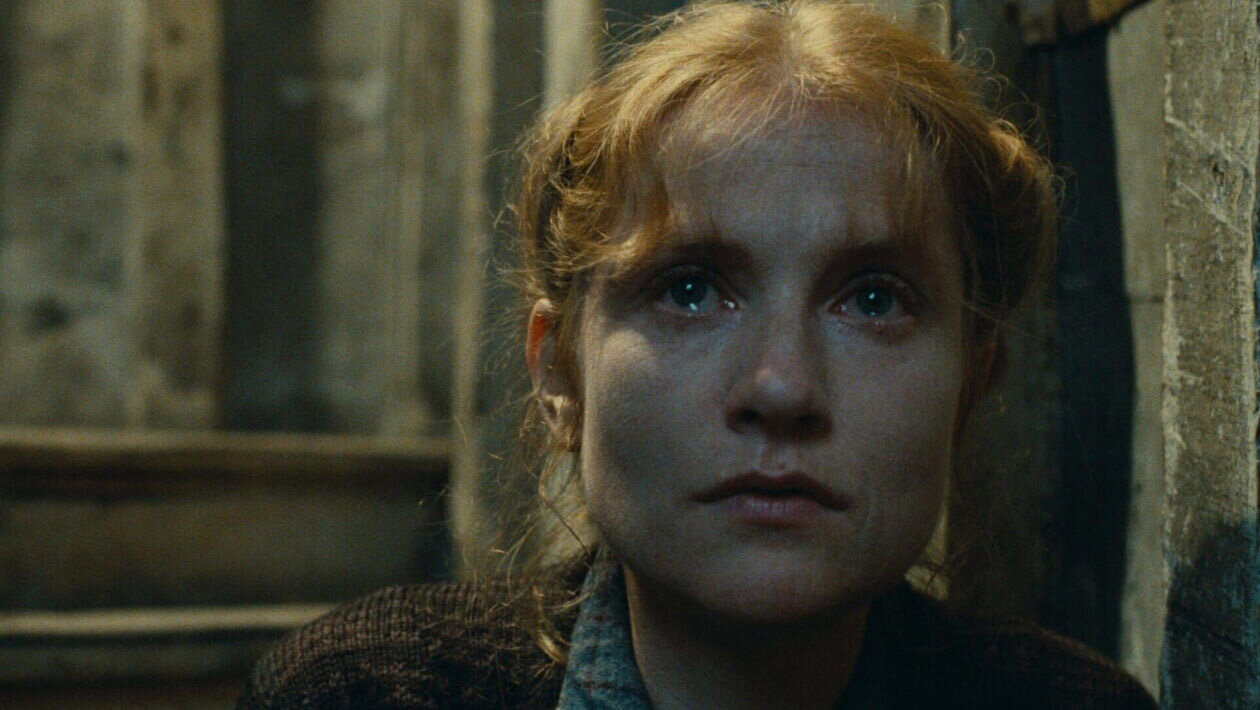
Story of Women (Claude Chabrol, 1988).
NOTEBOOK: When you worked together, did you regularly become involved in the script?
HUPPERT: No, never—with somebody like Chabrol, no. The scripts were always perfect, and he was so strong with dialogue, I didn’t have this kind of attitude. I left it to him. We never did readings of the script, he never really talked to me about anything. Maybe a little bit before—a few lines, a few words, how he would define the character—and that was it. For the rest of the film he would never give me an indication, never direct me—he would leave me totally free. In La cérémonie, I was chewing a piece of gum, and just before the take I took it out and put it under the table. He said, “Oh, that’s wonderful, do it again.” That’s also an indication of how Claude would proceed, welcoming all these little unexpected details. It really says a lot about how she’s free, with no barriers and love.
NOTEBOOK: Six of the seven films made together are based on either novels or an actual person. Were you encouraged to read the books or do any research on the people?
HUPPERT: For Violette, I read the book, because that was really interesting. I read Madame Bovary, of course, and La cérémonie—Ruth Rendall’s book was great. On that film, he had me choose the role. He said, “There are two roles. One is more silent and doesn’t say much, and the other one is very talkative and agitated.” Immediately when I read the script, I said, “That’s the one I want to do.”
NOTEBOOK: Watching the films again in chronological order, I noticed that he really liked to shoot on soundstages as much as possible, and there’s more integration of on-location exteriors and sometimes interiors as the films go on. Did you notice any kind of change in how he approached scenes based on where he was shooting?
HUPPERT: No, it was classical work in that respect. There was lighting, whether outdoors or indoors. When we shot Violette, we didn’t shoot in the studio; we shot in a very small apartment in the 15th arrondissement in an old building. He would always say something funny: “It’s not so difficult to find where to put the camera, because there is only one possible place,” meaning that the space was so narrow. That’s how he would define his choices, in terms of where to put the camera: There is only one possible place. The angle was obvious because there was no choice to make between two angles.
He wrote a book called No Matter What, I Shoot. [The 1976 book’s title is et pourtant je tourne…, which translates as And Yet I Keep Turning—a translated pun on Galileo’s Italian statement “E pur si muove” about the earth: “And yet it moves!”] That was a good summary of Chabrol’s attitude regarding moviemaking. He had to shoot, to work, to make movies. He was perfectly aware that certain ones were better than others, and he didn’t have this pretension of being a genius each time. But he had to shoot and make movies no matter what. I would have made more films with him if he had not left us so quickly.
NOTEBOOK: There’s a lot of art in the films, on the walls in the sets. Did you ever talk about the art together or go to museums together and look at art?
HUPPERT: No, but Chabrol was highly educated and we would talk a lot about it. He knew music very well. He loved talking about music between takes or before shooting. He knew basically everything—he had read a lot, seen many movies, and discussed a lot.
NOTEBOOK: I’ve read that he was a big gourmand.
HUPPERT: Yes, there was kind of a legend about him. People like to think that he would choose his locations according to what he knew about good restaurants. Of course, the catering on the set was always good but not so much better than most of the sets I’ve been working on. That was slightly exaggerated.
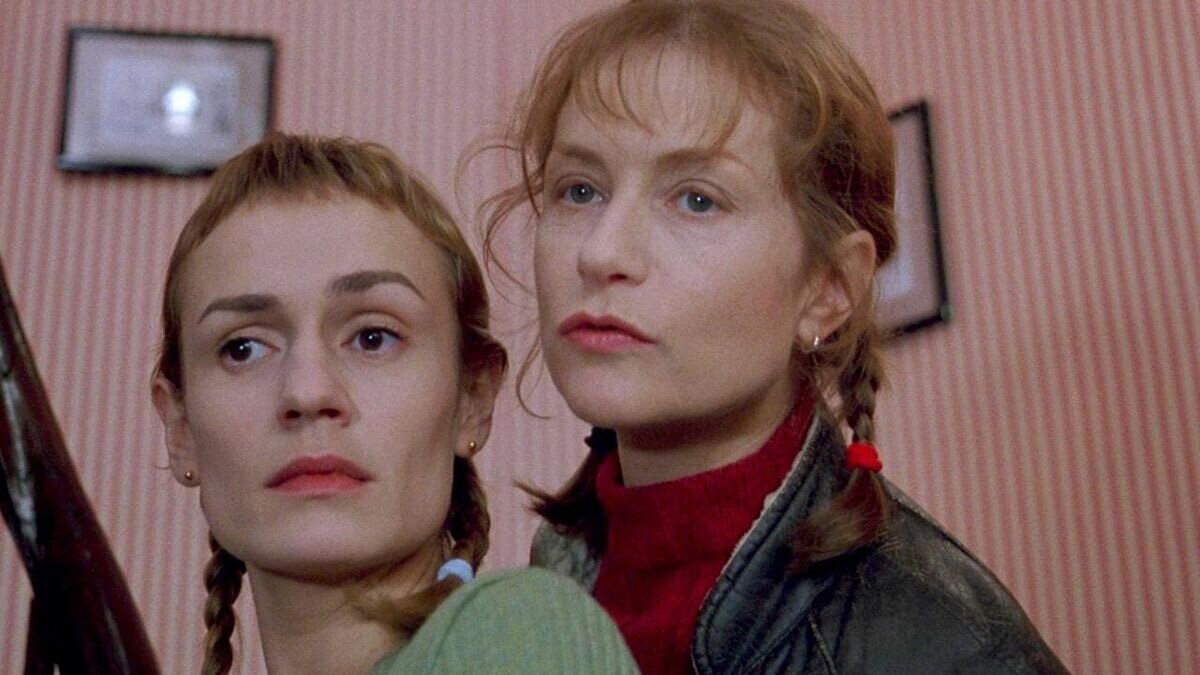
La cérémonie (Claude Chabrol, 1995).
NOTEBOOK: Starting with La cérémonie, there’s also a repeated emphasis on people watching television.
HUPPERT: That was another legend about Claude that was not a legend. He was known for loving watching television and watching the most basic programs. He loved a German fictional character in a German series that was very popular in France all those years, Derrick. That was his favorite program to watch; he wouldn’t miss any episode.
NOTEBOOK: I want to ask about The Swindle. The way that I understand the movie, which is maybe wrong, is that we don’t know if you love him until the very, very last shot. I don’t know if you thought of it that way.
HUPPERT: I always thought that The Swindle was one of his most autobiographical films, like a hidden self-portrait of himself and our relationship as a director and as an actress. It was easy for me to relate to Michel Serrault’s character. There was something in the complicity, in the connections between the two of us, in the film that was close to maybe what our complicity and connection was in reality. It was also a movie about moviemaking. He would consider the cinema world and moviemaking as, sometimes, a world of little crooks—you know, people trying to make money and make their way. I think he was speaking about himself in that film and about the world of cinema, in a very fun and tender way. Everybody was trying to make a little business, you know?
NOTEBOOK: Did you see him between movies or was it a relationship that was close but only while working?
HUPPERT: I did not see him much—maybe twice at his place in Paris, and I visited him once in his country house in the center of France. Life would keep us apart for some time, so it was not a constant and regular relationship, but also we knew and were sure that, no matter what, we were going to see each other and connect again on a film. That was always the idea. We would have always made movies together, I’m sure