Illustrations by Niklas Wesner.
This is the first in a series of features that look back over notable new releases from 2025.
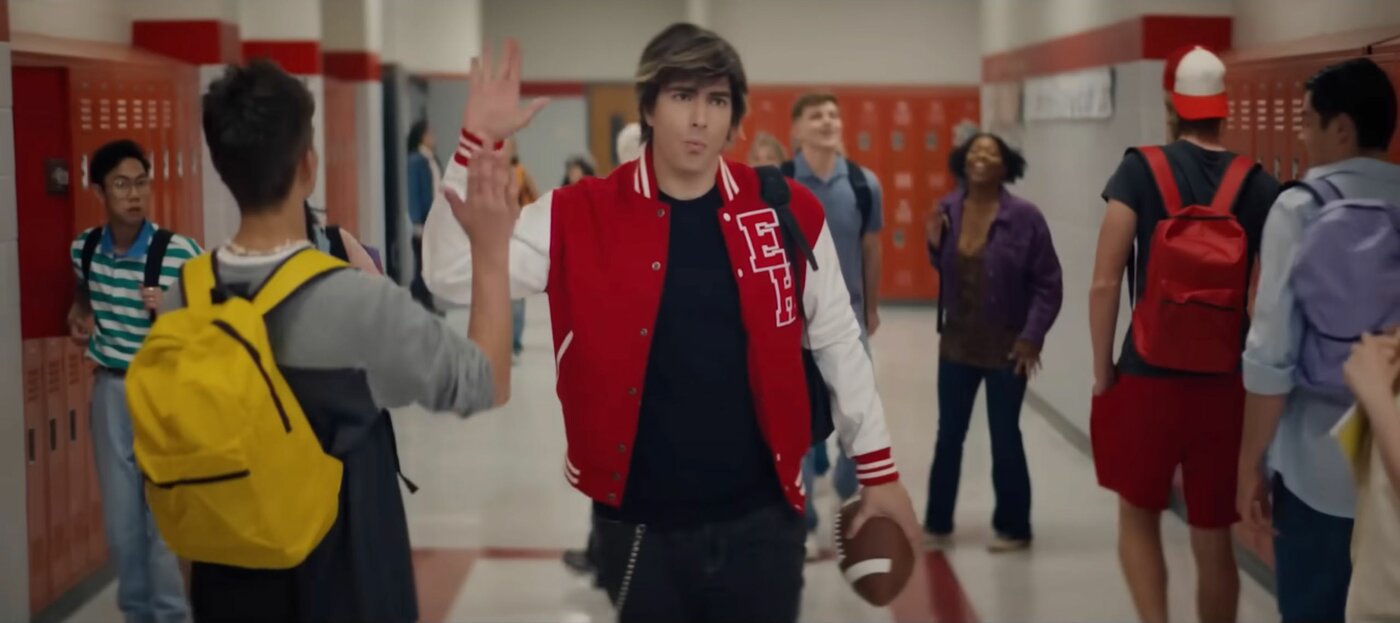
Ick (Joseph Kahn, 2024).
Let’s all meet up in the year 2000, where Hank Wallace (Brandon Routh) is the big man on campus at Eastbrook High—an only-in-the-movies educational facility where the hallways are bedecked in banners, handsome jocks get the blondes, and the nerds live on the margins, perpetually plotting their revenge. The triumphal coming-of-age imagery at the beginning of Ick (2024) is as wholesome as as a slice of American Pie, and the movie knows it; the opening montage of Joseph Kahn’s fourth feature is like being force-fed an entire studio commissary’s worth of empty-calorie, fin-de-siècle teen comedies on a treadmill while their contents rot and congeal in between your teeth.
The idea of starting a movie in the midst of a happily-ever-after-gone-wrong is savagely funny, and Kahn piles on the schadenfreude by staging it all in fast forward—very fast, with the synapse-frying precision of a filmmaker who typically obliges his audience to keep up. The sheer speed with which Hank is humbled—a broken ankle on the football field leading to a breakup with the class hottie (American Beauty Mena Suvari), prefiguring the death by heart attack of his father and the sudden deferment of his college dreams—is synced to a sense of existential dread, further deepened by the ignominy of the musical accompaniment. It’s one thing to see your life flashing before your eyes in real time; it’s another to realize that the story peaked sometime around the second Hoobastank album, and it’s all downhill from here. And the reason? It’s youuuuu.
The bottom is always falling out in Kahn’s movies, not least of all because of the genuine sense of risk encoded into their production. His distance from the industry is practical rather than (merely) postural; at a time when most filmmakers will do whatever it takes to be liked, Kahn has embraced and cultivated a reputation as an iconoclast. He’s certainly candid: At this point, it’s probably easier to find an interview that doesn’t mention his predilection for channeling the money he’s earned as a maker of high-end pop promos—for Taylor Swift, Eminem, Britney Spears, Jennifer Lopez, Mariah Carey, U2, Wu-Tang Clan, and Imagine Dragons (hey, they can’t all be winners)—into films whose lack of commercial viability belies their maker’s savvy commercial instincts. Or maybe it’s vice versa, and Kahn just keeps misreading the room. Either way, the paradox of a filmmaker with a finger on the pulse who never quite manages to tap a vein is fascinating to contemplate, if not necessarily fun for Kahn himself. Time and again, he throws himself into the fray, only to get lost in the shuffle.
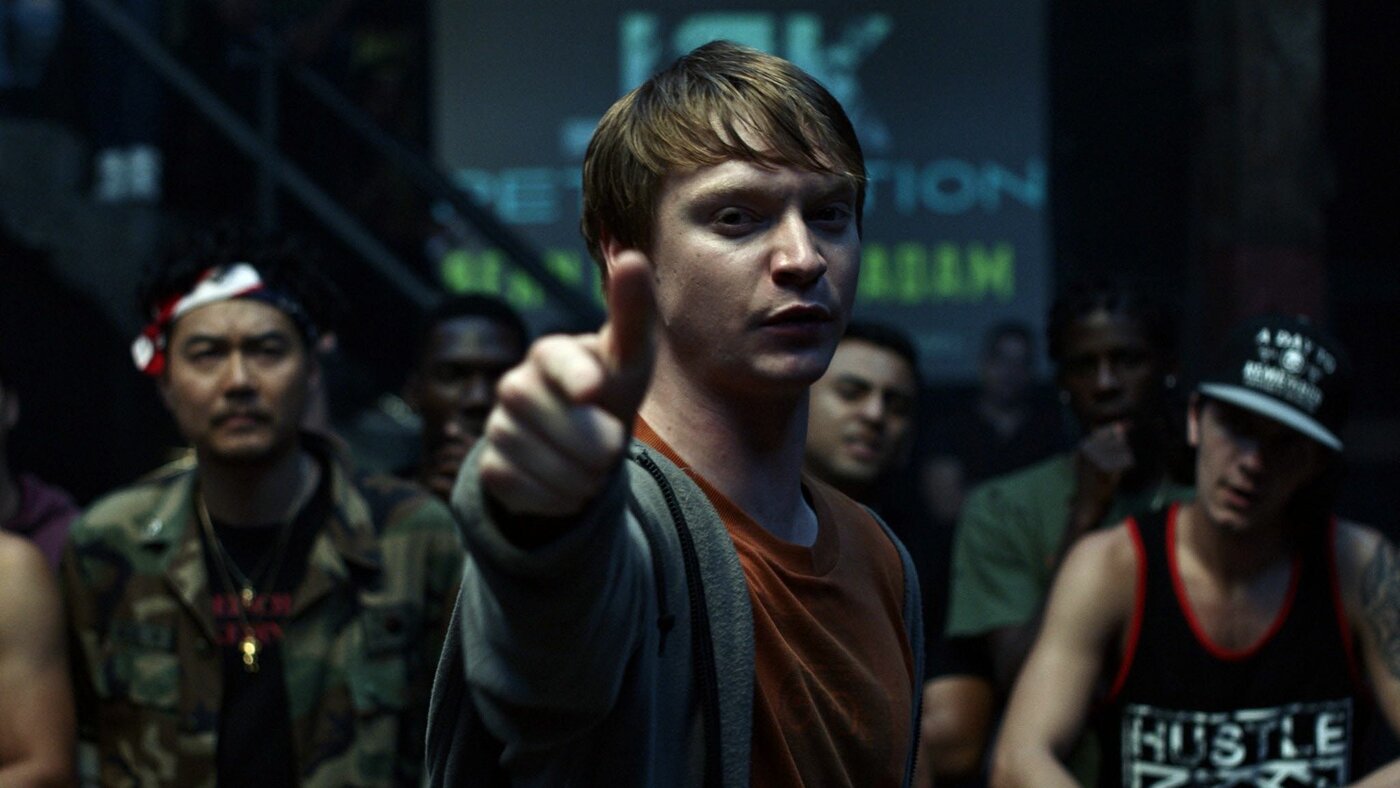
Bodied (Joseph Kahn, 2017).
Take, for instance, Bodied (2017), a ribald and enjoyably obnoxious comedy under the sign of Do The Right Thing (1989). The film is set within a broadly multicultural, politically incorrect social microcosm of underground battle-rappers, a milieu that proves conducive to capturing the vibes (if not cornering the arguments) of early 21st-century cancel culture. Kahn shoves the contradictions of free-speech absolutism directly into the audience’s faces, as well as down the throats of his own epithet-slinging characters; the storyline deliberately spoofs the great-white-hype mythos of 8 Mile (2002), with Marshall Mathers himself serving as an executive producer. “I have never seen a movie that does so much with that old staple of narrative cinema, the basic shot-reverse-shot setup,” wrote scholar Steven Shaviro in Cinema Scope, giving Kahn his due as a formalist; Shaviro’s piece inventories Bodied’s virtuosic “flips of perspective” and “confusions of address” before invoking Lenin to praise the film for being “as radical as reality itself.” (Shaviro’s analysis is apt; Kahn’s next boring camera set-up will be his first). Kahn’s reward for impressing the egghead set was a distribution deal via YouTube Red, an acquisition that didn’t exactly place Bodied in the year-end discussion, even as its bilious punchlines easily outstripped the misanthropic sanctimony of, say, Three Billboards Outside Ebbing, Missouri (2017).
Still, at least Bodied got distribution at all. The rough reception that greeted Ick last September at the Toronto International Film Festival—represented by a series of middling Letterboxd reviews in the wake of its Midnight Madness premiere—has metastasized, like the film’s eponymous tangles of sentient, extraterrestrial goo, into a tangible and intractable malaise. A year and change later, Kahn’s film has yet to secure either theatrical or online distribution. This despite the fact that its contents would make for perfectly serviceable entertainment, especially for a teenage and young adult demographic who aren’t familiar with Steven Shaviro (or Lenin). The film is goofy and enjoyable beyond its metaphorical pretensions, much in the same way that Kahn is a filmmaker worth rooting for despite his dyspeptic public persona. In fact, there would seem to be a degree of embittered self-portraiture in Hank’s characterization; the implication that the early 2000s represented his glory days dovetails with Kahn’s time as one of the reigning image-makers of MTV’s Total Request Live (1998–2019). Through this interpretive lens—and for all his surface sarcasm, Kahn is as hyperconscious about the relationship between semiotics and subtext as any working American filmmaker—the film’s sci-fi storyline doubles nicely as an allegory of (pop-)cultural decline. In this equation, Hank becomes the fall guy for white-male-millennial obliviousness; the Ick, which encroaches on its victims so slowly that they barely notice, serves in counterpoint as a stand-in for all manner of enshittification, spreading kudzu-like across a version of suburbia that’s more effectively stylized—and less Stephen King–derivative—than any given episode of Stranger Things (2016–), to which Ick has inevitably and unfortunately been compared.
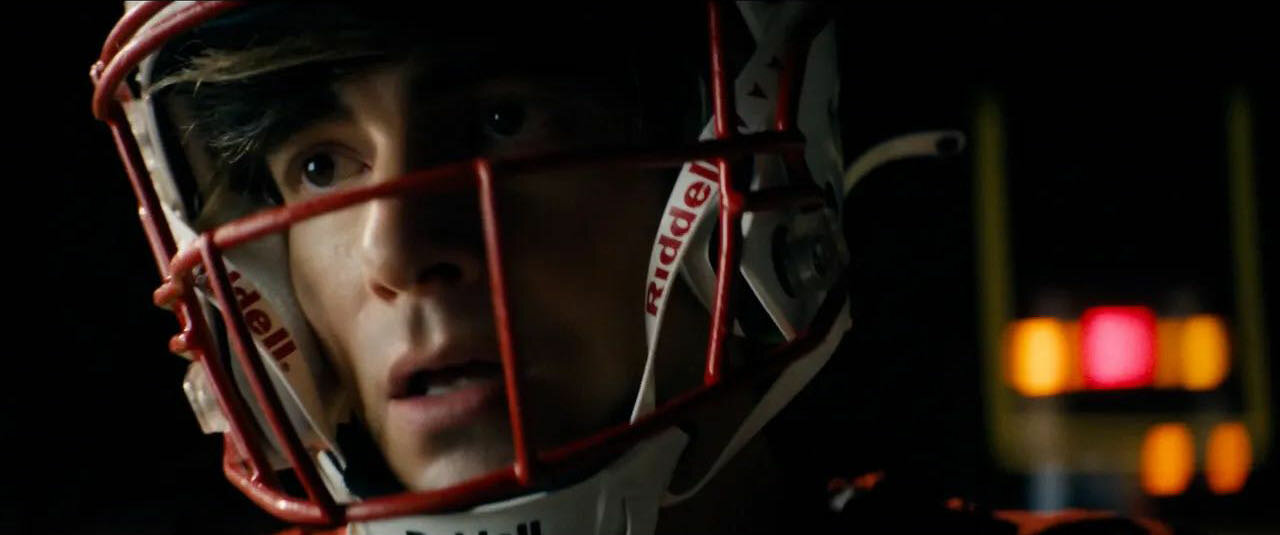
Ick (Joseph Kahn, 2024).
Instead of becoming a football star, Hank has gotten a job at Eastbrook as a science teacher—a rhetorical punching bag for the next generation of slackers. The casting of former Son of Krypton Brandon Routh as a harried, distinctly non-superheroic protagonist is witty enough, but the performance—which is deeply indebted to Evil Dead–era Bruce Campbell—goes on to transcend the joke. Routh is a resourceful knockabout leading man; Hank’s square jaw is made of glass, but his willingness to take it on the chin in a series of slapstick set pieces that draw on pretty much every invasion-of-the-whatever-snatchers movie is endearing. The tension between mockery and empathy is real; Kahn’s occasional penchant for pedantry belies his basically humanist sensibility. The obvious read of Ick is as a fable excoriating Gen-Xers for their lack of accountability; the conceptual punchline is that Hank’s desire to save sardonic high-school wasteoid Grace (Malina Weissman)—whom he suspects may be his biological daughter—from both the Ick and her own potentially self-destructive choices isn’t enough to give him a shot of redemption. Instead, our man earns his stripes by realizing that he has a responsibility to Grace whether or not she’s literally his kid, and that his protective instinct should apply to her friends as well. The message isn’t subtle: Look out for everybody, not just your own. But it’ll do in a pinch, especially when carried aloft by the majestic sounds of Creed.
Car chases, armed standoffs, military personnel locking down schools, COVID masks, the scramble for literal and figurative higher ground, ominous paternity tests, girl-dad metaphysics: Squint a bit and Ick could be the PG-13, alien-DNA-infested doppelganger of One Battle After Another (2025), a movie that Kahn doesn’t seem all that nuts about (one among many; more drive-by takedowns follow below) but concedes kinship to insofar as it is mutually channeling parental anxieties. My point is not that Ick is necessarily better or worse than One Battle After Another, or any more coherent as a phantasmagoria of contemporary political attitudes and shibboleths. Kahn’s sense of humor can be juvenile (but then, so can Paul Thomas Anderson’s) and his politics are voluble (ditto); if a sarcastic aside or two don’t land (or liberals catch strays), it all comes out in the wash. Ick doesn’t quite have the muscular force of Bodied, a Faustian vision in which a white boy gets a hood pass at the expense of his soul. But it still gets its licks in where they count; by my reckoning, it’s the first and only movie to date to contain the phrase “J. K. Rowling sucks,” which is surely worth something.
Anyway, there’s nothing wrong with gobbling low-hanging fruit—that’s what it’s there for. And, as he ages, gracefully or otherwise, Kahn’s appetite for de(con)struction remains voracious—termitic, you might say, hungrily eating the lunch of filmmakers with more resources at their disposal. A picnic is only as good as the bugs, after all. Kahn and his sweetly creepy-crawly creature feature deserve a place at the table.
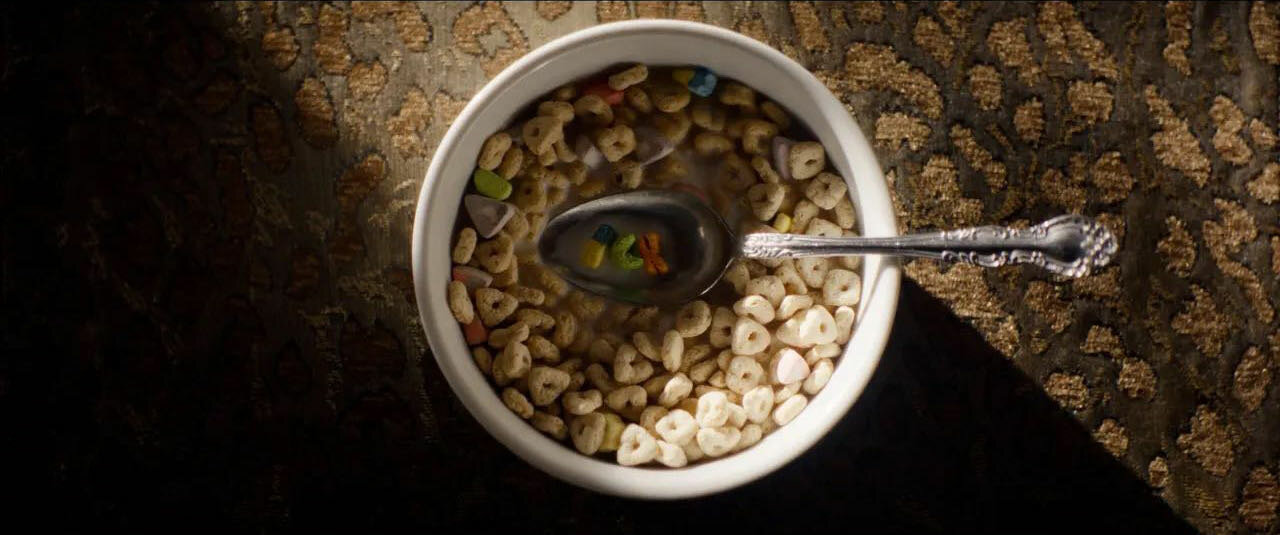
Ick (Joseph Kahn, 2024).
NOTEBOOK: You’re talking to a film critic, so we can begin by talking about film criticism. You tweeted that it’s “a mess” and gave a bunch of (sarcastic?) examples of who and what makes up the commentariat these days: “12 year olds, disgruntled film students, part time activists/baristas, laid off drunk sports writers, couples therapy podcasters in denial about the furry husband, all believing they are the better Yorgos Lanthimos.” It’d be fun to take these examples all one by one but, with the promise that my next question will be about Ick and not your Twitter account: How much film criticism do you read—of your work, and of other people’s—and do you really think things are worse now than they were “before”?
JOSEPH KAHN: I used to read a lot of film criticism, but there are just so many voices that it starts to turn into noise. A lot of what’s out there is—what’s the word—boring. I try to seek out positive reviews of my work to promote it (showbiz, baby), but I try to avoid the negative stuff because they’re always wrong. Sorry, I don’t edit too fast, you think too slow. If it’s not something I want to hear from someone while eating a Big Mac, I don’t want to willingly give my non-McDonald’s time to a half-speed doofus. I do love a great thinkpiece, but I question how many people these days think, rather than groupthink. Film criticism may be harder than filmmaking because as a filmmaker you can distract with the bells and whistles of the clown show, while the critic is just an asshole on a stage. Criticism is only as interesting as the critic. You can fake being an interesting filmmaker. You cannot fake being an interesting critic. Anyway, I have never finished a Yorgos Lanthimos movie. I thought his name sounded funny and made a great finishing punch line.
NOTEBOOK: OK, so let’s talk about whether you edit too fast. I didn't find Ick hard to follow, but I did think that the pace was accelerated even by your standards—especially the prologue which I also happen to think is very funny. Can you talk about trying to compress the entire millennium so far into 93 minutes, and in the style of an American Pie teen comedy? I thought the implication was that pop-culturally speaking, it’s more rewarding to look at those decades in fast-forward...
KAHN: Humans use stories to make sense of their lives. This is why you’ll see people bring up stories from their religious books to contextualize their experiences. Our moral perspectives and expectations are codified through if-then parables. However, the medium affects the framework. Thousands of years ago, we would have thought our lives were just like that song. Two hundred years ago, our lives were just like that novel. 50 years ago, just like that movie. Today, like a TikTok.
Hank’s prologue is framed in the medium in which he saw himself in his heyday: an early-2000s music video. As a millennial high schooler, he lived in a sliver of time where he could be Neo or Joel Madden. He chose Good Charlotte. He is the main star in his own music video, and even as triumph descends to tragedy, his song doesn’t stop. For Hank, it just switches from pop-punk to emo.
It’s very tricky injecting this alternate grammar into movies because there is a significant base of film fans who view their life narratives cinematically; that’s why they love movies. This is a demographic that sees themselves as characters in Magnolia [1999] or Parasite [2019], not an All-American Rejects clip. They chose Neo. Asking them to relate through the medium of music videos or TikTok in a genuine way feels unserious. The only reason the editing feels fast is because they are exhausting themselves thinking: Life isn’t a music video, it’s a movie. Truth is, it’s neither.

Detention (Joseph Kahn, 2011).
NOTEBOOK: The “sliver of time” reminds me of your earlier film Detention [2011] and the purgatorial centerpiece sequence, which I still think is one of the smartest depictions of pop culture I’ve ever seen in a movie; the surfaces and fashions change, but the subject position (and sense of being locked inside one’s own subjectivity) never does. (Rhymes with Dazed and Confused [1993], in my opinion; the kid gets older, his classmates stay the same age...) What’s interesting about this time-based formulation is that the Ick itself is very slow. It takes a while to coagulate. Hank’s life spins out of control too quickly for him to stop it; by contrast, the thing slouching towards him—and if you’ll forgive me, the capital-A America that the movie makes its backdrop, however stylized and artificial—is almost comically unhurried. I wonder when you first started to feel the Ick, or at least notice it at the edges of your own backyard—or if I’m reading too much into what you keep telling anybody who will listen is a goofy creature feature–style B movie.
KAHN: I’m really reluctant to talk about the political inspirations for the Ick because even if it was inspired by a specific origin, the movie evolves as you make it. The world has moved on since I started writing Ick in 2016, and I knew it would, so the thematic throughline was designed to be broad and malleable. I threw in a few COVID jokes to address the elephant in the room, but it is not a COVID movie. I also threw in a “four to eight” years jab at presidential elections. It’s clearly not a rigid allegory. It would suck if George Lucas revealed Darth Vader was just about his math teacher.
What it definitely is about is the modern response to monsters, which is apathy and convolution. Some audiences check out at the halfway mark when the town goes back to their routine after the attack. They think this is ridiculous, but it’s the most realistic plot point of the movie. In fact, the audience members who deny this are literally manifesting the Ick’s memory loss! The slogan of 9/11 was “Never Forget,” but I’m pretty sure a lot of them forgot to the point that they don’t even know what event that slogan signifies. All major threats blip out in our modern world for the next thing. This could be apathy, this could be ignorance, laziness, or bandwidth—but it could also be the human survival instinct. Move past trauma to live.
And yes, it is primarily a goofy creature-feature B movie. My primary objective is to entertain, but I will admit the shitposting of the movie should be part of the fun as long as you put it in the proper context: I am satirizing, not solving. Why would you want answers from me anyway? What the fuck do I know?
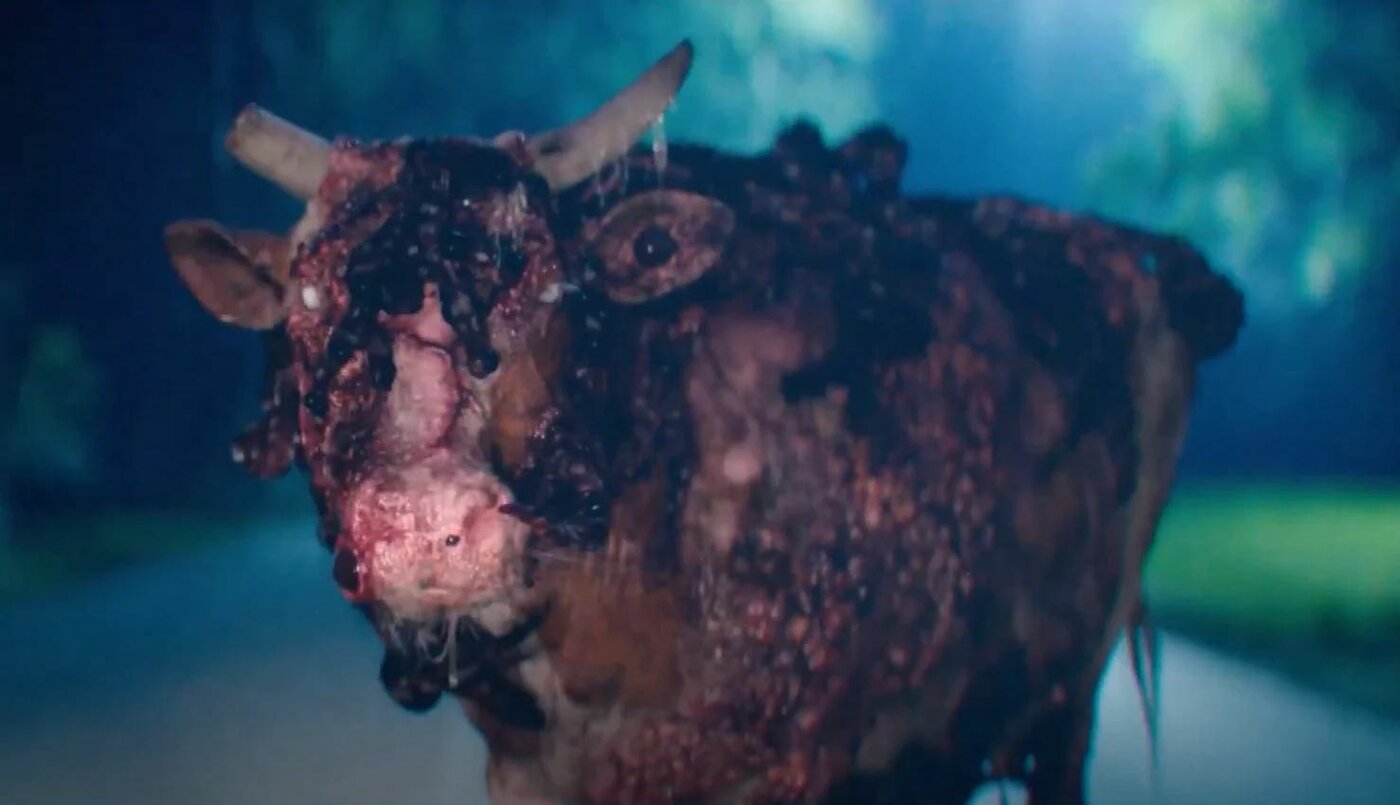
Ick (Joseph Kahn, 2024).
NOTEBOOK: I wonder if that anxiety about not knowing much—and feeling like we’re supposed to know something, about something—is why you chose to make what’s basically a girl-dad movie. The way I read Hank’s dilemma with the paternity test, it’s not just about whether or not he’s biologically Grace’s father, but whether he’s ready to take responsibility for somebody else other than himself (or even capable of that). I find the idea that the results of the test are less relevant than the impulse toward accountability very moving; it also makes me think this movie has something in common with One Battle After Another (maybe just one thing, but nevertheless).
KAHN: PTA and I are both wrestling with the existential reckonings of being fathers. His current take seems to be fuck the world that may harm my mixed-race kids; I will punish them in my movie. It’s a weird place when filmmakers are so powerful that they literally play God. PTA makes racists and kills them. Tarantino kills Hitler and the Manson clan. Meanwhile, I can’t even kill my own Ick monster. Perhaps not being accepted by the mainstream studios and critics keeps my ego in check and prevents me from going to that God mode, or maybe I’ve never been interested in being judge, jury, executioner. I am less interested in the paternal position and more fascinated by the paternal love in me that kicked in out of nowhere. The question of whether Hank is Grace’s daughter doesn’t need to be answered. If he feels that fatherly love, why would it stop if a genetic test said otherwise? I guess that mirrors DiCaprio’s character and Routh’s, and I don’t think that’s a coincidence. Parents know once you imprint your love, like a reverse David in Spielberg’s A.I. [2001], it doesn’t shut off.
NOTEBOOK: You say that powerful filmmakers play God; the Frankenstein metaphor is right there for the taking. Victor, as we know via a recent Netflix Original, wasn’t thrilled with his monster: Did making a movie with an ever-present, always mutating CGI protagonist stress you out? The old-school monster movies were tactile; one of the things I hated about Stranger Things—a show I’m sure you love hearing invoked with regards to Ick—was how anodyne and weightless the CGI felt. What were your own design parameters?
KAHN: I’ve never seen a single episode of Stranger Things. An eight-hour season is a nonstarter for me as a working dad. I’ve watched more episodes of Paw Patrol (2013–). When designing the Ick, it’s important to note that one year’s state-of-the-art is next year’s camp. The prosthetics in John Carpenter’s The Thing (1982), a movie I love, now clearly look fake. Movies can’t even get practical blood to stay consistent. You’ll see blood that’s thinner or redder, and the blood splatters are overexaggerated. The audience decides if they are willing participants in mass hypnosis. If they can’t even agree if the World Trade Towers were hit by planes, how are they going to agree on what a football-field-sized vine monster should look like? The only reason they believe David Corenswet flies is because they want to believe in Superman. Something’s gotta replace the lack of Baby Jesus in these atheists. We’re at a state where we call something “AI” not because it looks fake, but because it looks real enough to question the motivation.
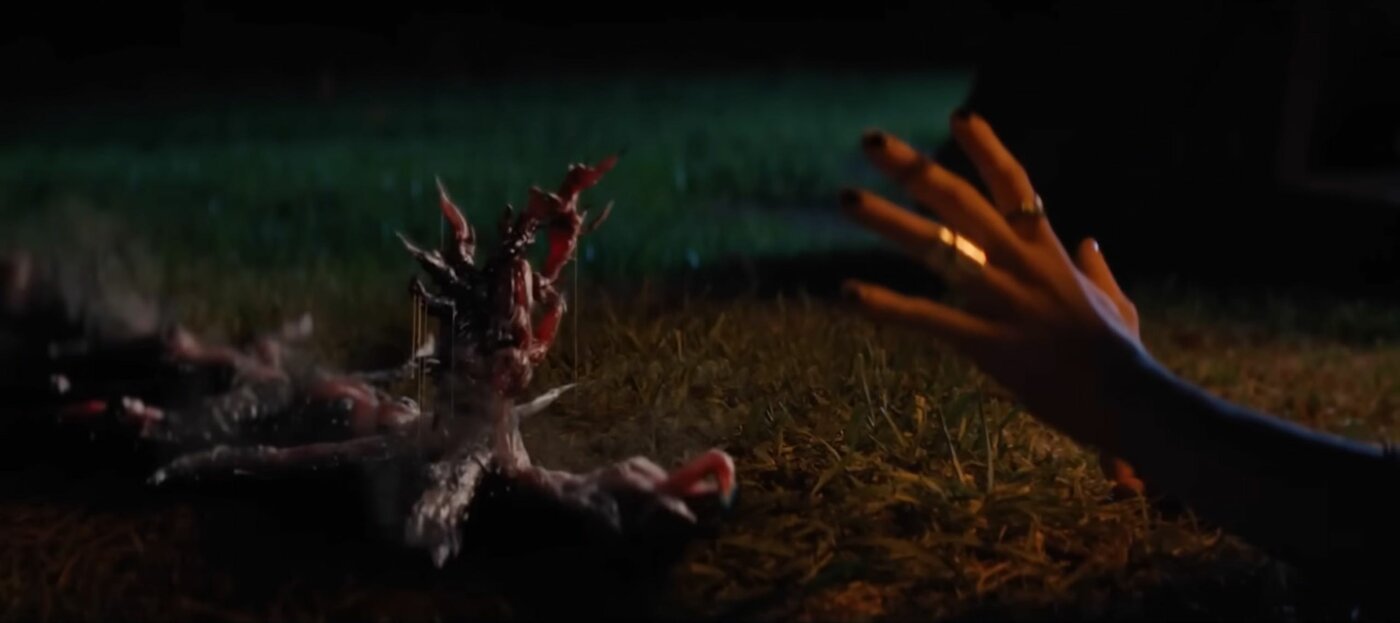
I imbued the Ick with real-world physics and lighting, but there’s also hyper-speed movement based on insects to give it an alien attitude. It suddenly lunges in a nonmammalian way. There’s no real-world counterpart because we don’t have six-foot-tall insects that move like half-inch insects. The only comparable movement is in animation, stop motion, or video games. Your suspension of disbelief will vary depending on your acceptance of those mediums. Kids grow up not only accepting CGI but expecting it. They don’t question the Ick at all. Adults used to old-school prosthetics weighed down by wires may see it as fake, but if an actual Ick attacked them in real life, the last thing they would think as they die is: It looks CGI.
Ick (Joseph Kahn, 2024).
NOTEBOOK: “This year’s state-of-the-art is next year’s camp”—fair enough. I guess this begs the question of whether you think movies like Torque (your very specific parody of The Fast and the Furious [2001–23], albeit made in 2004, before the series really locked in and became mega); Detention (a movie literally about the relationship between interchangeable surfaces and deep structures); Bodied (which features, among other period signifiers, a Bernie Sanders sticker as a sight gag), and, while we're at it, Ick (a movie that dares the viewer to say “too soon” as a COVID allegory) are built to last—or if your hyper-specificity goes on the list of things that make your work risky business?
KAHN: The reluctance of movies to be hyper specific to a year is dishonest. They’re just trying to extend the relatability shelf life by being generic. It’s like a Kardashian trying to mask their age by stretching their face back to look like a nondescript mask, but it feels wrong, and time catches us all. I purposely defy film Botox and embrace aging. I knew Detention would reach its awkward puberty age within five years, by 2016, when everyone dismissed a film set in 2011—with all its cultural baggage—as dated and cringe. Yet give it another ten years and Detention is now vintage and cool. The audience past 2025 is who I ultimately made it for.
It is a gambit for sure. I make these movies to appeal initially for a very short shelf life. The audience in the moment gets the thrill of being in that moment. Then my films go into hibernation and emerge twenty years later as beautiful, time-specific butterflies. Wait ’til you see how the music in Ick cements the movie’s thematic conceit in 2045.
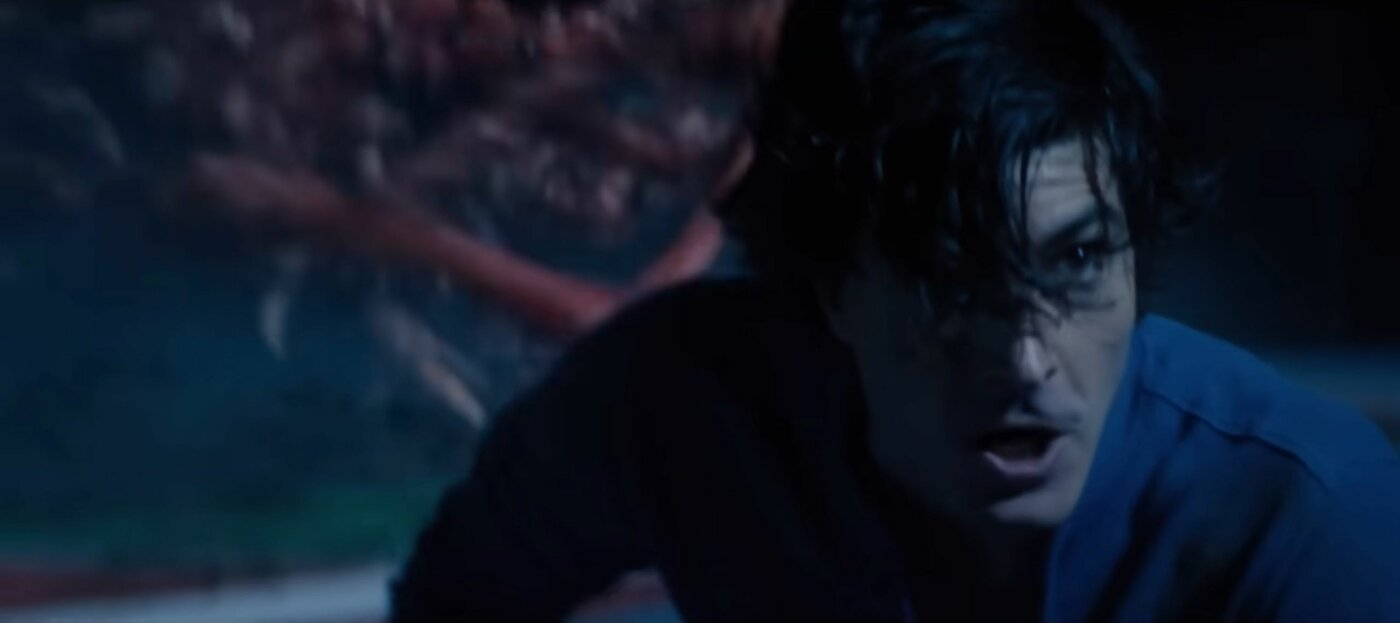
Ick (Joseph Kahn, 2024).
NOTEBOOK: Let’s hope that by 2045 people are able to see it. Let’s end by talking about the music, since you brought it up. How sincere is the curation of the soundtrack? What’s your barometer for inclusion when it comes to millennial pop-punk stalwarts? How likely is a Creed revival, and where do you rank their Thanksgiving Day football performance considering you’ve worked with numerous halftime-show guests yourself?
KAHN: The soundtrack is both sincere and a troll. Rock music in 2025 is dead because society killed the ones who make it: white men. As a music-video director who’s been at it for a while, I can say white male artists in popular music today are definitely in the minority, which is a greater reflection of [the prevalence of] white men in pop culture more generally. Hank is an allegorical vessel of that decline over the last two decades. In the early 2000s, both he and his rock music were at the top of the food chain, and then the world decided to break that. The songs in his MP3 player are strange now, antiquities from a completely different culture of jock rock and men’s power ballads. That’s the troll.
The sincerity is that I genuinely love all these songs. I may not be white—though some tribalist Asians may debate that—but I am definitely male. These pop rock songs with their hooks, melodies, and emo lyrics speak to the emotions I don’t indulge outwardly because I have man duties to attend to. It’s great that Tyson Ritter, Tom DeLonge, or Scott Stapp can do it for me so I don’t have to think about it, and this is how these songs are applied in the movie. It’s curated for narrative punctuations of release, like replacing a John Williams score with Chevelle’s “The Red.” Some are straight-up punch lines. Toad the Wet Sprocket playing during a creeper’s death is just weird, even by my standards. It’s a mosaic of rock songs that makes you see the trials of the modern world through Hank’s eyes—a song for each occasion.
Where the trolling and the sincerity completely merge is Creed. They are undeniably a great band—hits that are straight-up timeless. When I started writing with Sam Laskey, Creed was just dead. No one mentioned or thought about them. Yet in 2023, they started having a resurgence, chosen by males as a counterpunch to the dominant rap and girl-pop scene. Scott Stapp became a resistance symbol, not by his choice, but by dudes who recognized his Greatest Halftime Performance of All Time as a personification of a bald eagle in flight. It really worried me that my greatest punch line in the movie was going to get blown, but luckily it still worked—though not in Spain, where they truly didn’t know who the fuck Creed was.
The greater takeaway, I hope, is that we are the culture we grew up in. We are what we eat, and we are what we rock to. Just turn the music down every once in a while to see the Ick.

Continue reading Notebook’s 2025 Year in Review.