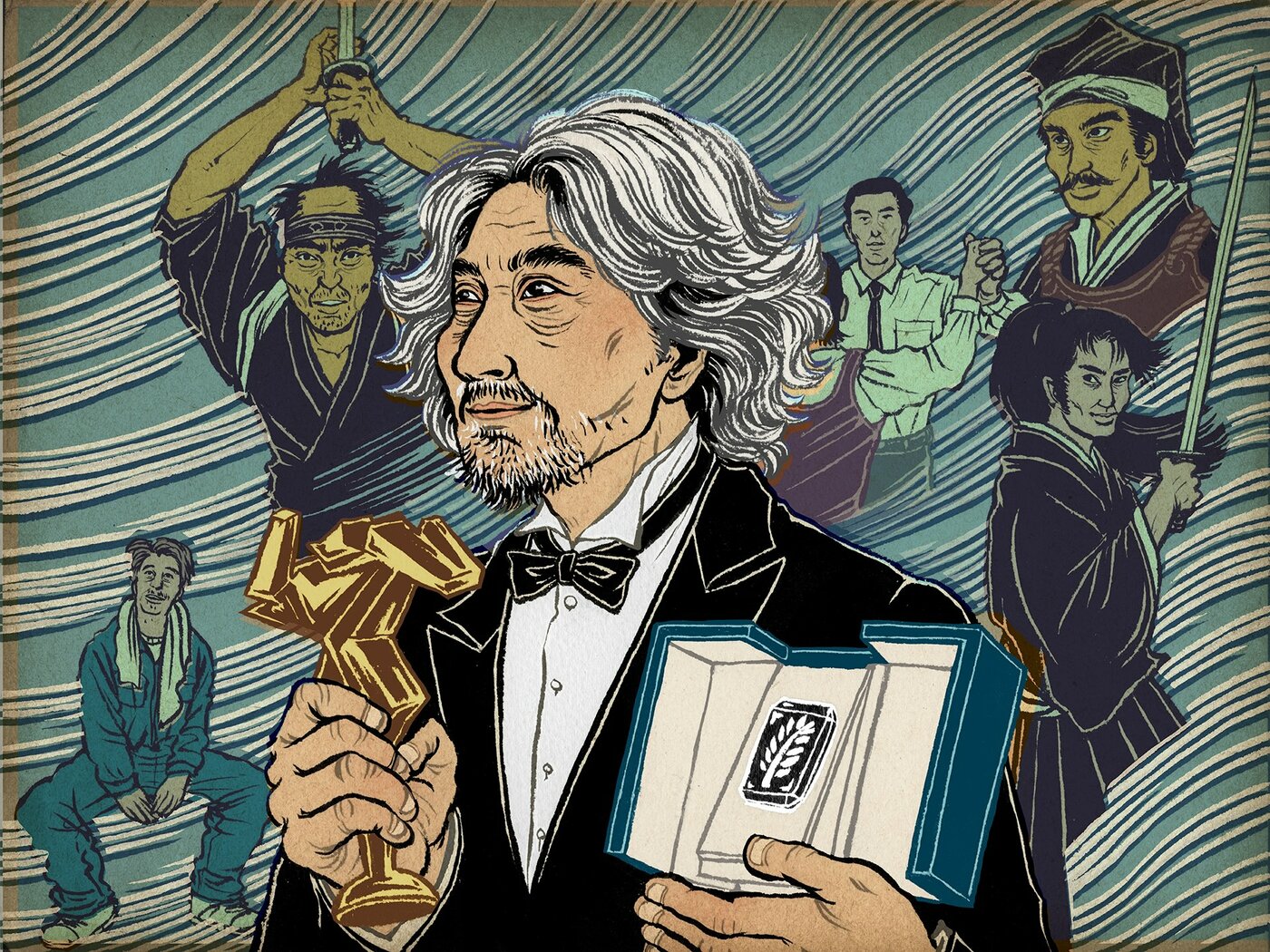
Illustration by Yuko Shimizu.
The sun is shining in Udine this April. This small Italian castle town, a little over an hour’s drive north of Venice, is mostly recognized for its medieval piazzas and loggia; its enduring Serie A football team; and its Friulian cuisine (try frico, a kind of fried cheese pancake). But for nine days each year, Udine looks beyond the scenic mountain ranges that mark the borders to Austria and Slovenia, and towards much more distant corners of the world—with the long-running Far East Film Festival (FEFF) celebrating Asian cinema.
This year’s event is marked by the presence of the latest two recipients of the Golden Mulberry for Lifetime Achievement Award—an honor previously bestowed upon names such as Jackie Chan, Takeshi Kitano, and Zhang Yimou. Ahead of the arrival of fellow awardee and martial arts cinema icon Yuen Woo-ping—whose fight choreography spans everything from Drunken Master (1978) to The Matrix (1999)—attention is focused on a performer who has effectively defined Japanese cinema for international audiences since the late ‘90s, and whose enduring screen presence is celebrated via retrospective screenings of eight of his most beloved works.
Originally a civil servant, Koji Hashimoto left municipal work behind in his twenties some time after being accepted to the prestigious Mumeijuku acting school, founded and led by Golden Age icon Tatsuya Nakadai (Harakiri, 1962; Ran, 1985) in 1975. By the time he had graduated to minor film appearances opposite his mentor in the early ‘80s, as he simultaneously built a reputation playing historical figures in TV period dramas, Nakadai had bestowed him a new identity: with “Koji Yakusho” referring to the Japanese terms for “administrative office” and “being able to interpret.”
It was in the following decade, though, that Koji Yakusho began to stake his claim as the defining actor of his generation in Japan—symbolizing the relatable “everyman” through his fatherly good looks, glinting eyes and smile, and naturally empathetic demeanor. Films like Masayuki Suo’s ballroom dancing romance Shall We Dance? (1996), Shōhei Imamura’s Palme d’or-winning arthouse drama The Eel (1997), and Kiyoshi Kurosawa’s psychological thriller Cure (1997) helped put Japanese filmmaking back on the map in the late ‘90s, with Yakusho’s warm and charismatic presence contributing to newfound international appeal and film festival success for a resurgent Japanese cinema. The latter film would mark the beginning of a decade-long collaboration with Kurosawa, a director with whom he made seven further features between 1997 and 2008.
By the time that Yakusho was being courted by Western filmmakers like Steven Spielberg and Rob Marshall (Memoirs of a Geisha, 2005) and Alejandro González Iñárritu (Babel, 2005), he had already won two Japan Academy Prizes from nine nominations. In the years that led up to his Cannes Best Actor win in 2023, for his performance as a toilet cleaner in Wim Wenders’ Perfect Days, he would collaborate with all kinds of leading Japanese filmmaking talents—playing samurai, lumberjacks, scientists, and serial murderers in films by the likes of Takashi Miike, Miwa Nishikawa, and Hirokazu Kore-eda.
Presented by Wenders with the Golden Mulberry for Lifetime Achievement Award at FEFF 2026, it’s clear that Yakusho—now 70—has lost none of the charm or gravitas that has long defined his cinematic footprint. His enduringly warm and kindly outlook underpins an insightful and reflective conversation following a generous panel discussion at the Teatro Nuovo Giovanni da Udine.
NOTEBOOK: Let’s start by going back to the early days. I’d be fascinated to know more about your time studying under (and later acting opposite) Tatsuya Nakadai. What was the biggest lesson you learnt from him?
KOJI YAKUSHO: In terms of being an actor, he was my master. My sensei. He had the aura of someone very scary and imposing, but he was actually very humane, and had a good attitude towards people. In terms of what an actor is supposed to be, he taught me everything—from scratch.
Touring all around the country for Mr. Nakadai’s stage performances, I’d watch him start from a tabula rasa, and create his roles from nothing. That gave me perspective, in terms of what the actual job of an actor is. But what you have to pay the most attention to is giving time [to each role], and using the right time to prepare yourself.
Nakadai gave me this way to turn towards the roles that I'm supposed to do; to never give up, and always proceed and go forward, step by step. That was my biggest lesson from him.
NOTEBOOK: One memorable early screen appearance came in Juzo Itami’s 1985 comedy Tampopo. It remains beloved to this day as one of the great foodie films. You mentioned a fun anecdote about this production during a talk at the festival earlier today.
YAKUSHO: I was the “Man in White”’ in this film, and [I had to] shoot all my scenes in three days before going away for another shoot. At the end of the film, there is this scene where I’m lying on the floor covered in blood. [Before we rolled the cameras,] I accidentally bumped into this iron bar on the set and injured myself, and got a lot of blood over me. The people around me wanted to take me to the hospital, but I said, “no, no, it will be helpful for my scene!”
At that very moment, a lady passed by and feared that there had been a true homicide killing. She wanted to call the police, and so the people around me had to convince her not to—and that it was all faked for the shooting of a film. The lady didn’t believe them. I was covered in blood, and I also had to try and convince her that, actually, I was feeling quite well. She was quite doubtful. I still laugh about it.
I knew Tampopo was a very peculiar film from when I first read the script. It was not a box office hit in Japan, but it was very much appreciated in the United States.
NOTEBOOK: It was reportedly the most successful Japanese film in America for a decade—until another film you starred in, Shall We Dance?, built on native box office success with 14 Japan Academy Prizes in 1996, before becoming one of the top-grossing international films of all-time in the US. You play an average joe office worker who develops a curiosity for ballroom dancing. Director Masayuki Suo once claimed that you were “very serious” about the dance training you undertook in order to prepare for the role.
YAKUSHO: Well, when I went to a ballroom for the first time, I started from the first steps. But I also [had to] remember the mistakes I made during those first days. I had to learn my mistakes in order to reproduce my first steps on the first days of shooting. I remember that very clearly.
NOTEBOOK: How could you tell that it had had a big impact on audiences?
YAKUSHO: Shall We Dance? was the first big hit movie that I had participated in. And, I have to be honest, I didn't think that it would become such a hit movie at first.
I remember being here, in Italy, for a private trip. I was in a very small town—I forget the name, but it was a town on a hill—and I was in this tiny shop with all of these old people. And there was this Western-looking lady who was just staring at me. I thought, perhaps, that there were not that many Asian people coming over here, so I must be very rare. But she kept staring at me, until eventually, she just asked: “Shall We Dance?”
That moment made a big impression on me in terms of [understanding] how a movie made in a faraway country could penetrate this area of the world, even though the language and culture is different.
NOTEBOOK: Only a year later, you began working with Kiyoshi Kurosawa, who was largely working in Japan’s straight-to-video “V-Cinema” industry at the time.
YAKUSHO: In those days in Japan, you would have a limited number of big productions in one year. And Director Kurosawa also didn't have access to such big budgets at that time. He had started out making political pink [softcore] movies, and then moved on to V-Cinema—which you didn’t watch in theatres, but at home on video. They were rather low-budget movies, but Kurosawa was still able to make good movies with that format, and I think that became a good base of training for him.
NOTEBOOK: V-Cinema productions were dependent on efficient shoots and fast turnarounds. How did this kind of filmmaking background impact the production style of Cure, your first collaboration with Kurosawa?
YAKUSHO: A consequence was that he was a fast shooter: one scene, one cut, one camera. There were almost no tests, and no rehearsals—or, at least, rehearsals would be very limited. But I think this [style] was also because he really dislikes the idea of actors getting used to their lines, and their movements. He wanted some freshness. Or, perhaps, some instability and uncertainty in the delivery. We also knew that he wouldn't wait around, and that he would go for “action” right away, and go with the first [take]. And so we actors needed to be very thorough in preparing ourselves, because we knew that, by all means, there would perhaps be only one chance to shoot that particular scene. Perhaps that was his aim all along.
NOTEBOOK: I’ve heard that Kurosawa also wasn’t exactly forthcoming when it came to elucidating on the nuances of the script for Cure. How did this shape the way you approached your scenes?
YAKUSHO: I remember asking Director Kurosawa a few times about how to interpret the character I was performing, which is a detective whose wife is ill, and who has a lot of stress in his life. He would not give me an answer. It was always: “I’m sorry, I myself don’t understand it.” It was also important to him not to express everything that the person I’m playing is. Kurosawa wanted a kind of ambiguity so that the audience could also imagine what that person was thinking.
I have to say now that perhaps this was the better approach. I think he wanted us actors to interpret what was written, and to show him what it was about. After that, I would come to understand that that was his way of shooting movies. The next time [we worked together], I didn't ask any questions. I would just go with the flow, and think to myself. After a while, you get used to that.
NOTEBOOK: The same year as Cure, you also made The Eel, in which you play a reclusive ex-con who nurtures a pet eel while working at a remote barbershop. It was directed by the Japanese New Wave legend Shōhei Imamura. How did you come to work together?
YAKUSHO: Before the casting for The Eel, I would attend the office of Mr. Imamura to rehearse [for other projects]. His office was available as a rehearsal space, and had a stage. I remember rehearsing there for a two-person performance, and I learned afterwards that he would come in and have a peek at what I was doing.
I didn’t know about it at the time, but this is how he got to know me. Eventually, he asked me to do the casting for The Eel.
NOTEBOOK: The Eel won Imamura his second Palme d’Or at Cannes in 1997. You then collaborated with Imamura again on his final film, 2001’s Warm Water Under a Red Bridge. What did you learn from working with such an experienced filmmaker from a previous era of Japanese filmmaking?
YAKUSHO: The main difference between, say, Mr. Imamura and Mr. Kurosawa, was that unlike Kurosawa, Imamura used to have very long and numerous rehearsals, perhaps due to the fact that film was rather expensive at this time. He would make us do these extensive test rehearsals, repeatedly. And then we would [roll cameras].
Imamura was different. He had his own style. He was an excellent director, but he was living in his own world. He was very keen and fond of reading, but he didn't have such a big knowledge of cinema or of other directors. And because of this, he was able to just use his knowledge as a reader, and would then create his own thoughts—so his style would become very peculiar, very personal. He didn't have this contamination from other directors.
NOTEBOOK: You pretty much became the face of Japanese cinema overseas after that, even appearing in Western productions like Memoirs of a Geisha and Babel in the early ‘00s. Long before this international visibility, you had cut your teeth working in TV jidaigeki productions in the ‘80s. How did those TV roles, playing historical figures and samurai warriors, prepare you for bigger budget jidaigeki films in the 2010s, like Takashi Miike’s 13 Assassins (2010)and Hara-Kiri: Death of a Samurai (2011)?
YAKUSHO: In Japan, NHK—the state television network or national broadcaster—has these long dramas that last for a whole year. [In 1983,] I had played this very famous character called Oda Nobunaga, who was a Japanese warlord [in the 16th century], and it was this role that really enabled me to abandon the other jobs and earn money solely from acting.
When I was shooting these jidaigeki dramas for television, we had to go through training—of course, it's not like in your everyday life you have the opportunity to act like a samurai. By all means, that was helpful in terms of gestures and movements when it came to Mr. Miike’s movie, but he also wanted to make a big-budget jidaigeki, and the only way to get a big budget was to make it a big production, with new, advanced technologies, and these great fight scenes.
NOTEBOOK: Is the jidaigeki a dying art today?
YAKUSHO: Well, to make a jidaigeki, you need actors and staff who can work on this kind of movie. [My 13 Assassins co-star] Hiroki Matsukata, for example, participated in historical genre films and knew jidaigeki very well. He was able to preserve the style of those films, and we could learn from him and rely on him. But there was also an imbalance on the set with his experience and the lack of experience from some of the other actors.
For example: nowadays, we are all used to our chairs. But this also means that newer actors are not able to do their seiza or agura—ways they used to kneel or sit in old Japan by crossing their legs—for a long time. To be able to see that performed is a kind of heritage or legacy in jidaigeki filmmaking.
I really hope that there will be more people like Mr. Miike who will shoot jidaigeki. It’s important, because this is what will make it possible to bring up a new generation of actors and staff who can shoot these movies, so I really appreciate the approach of Mr. Miike.
Actually, Mr. Kurosawa is also shooting [The Samurai and the Prisoner], a jidaigeki, now —though sadly, I’m not in it!
NOTEBOOK: You played an imprisoned murderer in Hirokazu Kore-eda’s The Third Murder (2017), and a corrupt police detective in The Blood of Wolves (2018). Come to think of it, The Eel opens with an incredibly brutal crime of passion, too. Where does the nastier side of Koji Yakusho come from and how do you prepare for these scenes?
YAKUSHO: Well, I have to say that I wake up rather normally. But then, of course, you go to the location of the shoot, and sit on a chair in front of a mirror for hair and make-up. And there, you start your preparation.
Every time they add a layer, the face becomes more and more the face of the person that I'm going to interpret. They add some features for your face. They change the nuances and the complexion. And then, there is my first movement into that person's personality. Slowly, I get more and more into character.
Then, I get to wear the costume. Usually, it’s an outfit I’d never normally wear myself. And so that, too, is a big jump to get into character. Then, you get to the set, and you see what kind of drink he drinks, and maybe smell the cigarettes he smokes. All the props are very important. And eventually, you get inside his world with your own body.
NOTEBOOK: And then at the end of the day, you’re back to being regular Koji again?
YAKUSHO: After the shooting, of course I remove everything and I get out of the struggles of this particular person, and I think that I’m able to go back to my everyday life. In my mind, I’ll be behaving normally and as usual, but sometimes my family members will say that there's something off about me—something bad, something too vehement. Perhaps, somehow, there’s something from that particular person that still lingers within me.
NOTEBOOK: On that note, you’ve picked up many skills over your years of acting. You learned ballroom dancing for Shall We Dance?; used sign language in Babel; chopped down a tree in The Woodsman and the Rain; and even learned to cut hair for The Eel. Have any of these skills come in handy in real life?
YAKUSHO: Well, if you’ve seen Perfect Days, there's a scene where I make little triangles for the tip of the toilet paper that is left [hanging from the roll]. I still do that every now and then.
NOTEBOOK: In fact, you secretly spent a whole week working as a toilet cleaner before you shot that film. What sort of perspective did you gain from that?
YAKUSHO: It is often said that Japanese public toilets are cleaner than those you find all over the rest of the world. In Japan, we have this culture to keep things clean, because you're taking into consideration the next person who will be using that particular space. But I have to say, with toilets… that's not always the case. The Japanese people keep very clean toilets in their own homes, but when it’s a public toilet… many people do not.
This is what the Tokyo Toilet Project in Shibuya [the driving force behind the production of Perfect Days] is all about. They wanted to give us a way to think twice about what we do as Japanese people not only for ourselves, but also in terms of hospitality for the foreigners that come to Japan. This idea of keeping something clean is something that I felt strongly once again through my training as a toilet cleaner for Perfect Days. If I go to a toilet when I'm working, and the toilet is already dirty, I always clean up. I don't want people to think that Koji Yakusho left a mess in the toilet!
NOTEBOOK: Wim Wenders presented you with a Lifetime Achievement award at FEFF this weekend. You described the prize as a “new stimulus” for your career going forward, as you enter your seventies. But people nowadays have shorter attention spans, and are watching media on smaller and smaller screens. What role would you like to play in the ongoing evolution of cinema?
YAKUSHO: Nowadays, you get to watch all kinds of famous and historical movies from the past on streaming services. You can watch them on your home television set, or on your smartphone—perhaps even at twice the speed.
But what I keep saying is that it's important to go to cinema theatres, because the kind of experience that you can derive by watching a movie on a big screen in the darkness, with good acoustics and audio effects, surrounded by other people that you don't know, but who can share your same emotions… that is a special moment. It is a special experience.
I don't know how we, who make movies, can express this much more. But what we can do is [encourage] you to go to movie theatres—because the moment you enter a movie theatre, you're getting an experience that is much richer than with any other device. A sometimes unforgettable experience. I think there is no other solution.
NOTEBOOK: With all this in mind, what keeps you going back to your craft as an actor who has already accomplished so much?
YAKUSHO: It's the chemical reaction that happens with all the other actors. It’s the energy that I receive from my counterparts. It's all the things that are not written in the screenplay. That is the biggest joy, and also my biggest interest, because it goes so much beyond my imagination.
The author wishes to thank Giuseppe Gervasio for translating.