
Dear Renzo (Francisco Lezama and Agostina Gálvez, 2024).
The view from the train window moves from right to left, outlining a city’s sequence of billboards in reverse, until it slows at the station platform. This shot at the outset of Francisco Lezama’s An Odd Turn (2024), set in Buenos Aires, provides a vulgar analogy for a hopelessly retrogressive present under capitalism. A backward position affords resistance, even if only in the form of irony: Even when you think you have no choice but to be swept along, you might still obstinately face the wrong way.
From this stance, it can be hard to know if one has arrived at just another turn in the tracks or a long awaited world-historical break. Does self-proclaimed anarcho-capitalist Javier Milei’s presidency—characterized by severe austerity measures and the proposed dollarization of the economy—mark a sea change in Argentina’s economic policy, or does it fall neatly in line with those of Carlos Menem and Mauricio Macri before him? When we do come to a break, it’s often far later that we can recognize it, if we ever do.

An Odd Turn (Francisco Lezama, 2024).
A suite of short films by Lezama—An Odd Turn (2024), Dear Renzo (2016), and Frankenstein’s Bride (2015)—traces capital’s backward turns. (The latter two titles were codirected by collaborator Agostina Gálvez.) In Lezama’s words, the films were created as a “kind of document on inflation.” The films could be called portraits of everyday life, although the tired phrase fails to account for the way that their “documentary” status is derived on an infrastructural and generational scale. Lezama’s shorts follow twenty- and thirtysomethings through side streets and follies, if only to suggest that too much regard for one character or plotline distracts from the larger backdrop of economic precarity, including debt, gig work, and gutted public institutions. When we hear of turns and late capitalism, we might recall Robert Brenner’s “long downturn,” which theorizes global economic stagnation since 1973, but I think of capital’s permutations as described by Beverley Best in her 2024 The Automatic Fetish: Capital, in “generating and positing its own presuppositions,” is a “kind of evolutionary movement in reverse.”1 To call capital’s turns backward might very well be a tautology, which gets us back to the difficulty of their articulation if individual consciousness proves inadequate when attempting to cognize the movement of value. Could they more accurately be called odd?
Filmed in part at the Latin American Art Museum of Buenos Aires (MALBA), whose cinema Lezama worked at for eight years, An Odd Turn is a workplace farce, a micro-romance, a portrait of a city, and a tale of the US dollar’s shifting value in Argentina. The short film follows a security guard at MALBA who predicts a heist at the museum as well as the dollar’s imminent appreciation. After engaging in salacious banter with another guard via walkie-talkie, she is fired and falls for the guy who works at the currency exchange center while buying dollars with her severance pay. The film’s setting is also a metacommentary on the independent Argentine cinema of the early aughts: Today, MALBA is known for its support of El Pampero Cine, the filmmaking collective formed in 2002 and made up of Mariano Llinás, Laura Citarella, Agustín Mendilaharzu, and Alejo Moguillansky. Llinás’s Balnearios (2002) was the first film to have a proper premiere at MALBA, which until that point had only shown repertory cinema; films such as Laura Citarella’s Trenque Lauquen, 2022, have played there since.
Lezama’s trilogy—often featuring film workers as characters—is a call to historicize cinema’s present, to take a closer look at the infrastructure by which Argentine cinema has been distributed and revolutionized. Most relevant to the questions of political economy at stake in Lezama’s oeuvre—and to the theoretical and philosophical demands of Milei’s Argentina—is El Pampero Cine’s notorious refusal of state financing. Unlike Lezama, whose films and interviews emphasize the dire conditions of funding in Argentina, El Pampero Cine owns its own equipment and does not apply for grants from the National Film Institute (INCAA). When Milei defunded INCAA last year, it seemed to prove the collective’s point. El Pampero Cine is not merely fantastical in its plots and aesthetic maneuvers but in the very process of its production, whose self-sufficiency is almost mystical.
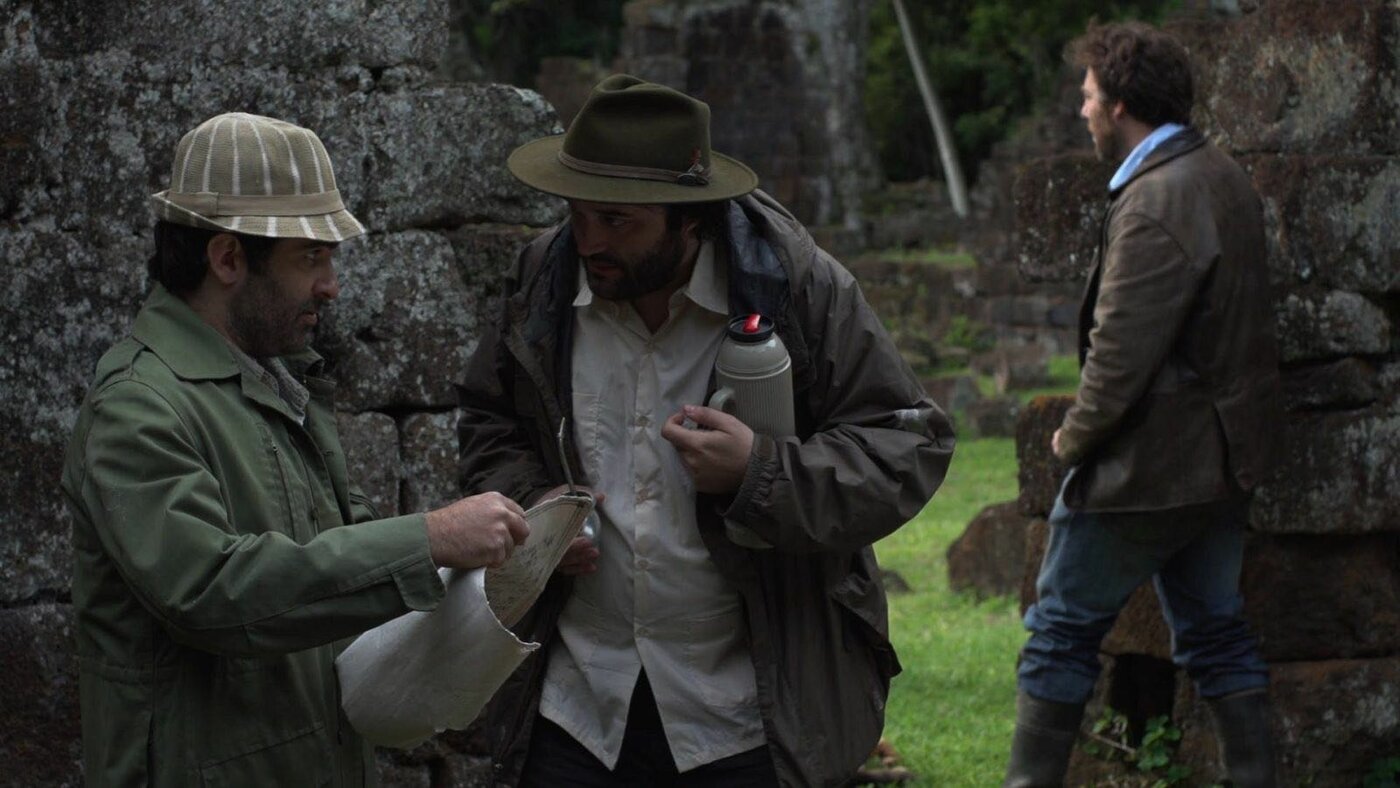
The Gold Bug (Alejo Moguillansky and Fia-Stina Sandlund, 2014).
To call Moguillansky and Fia-Stina Sandlund’s The Gold Bug (2014) a historical drama about Leandro N. Alem, the nineteenth-century founder and leader of Argentina’s Radical Civic Union, would be a crude misinterpretation in keeping with the perverse spirit of the film. The film’s black-and-white interludes—which proclaim the recorded or “historical” status of the narrative—mock the fraudulent didacticism of a genre like the overwrought biopic. If Christopher Nolan’s Oppenheimer (2023) already registers as farce, The Gold Bug—with its inane abundance of historical information that cannot possibly all be relevant or even apparent to its viewer—announces with doubled irony: It is so true! It is so historical! Featuring fictionalized versions of Moguillansky and Sandlund, The Gold Bug reconstructs the directors’ own production and funding process; the pair initially received funding from the Copenhagen Film Festival to make a film about the Swedish nineteenth-century realist writer Victoria Benedictsson. Their fictional proxies set out on the same undertaking until a crew member discovers a treasure map to the city in Misiones that bears Alem’s name The possibility of nearby gold necessitates a convenient pivot for their biopic, so they switch course to anchor their film on Alem (and mount an expedition).
The Gold Bug is less “about” Benedictsson or Alem than what it means to be loyal to an idea that cannot quite be explicated except through a screwy commitment to the adventure of the production process and all of its attendant contingencies. The film makes the cinematic apparatus visible, even in-your-face, but not as postmodern pastiche; it’s because explicit reference to the production process permits Moguillansky and Sandlund to write their film’s own materialist history. The Gold Bug becomes a parody of the historical drama form. As it turns out, the film crew in The Gold Bug will (of course) not meaningfully encounter the specter of Alem along the course of their treasure hunt. Arrival to a site never confers upon the traveler the ability to resuscitate history. Filmmakers must know that, but their repeated attempts enact this comedy of errors anew. The seeming failure of Moguillansky and Sandlund’s film doubles as a critique of an exhausted historiographical tendency.
Moguillansky and Sandlund most pointedly assert their metacommentary with regard to the transnational economic exchange otherwise known as film production: “It comes as a new manner of producing art: a film festival from Copenhagen hires a Scandinavian artist, and a non-European filmmaker, preferably from the ex-European colonies, from exotic places as Africa, Asia, maybe South America, and they give them money to work together, in a film in between experimental collaboration and charity.” The metacommentary is made all the more strange in its delivery; these words are spoken by the film’s version of Benedictsson. In one sentence, Benedictsson’s voiceover outlines the relationship between the project at hand, the imperial logic surrounding its production, and capital’s multinational character. We hear a similar explanation from Ivana (Miel Bargman) in Lezama and Gálvez’s Frankenstein’s Bride: “The movie was really set in Austria, but they shot it here because it was cheaper.”
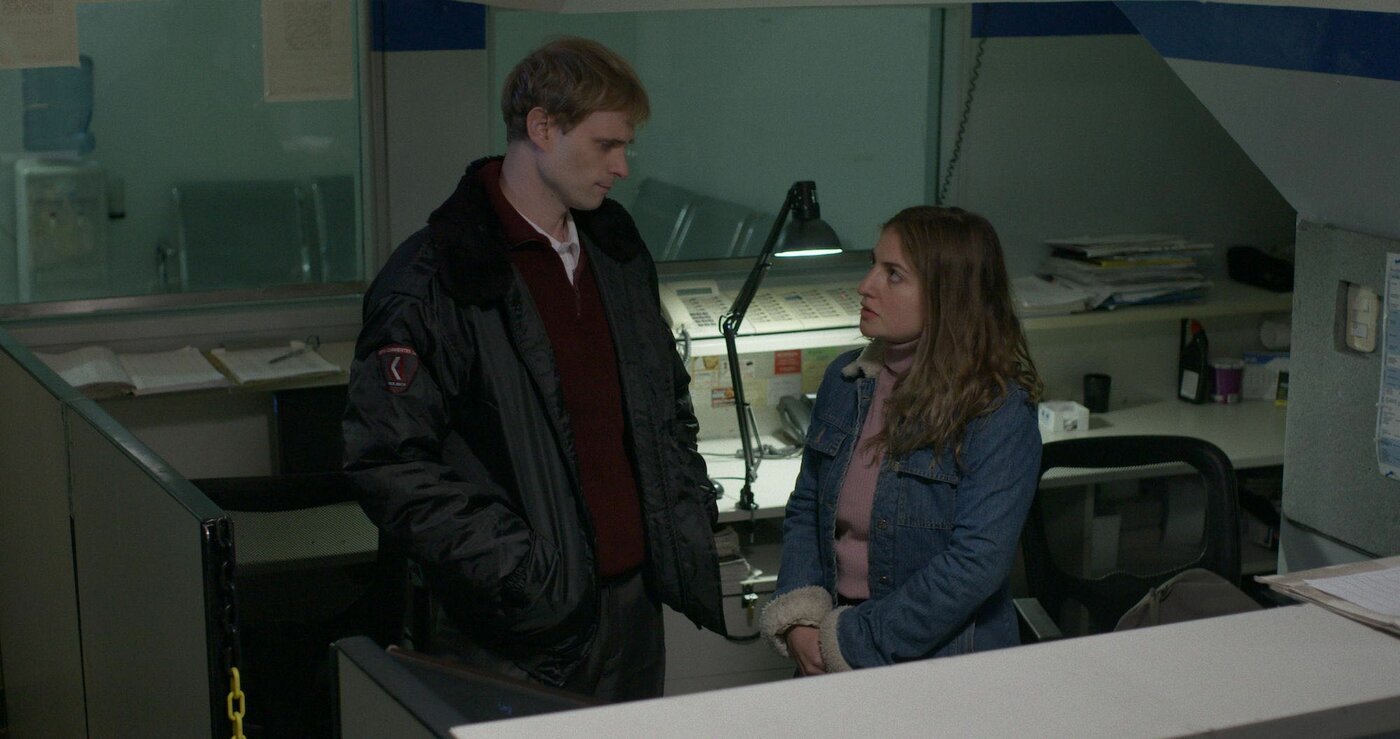
An Odd Turn (Francisco Lezama, 2024).
Tracing a history of contemporary Argentine cinema from the formation of El Pampero Cine at the turn of the 21st century to Lezama’s nascent body of work, we begin to chart an ethnography of the dollar in Latin America: Lula da Silva’s recent campaign to disentangle the economy of Brazil and other nations from the US dollar was interceded by the election of Milei in 2023, who campaigned on and endeavors toward total dollarization of the Argentine economy. Milei’s diligent allegiance to Trump paid off when the Trump administration opened a $20 billion credit line to bail out Milei last year, and just this February signed a trade deal to slash tariffs between the two countries. “Who decided to make the dollar the currency after the demise of gold as the standard?” Lula asked during a visit to China in 2023.2 Lezama’s cinema—as well as that of Martín Rejtman and El Pampero Cine—takes up that query in visual form.
Lezama’s cinema is always infrastructural. In An Odd Turn, we are in the city, at the football field, at the museum, in a corner of a room, at the currency exchange center, and then back at the museum. A sense of claustrophobia unites all these spaces, rendering the film’s title ironic or incongruous. The range of movement available in such constrained spaces is undoubtedly odd, though that determinism is commonplace: Of course, money is exchanged for more money. Of course, someone logs onto Grindr and might meet a prospective lover. Rejtman’s The Practice (2023) is bookended by Gustavo (Esteban Bigliardi) falling down the same manhole twice, making one wonder if it is possible to make anything other than a wrong turn in our daily lives. At other times, we get to witness the infrastructural dimensions of these turns—in this case, of the dollar—via the currency exchange center. One of the few English sentences that Airbnb manager Ivana teaches her coworker Renzo (Renzo Cozza) in Frankenstein’s Bride is “If you need to buy pesos at a good rate, give me a call.” Passing layers of nets and fences one evening, Ivana arrives at a football field, where she exchanges pesos for dollars as if the activity were a sport, with all the speculative fervor that implies.
When Ivana and her confidante kiss, a train glamorously passes above them. Lezama shoots the scene from below, looking up at the city’s infrastructure. Refusing a view from above, a representation of totality so eager to be comprehensive it could only be false, Lezama’s camera conjures Argentine political theorist and activist Verónica Gago’s critique of a commonsense understanding of neoliberalism. Gago—who organizes with the feminist collective Ni Una Menos (Not One Less) against debt, Milei’s austerity measures, and “the financial colonization of everyday life”—argues against a focus on the state and economic policy “from above” and toward a more robust understanding of “the pluralization of neoliberalism by practices from below.”3 For Gago, that entails an analysis of how neoliberalism is articulated, resisted, and reinscribed within informal economies or “communitarian practices.”4 At risk of an overly glib translation of a theoretical framework into optical metaphor, Lezama’s camera reminds us of cinema’s capacity to formulate a critique of what Gago has more recently called Milei’s “plunder neoliberalism,” by which she means his administration’s commitment to extractivism, land speculation, and austerity. If plunder neoliberalism stages a “a strategic war against social reproduction,” Lezama’s short films supply an archive of these practices by economically precarious gig workers, Airbnb owners, and artists “from below” in contemporary Argentina.

Frankenstein's Bride (Francisco Lezama and Agostina Gálvez, 2015).
The city on display through the train window at the beginning of An Odd Turn could be almost anywhere. A Coca-Cola sign, a red car, and damp gray blurs of platform provide a parody of the now exalted modernist metro in what we’ve all learned to call The City. Is it 1996, outside the Hard Rock Cafe of the increasingly globalized Taiwan of Edward Yang’s Mahjong—to which I’ve previously compared Lezama’s work—or are we really here in the Buenos Aires of Milei’s 2024 anarcho-capitalist making? Coca-Cola, in any case.
A question of genre emerges: What kind of comic tendency is proper to anarcho-capitalism? Lezama’s cinema proposes a realist one, which aims to document and take up the intricacies of an increasingly technologized, financialized, globalized Buenos Aires. Lezama attributes his realist impulse to Honoré de Balzac, but almost any realist novel of the nineteenth century enacts the longtime convergence of financial and social ruses through narrative form (think of the financial foibles in George Eliot’s Middlemarch, or the attempted heist and escape to Canada in Theodore Dreiser’s Sister Carrie). Lezama and Rejtman’s marriage plots, and even Moguillansky and Sandlund’s parody of the historical film (as well as their film’s focus on Benedictsson’s career), invite us to read them within the history of realism. Rejtman’s Shakti (2019), on which Lezama was an assistant director, is replete with all the usual realist themes—social reproduction, spiritual lack, and domestic life—transposed to the 21st century. The inheritance of realism, though, requires us as ever to consider whether the mode resides in our practice of interpretation or the aesthetic features of the object itself. Lezama’s cinematic analysis of social form is a recommendation to bring an unflinching eye to even the most surreptitious, generalizing turns of contemporary capital. Realism, in his case, might very well mean a commitment to represent, rather than shirk, these redundancies, if only so we can then try to oppose them beyond the screen.

The Practice (Martín Rejtman, 2023).
Spirituality remains a central preoccupation for both Lezama and Rejtman. “If you are a natural seer, you can read anything from a shoe sole to a melting ice cream,” Lucrecia says to her coworker in An Odd Turn, suggesting that the specific form of an inquiry is less important than the general practice. A tea bag suffices to reenact Brite’s (Valeria Bertuccelli) performance of a pendulum ritual in Rejtman’s Silvia Prieto (1999). Lucrecia eventually does see something rather specific: “a skyrocketing of the dollar’s value.” By the film’s end, her prediction is borne out when the exchange rate of the dollar climbs from 62 to 106 pesos. The financialized present told through a religious imaginary is not merely a gimmick or comic ploy in Lezama’s work, or in Rejtman’s The Practice, but an engagement with the “theological aspect of economy.”5
Everyone is always on yoga retreats in The Practice, which reminds me of an encounter at a Bay Area arts event a few years ago with two strangers who described a retreat at which they had “learned how to die.” They might have saved money by simply looking around at the decline of social welfare under neoliberalism, racial capitalism enforced by policing and prisons, or the genocide in Gaza. Capitalism produces death, though not in a sufficiently sublime form to be marketed as a spiritual education. Instead, we are encouraged to wish that everything could be resolved with one brisk maneuver, as when a physical therapist cracks Gustavo’s leg into shape (echoing the auditory catharsis of Silvia Prieto who repeatedly brings down her knife on chicken bones). Collective action, by which we might mobilize to change these conditions, is at least as spiritually bound a practice as any individualized course to salvation, which is often predicated on exchange and self-sovereignty.
“Money,” according to Marx, “forms the starting-point and the conclusion of every valorization process.”6 By that logic, the cinema in question, which casts money as its starting point and conclusion, in a recursive loop, tracks capital’s own “self-narrative [as] an endless (and origin-less) line of newly dressed-up versions of itself that are … always already obsolete,” in Best’s words.7 Whether Lezama’s characters transfer money online or hold hard cash, there’s a sense that its concrete form is less important for us to note than its multiple and constantly adaptive necessary appearances. In the films of Lezama, Moguillansky, and Rejtman, the comedy of the climbing dollar becomes hard to miss. We arrive at another iteration of the question of genre: What is the function of narrative when one lives in the Hayekian hell of Milei’s dream for statelessness and decentralization; Bill Gates’s “frictionless capitalism”; or what Lezama calls “hyper-digitized capitalism,” which produces such assurances as “if I have an app that protects me, the State is no longer necessary”? In other words, what is narrative when we live within the tautological loops of capital’s self-valorization?

Silvia Prieto (Martín Rejtman, 1999).
Tautology is one way into Rejtman’s Silvia Prieto, rife with characters who, according to critic David Oubiña, “don’t realize they are wandering in circles.” Like all properly dialectical thinking, Rejtman and Lezama’s films tell us what—or that—we already knew: Anarcho-capitalism already dictated the conditions of modern life before it properly arrived. Film production is necessarily bound up in these materialist questions, not only for Lezama—who both narrates the difficulty of acquiring a scholarship to study film at NYU and invokes a translation study scholarship in Canada in Frankenstein’s Bride—and not only for the filmmakers who have lost their source of federal funding under a Milei presidency. (As Lezama has said, “Without the INCAA and the Film Law, there would be no Argentine cinema.”) For US-based artists under a far Right, revanchist Trump administration, it is a familiar story. Or maybe it’s not even a story but a sequence of images that tell us there must be hope, if only because we are bound to encounter some turn, some reversal, even when we fail to see it coming.
Seated backward on the train, you feel a movement in your gut and brace your body against its force. You raise your eyes to the window and find you’re facing another direction. The landscape looks the same, even though it’s a different year or you’re on another street. If you call that turn “history,” you will always be right. The regularity—or realism—of this perpetual accuracy is an invitation to ask: What is a turn if everything is always happening at once, and not always leaving behind evidence of what has taken place? The question is posed in the cinema of Lezama, which takes us around the city in swirling, synchronic bliss. If we could just let ourselves forget the year, we could be “anywhere”: In the afternoon’s stillness, we could even be—we really want to say it, though we know it’s wrong—out of time. Lezama’s generality is not a mode of political apathy. It is a critique of the insidious condition of a present that aims to appear so synchronic we could almost forget history, the kind that wants us to look around and think: It was always this way. There is always history in Lezama’s cinema, even if his characters’ eyes can unfocus themselves to a vacancy that makes us believe we might pause it. Of course, we can’t.
- Beverley Best, The Automatic Fetish (Verso, 2024), 58. Italics in original. ↩
- Mauricio Beccera, “Lula and Xi Jinping pave the way for trade de-dollarisation,” Progressive International, July 20, 2023. ↩
- Verónica Gago, Neoliberalism from Below: Popular Pragmatics and Baroque Economies (Duke University Press, 2017), 19. ↩
- Gago, Neoliberalism from Below, 2. ↩
- Amin Samman and Stefano Sgambati, “Financial Eschatology and the Libidinal Economy of Leverage,” Theory, Culture & Society 40, no. 3 (2023), 106. ↩
- Karl Marx, Capital: A Critique of Political Economy, Volume 1, trans. Ben Fowkes (Penguin, 1992), 255. ↩
- Best, The Automatic Fetish, 306. ↩