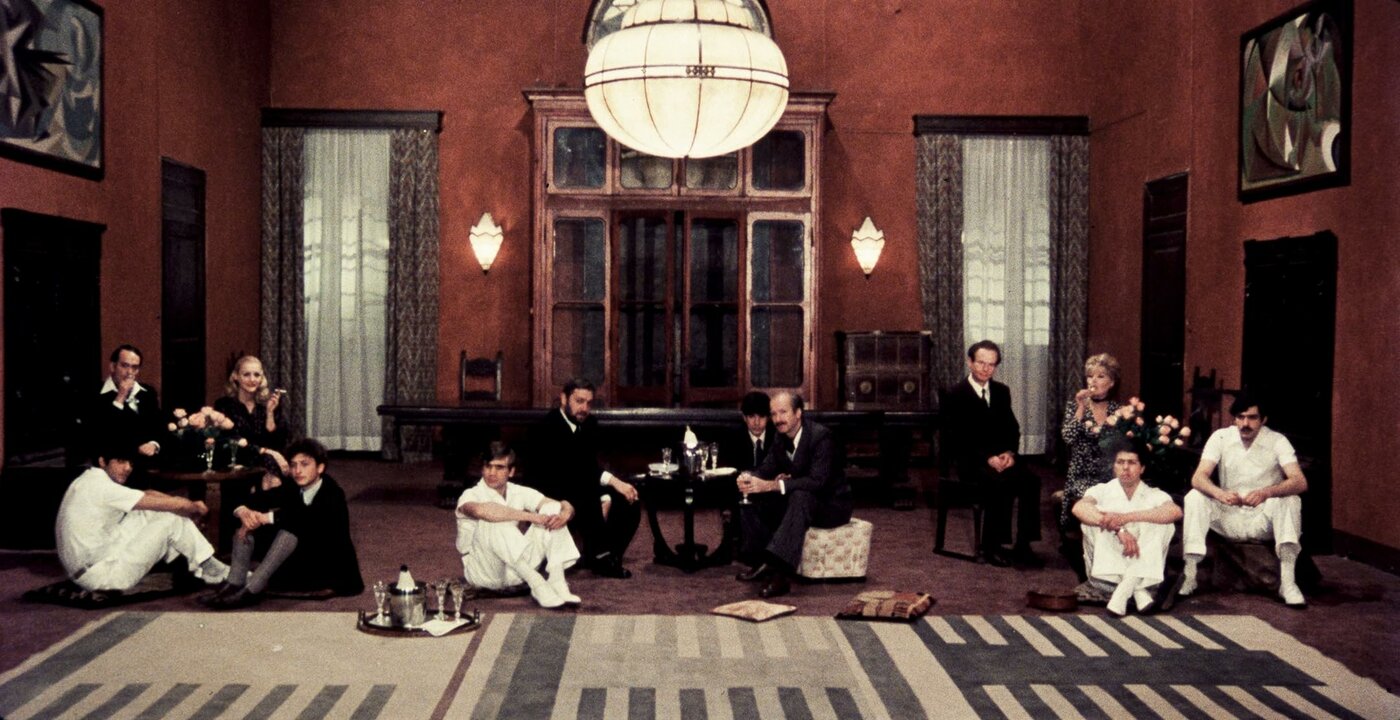
 Salò: Or the 120 Days of Sodom (Pier Paolo Pasolini, 1975).
In 2005, during a television interview in Italy, Giuseppe “Pino” Pelosi—AKA “The Frog”—recanted his confession about murdering Pier Paolo Pasolini on a beach in Ostia 30 years earlier. He claimed that it had been extracted by coercion and threats of violence, against both himself and his family (Pelosi was seventeen at the time). He also said that the legendary director’s death was a political killing disguised as a crime of passion—the premeditated and methodical muzzling of a “Dirty Communist.”
Sergio Citti, a close friend of Pasolini, contributed to the controversy by suggesting that the filmmaker had been lured to the water under the guise of retrieving stolen reels of film from his transgressive—and, as it turned out, valedictory—magnum opus Salò: Or the 120 Days of Sodom (1975)—a savage critique of his homeland’s then-recent legacy of fascist decadence.
“All’s good if it’s excessive,” says a religious figurehead early in Salò, describing both his unchecked fetishism and the M.O. of the film around him. The question of whether Pasolini’s Sadean vision tested the limits of cinematic transgression or transcended them remains open (Buñuel had gotten to Sade first in L'âge d'or [1930]) but the idea of a filmmaker getting too close to the ugly truth about the ruling class and paying for it is more than irresponsible: It’s irresistible. When Stanley Kubrick died before the theatrical bow of Eyes Wide Shut in 1999, the Internet was in its infancy, but whispers of a cover-up persisted—no more absurd, perhaps, than the rumor that Kubrick had faked the moon landing.
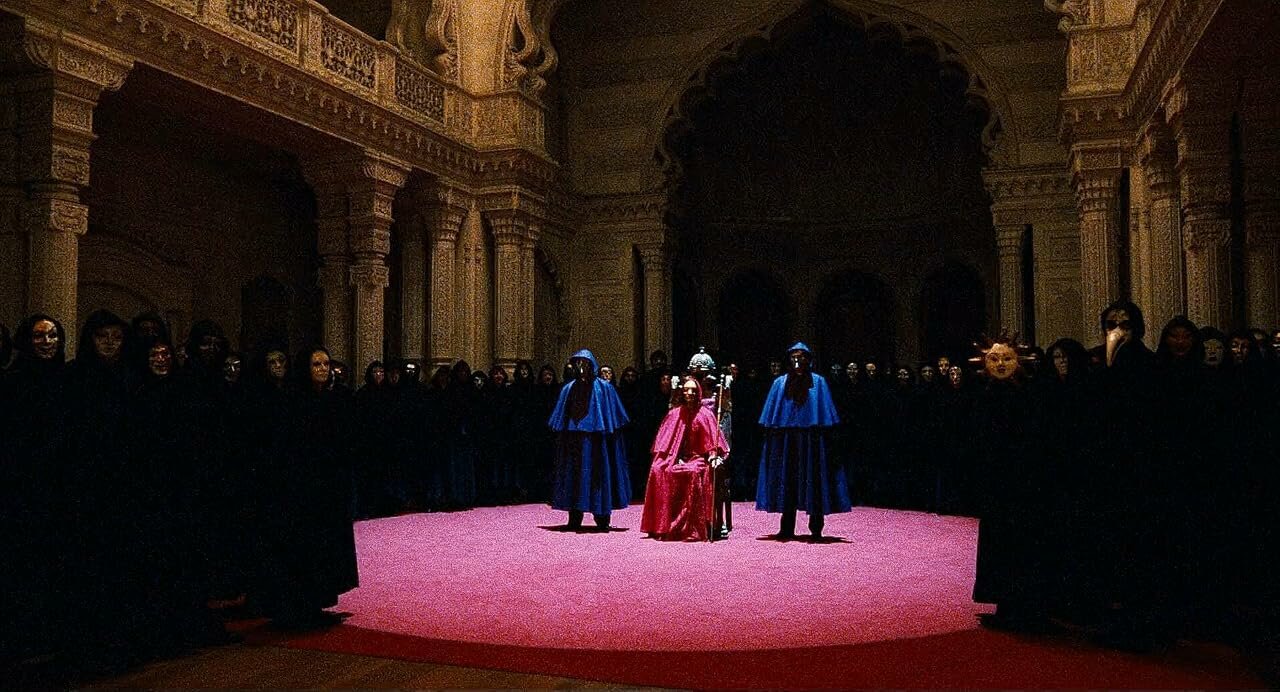
Eyes Wide Shut (Stanley Kubrick, 1999).
On December 19, 2025, the US government released its first major batch of the “Epstein files” to the public, implicating myriad political figures and billionaires in a decades-long global sex trafficking scheme. Despite the overwhelming evidence of a real-life 120 Days of Sodom-situation, not a single US citizen has been arrested in connection with these crimes. Maybe one reason people cling to the myth of artists like Pasolini and Kubrick as tragic, thwarted whistleblowers is that it makes them nostalgic for the possibility that art could actually make a difference. In the 1970s, Pasolini’s filmmaking and journalism represented a viable threat to Italy’s political and religious establishment; by the time Eyes Wide Shut came out, though, Americans had been inundated by allegations of public and private abuse of sexual power by Bill Clinton while his friend Jeffrey Epstein operated an international trafficking empire in the background. “No I’m not going to tell you their names,” says Sydney Pollack’s malign Victor Ziegler to Tom Cruise (playing a different Bill). “If I did, maybe you wouldn’t sleep so well at night”).
The nostalgic view of Eyes Wide Shut as the proverbial last film of the 20th century places it in conversation with one that exists at the primal scene of the 21st. People love to throw around the phrase “eerily prescient” when describing genre works that trade in social commentary, as if filmmakers are different from the other artists who call attention to where things are going. There is nevertheless something retrospectively uncanny about Clifton Holmes’ S.O.V. (Shot on Video) classic In the Dark (2000), which came out of nowhere (Chicago) and predicted something of the paranoid tenor and texture of the decade to come. Surveillance, exploitation, and the link of late capitalism to implacable evil: It’s all there, in 240 fps.
Holmes’ Raymond Laymon adaptation follows—or more literally stalks—Jane (Kim Garrett), a manic pixie dream librarian whose day-to-day life is shaken up by a strange hand-written note stowed in a copy of Thomas Wolfe’s Look Homeward, Angel. Its author, The pseudonymous Master of Games (MoG), promises her a crisp $50 bill if she can follow his clues to the next missive. Lo and behold, Jane does as she’s told. The amount of money is doubled every time as the degree of difficulty—and personal risk—increases. Is our heroine playing or being played? It’s all fun and games until somebody’s being offered up to strangers as a sex slave.

In the Dark (Clifton Holmes, 2000).
This month brings the first ever Blu-ray release of In the Dark from Saturn’s Core, but a case can be made that the film’s spell deepens when viewed on YouTube; the low-quality format bolsters the sense of stumbling upon something not meant for consumption. In the Dark feels like a movie that MoG recorded and uploaded himself; Holmes’s aesthetic recalls detective Danny Upshaw’s man-camera technique in James Ellroy’s novel The Big Nowhere in the way it puts the viewer in the driver’s seat (we’re bracing for the crash). MoG exploits Jane, but he also employs her, quite literally by paying her more and more for each stunt. She’s freelancing! But soon Jane joins in on her own exploitation, writing messages on her own body and trying to surveil her own watcher, only to find a message left inside of her; pre-dating the OnlyFans comments and requests model in its own sick way. Soon her own participation turns from gleeful to compulsory. The only way out is to become an MOG herself—to climb the corporate ladder. Her reward resembles nothing so much as the proverbial corner office—a room of her own in a luxurious downtown skyrise. She has her own Jane to boss around; the building’s vastness implies that each of her neighbors has become a Master themselves. The dirty little conspiracy launched in that library is nothing more—or less—than a pyramid scheme.
In the Dark is one of one, but it also laid a foundation—modest but solid—for a distinctly millennial subgenre predicated on the same contradictions between social collapse and elite control explored in Salo and Eyes Wide Shut. In these films, more things fall apart below a certain level, the tighter the grip grows at the top. Call it cabal-core, where evil lurks behind closed doors, embedded into the language, structure and aesthetics of bureaucracy itself. (A goofy Hollywood precursor: Taylor Hackford’s The Devil’s Advocate, [1997], itself a parody of Rosemary’s Baby [1968]). If In the Dark doesn’t literally depict corporate environments or characters, it nevertheless approximates and weaponizes the logic of late capitalism; it’s structured as a series of revelations exposing a massive sex trafficking operation of girls and young women. Holmes’s roughness is a byproduct of his low budget, but the use of surveillance-style perspectives anticipates other entries into this unofficial but suggestive microgenre, as does the refusal of closure or catharsis. In cabal-core, the Big Bad is never defeated; instead it subsumes our day-to-day. Nothing Ever Happens.

Demonlover (Olivier Assayas, 2002).
Our final glimpse of Jane in In the Dark, as a brainwashed plaything wielding a controller, is sobering; the cinematic rabbit hole would only get deeper from there. Master of Games, meet Mangatronics; Oliver Assayas’s nice ’n’ sleazy 2002 film Demonlover puts us in the middle of a twisted web made up of multinational corporations whose portfolios include soft-core pornography and possibly also snuff cinema. Diane de Monx (a steely Connie Nielsen), a lupine exec at Volf Corporation, will do just about anything to further the agenda of whoever’s payroll she is on, even if it means killing a higher-up at Demonlover, Mangatronics’s main rival. During the course of her adventures—as indebted to the erotic espionage of Feuillade as Irma Vep (1996)—she discovers that Demonlover is a front for the Hellfire Club, a dark-web site that creates made-to-order torture porn—but that’s just business.
Once Diane is caught for selling corporate secrets and sabotaging deals (and murdering Gina Gershon, a terrible crime indeed) her punishment is a fate worse than death: donning latex and starring in superhero movies. Well, I’m half-kidding. Having gotten rich (and gotten off) on trafficking women, she becomes the product, a helpless fetish object on offer for anybody with a credit card and the gumption to open an onion browser. Which begs the question—is it actually more ethical to ask Grok to generate some “shipper porn” than it is to go to “starznaked.com”? Inquiring minds want to know.

Kill List (Ben Wheatley, 2011).
Where Demonlover connects us to the future, Ben Wheatley’s 2011 folk-horror inversion, Kill List, is a bridge to the past. The British director’s sophomore feature draws deeply from the imagery of the UK folk horror urtext, The Wicker Man, to elucidate a contemporary set of horrors. Two British Iraq war veterans, Jay (Neil Maskell) and Gal (Michael Smiley), are at a career crossroads. A few years removed from the war that brought them together, they’ve found themselves employed as hitmen; their softer bodies not getting in the way of their usefulness as hardened killing machines. Gal’s mysterious new paramour, Fiona (Emma Fryer), explains over dinner one night that her line of work is “human resources,” and that she explicitly deals with managing “extraneous manpower.” Fiona’s all-business persona really grinds Jay’s wife Shel’s (MyAnna Buring) gears, drawing comparisons over lamb chops to Nazi Germany, especially when the guest also admits she doesn’t identify with the cause of Irish liberation. Jay and Shel, and to a lesser extent Gal, are positioned in opposition to Fiona, as workers (and small business owners!) in fear of being seen as fat to be trimmed from the whole operation.
Kill List is divided unevenly and erratically into four chapters, and in its third, we get a glimpse at the Lord Summerisle that we unfortunately deserve. The string-pulling millionaire billed as the Client (Struan Rodger) somehow looks like a Joe Biden/Donald Trump hybrid puppet right out of Spitting Image. Toward the end, Jay and Gal lie in wait for their final target, only to stumble upon a scene straight out of a QAnon fantasy of Bohemian Grove—a virgin girl being sacrificed on an altar of pound notes. Except The Client is not honoring paganism in the face of rapidly spreading Christianity—he’s the very man who hired Gal and Jay in the first place. They were not sent to stop a ritual; they were sent to be part of it, in possibly the most twisted layoff meeting ever imagined. At the heart of both Kill List and Demonlover is some sort of corporate conspiracy related to the violent and sexual exploitation of women—between the Hellfire Club’s pixelated misogynist fantasia and “The Librarian’s” massive archive of homemade samizdat, including some implied kiddie porn—we have two complementary, cautionary fables stories of cogs being eliminated for grinding too close to the truth.

Bastards (Claire Denis, 2013).
In Claire Denis’s Polanski-ian 2013 neo-noir Bastards, sturdy seaman Marco Silvestri (Vincent Lindon) returns home to Paris to help his sister recover from her husband’s mysterious suicide; he means well, not that it matters. The double-dip recession facing Europe in the early 2010s looms over the story like a Biblical plague, infecting everyone and everything except those who deserve it. At first blush, the motivation behind the suicide is the dearly departed indebtedness to an Epstein-like monster. It turns out the collateral was his daughter, and after an extended fugue of carnage, we get a cosmic and incestuous miscarriage of justice à la Chinatown (1974). From its title on down, Bastards vibrates with rage at individuals and systems—patriarchy distilled into an epithet. Denis’s detached, surveillance style of shooting—her first film on digital, less voluptuous than the vampirism of Trouble Every Day (2002)— and climactic reveal of a repurposed corncob would make Chekov (or its literary source, Faulkner) blush. “Put your love in me,” pleads Stuart Staples on the soundtrack, a perfect and perfectly horrible needle drop in a movie where everything has been perverted.
Bastards essays helplessness; Lynne Ramsay’s You Were Never Really Here (2017) imagines a vigilante in order to orchestrate a happy ending: Joe (Joaquin Phoenix), a traumatized veteran who specializes in rescuing sex-trafficking victims. His latest assignment is Nina (Ekaterina Samsonov), the young daughter of US senator Albert Votto (Alex Manette). She’s being held in a makeshift brothel in the middle of New York City; figuratively if not literally near 9 East 71st Street. Ramsay’s adaptation of Jonathan Ames’s novel is grounded and even realistic: Joe has a cellphone, a boss, a handler, his mother to take care of, and the severe PTSD and suicidal ideation that plague his every waking moment. His home is not an aspirational Parisian flat, or even a picturesque British cottage; it’s strewn with family photos and the soapy footprints Joe’s mother leaves behind when she forgets how to bathe herself.

You Were Never Really Here (Lynne Ramsay, 2017).
Joe’s work is very specialized, but he is wage-dependent; at the same time, it seems that enacting extreme acts of violence upon the people who make the world sick is the only thing that keeps his demons at bay. He rescues Nina fairly early into the film, which points to the other shoe waiting to drop: she is not who we think she is. The revelations come to the viewer via background information (the TV news, secondhand confessions), giving the conspiracy of high-level child-sex trafficking a larger-than-life shadow. That shadow hangs over Ramsay’s narrative affairs, encircling every innocent who had the misfortune of being tangentially involved in Joe’s life. He prepares to go rescue Nina a second time, but we are denied the satisfaction of seeing her captor pay for his crimes; Joe arrives on the scene after Nina has already taken matters into her own hands, the cavalry coming in too late; their bloody victory over the bad guys yields neither catharsis nor change, but further visions of self-annihilating despair.
Ari Aster’s polarizing COVID-western Eddington (2025) positions Phoenix yet again as a man on a mission named Joe: not so much the dapper, white-hat sheriff, but an impotent cuck-in-waiting. The film has one foot grounded (maybe too) firmly in COVID-era reality—“hindsight is 2020,” goes Aster’s tagline—and another in the filmmaker’s signature heightened, penny-dreadful comic-book world, yet it somehow feels like the truest representation of the pressure-cooker that was the USA at the height of the pandemic. Again, Sheriff Joe Cross is not the hero we want, but he is probably the one we deserve; having proven ineffectual in his own life—as a husband, a lover, and a boss—he is determined to become a transformational figure. Dismayed by mandatory masking and jurisdictional red tape, he decides to run for office, positioning himself opposite (and to the right) of the town’s handsome, neoliberal cipher of a mayor (Pedro Pascal). Joe’s wife (Emma Stone) isn’t turned on by her husband’s initiative; she’s repulsed even more by his exploitation of her mysterious sexual trauma as a stump speech. She duly runs out on him for the enigmatic, Svengali-esque cult leader Vernon Jefferson Peak (a delightful Austin Butler), who works his magic on her and everyone else in his orbit. One of the tricks up his sleeve: the invocation of ritualistic child molestation as a motivator—a plot point Aster jams into the movie like the wedge issue it is. Vernon exploits those around him using (likely false) memories of having been hunted for sport as a child by powerful men in DC—the same tactic that many at the front of the QAnon movement use to manipulate their base while keeping them from sympathizing with the actual adult women who are also victims of trafficking.

Eddington (Ari Aster, 2025).
Vernon and the Client in Kill List should exchange numbers, but he isn’t Eddington’s Big Bad. The real specter looming on the horizon is the SOLIDGOLDMAGIKARP Data Center, in whose name the ensuing horror unfolds. The citizens don’t even notice—they’re too busy taking their cues about the protest from CNN. Joe assures the constituency that Black Lives Matter but also that the fact that some people aren’t sure about that isn’t his fault, specifically; he’s a perfect, unwitting fall guy for the crisis actors masquerading as Antifa supersoldiers, deployed to Eddington to ensure the data center’s erection. Like Kill List, Eddington transforms late into a kind of war movie (crossed with a stand-off western as per the New Mexico backdrop), and Aster shoots these conflicts as plausibly schizophrenic: The enemy is faceless, prolific, and omnipotent. No matter how valiantly Joe fights his unseen opponent (staged like a Looney Tunes climax), it’s no use. He’s shot up, stabbed, and paralyzed, a combination scapegoat and sacrificial lamb; the real winner is a local failson who arrives on the scene in time to get off a single lucky shot and become Kyle Rittenhouse. (Aster’s next movie is supposedly about Charlie Kirk.) Actually, Joe does win: he becomes mayor, living in a state of mute paralysis, unable to even cut the ribbon on the data center. A Pyrrhic victory: Joe gets what he wants because they get what they want.
Aster surely loves his secular and sacrilegious rites: one of the ancient pagan rituals not wiped out by Christianity and modernity is that of the sin-eater. The sin-eater is meant to fall on the sword for the sins of another in a metaphorical act of absolution. For instance: Mussolini’s death was a huge turning point in the war for a free Italy, but more importantly it was a massive symbolic win: a public bludgeoning of an effigy of Italian fascism. Of course Il Duce was not the only one responsible, but at the very least the face of the party was hanged. It appears that our sin-eaters for the crimes of Jeffrey Epstein are Ghislaine Maxwell and certain others as we have been denied the satisfaction—however brutal— of watching Jeffrey Epstein face any semblance of justice.
It seems at this point we will be denied watching any of his other co-conspirators receive anything close to adequate punishment either. Certainly one thing each of these filmmakers is doing is attempting to make some sort of sense of this darkly farcical landscape we’ve found ourselves in. At this point the (business side of the) art is imitating that morbid side of life. Movies are not banned from wide release (like Ken Russell’s recently restored The Devils was originally in the US) due to their content, but instead due to their being a tax write-off rather than a viable theatrical success (welcome back, Coyote vs. Acme). This week, news of the Paramount/Warner merger’s passing emerged—a Faustian bargain for those of us living in California, and in truth just one among many, in an industry whose fingers are in everything and rarely clean. But what can you do? You can put your head down and doom-scroll through it; if you’re Paul Walter Hauser, you can wear a “KUBRICK DIDN’T KILL HIMSELF” T-shirt to a premiere. Perhaps art doesn’t have the power to cut an empire down at the knees anymore, but there’s still something to be said for movies that have teeth and use them to bite you know what. Rage is a powerful tool, and at its best cabal-core channels that feeling, beyond comfortable numbness or fashionable despair. There’s something at stake in these movies, burning or otherwise; a flicker of resistance in the dark.