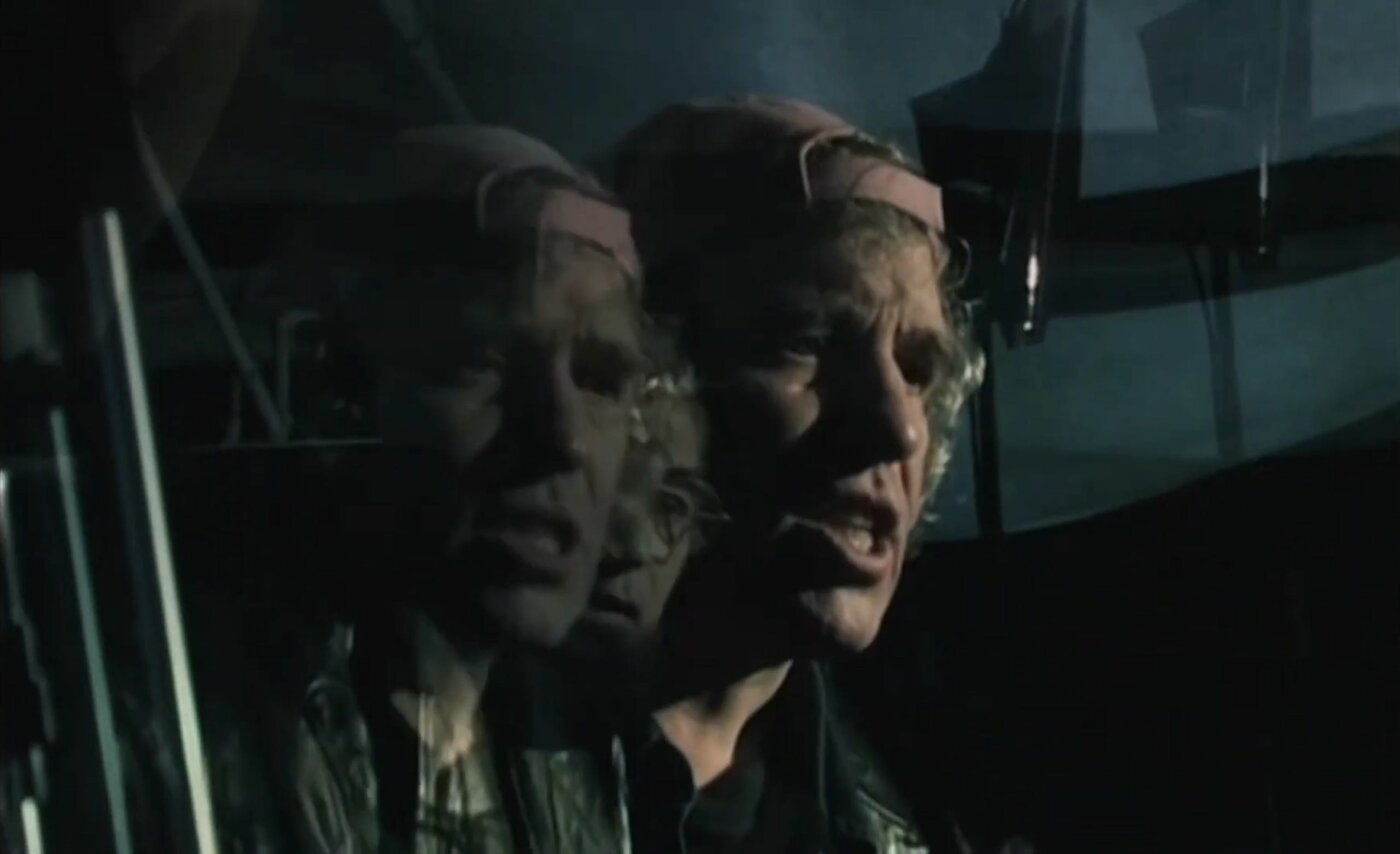
Abel Ferrara: Not Guilty (Janine Bazin and André Labarthe, 2003).
For Closed on Account of Rabies (1997), a multi-artist tribute to Edgar Allen Poe, Abel Ferrara was recorded reading “The Raven” at St. Ann’s Church in Brooklyn. The event took place sometime between the production of The Blackout (1997) and that of New Rose Hotel (1998)—two films typical of the director’s ’90s fog of heroin and regret. His interpretation of the poem is loose, interrupting Poe’s driving rhythm with adlibs (“Lenore, baby… Who is this Lenore, man?”). One assumes that this is why it’s the only track marked as an “excerpt.” Partway through the “Rehab” chapter of Scene, his new memoir, Ferrara describes the writing of Herman Melville clicking for him in ways it never had before during his recovery in 2014. “Poe,” on the other hand, “started not working for me.” An alcoholic himself, Poe wrote about the inexorable return of repressed desires, a trope that might contradict sobriety’s mandate to keep certain urges at bay.
A memoir from the safer shores of sobriety is a tried and true venue for celebrities seeking absolution, if not always a guarantor of literary merits. Russell Brand’s Freedom (2017), comes to mind, as does No Malice’s first born-again LP, Hear Ye Him (2013). Among Ferrara obsessives, the broad strokes of the director’s working life are well known: his beginnings directing pornography; the junkie decades that yielded his most famous films; the 1996 Conan O’Brien interview in which he itches and slurs, lurching back and forth in his seat; and, most remarkably, his sober period commencing in the 2010s. He’s been the subject of a number of documentary pieces. From what is certainly the most expletive-laden episode of Cinéastes de Notre Temps, “Abel Ferrara: Not Guilty” (2003), to the comparatively chaste, Yves Saint Laurent–financed Sportin’ Life (2020), we have had ample opportunity to look behind the music. But with its generic obligation to organize one’s life—separating the present teller from the past liver, compartmentalizing personal history into discrete episodes—a memoir accords well with the basic demands of sobriety: There’s an old me and a new me, places I can’t go anymore, friends I can’t see.
The great virtue of Ferrara’s cinema, however, has been his unwillingness to make these separations. When a professional porn actor “couldn’t get it up” on the set of 9 Lives of a Wet Pussy (1976), the crew drew straws and, as Ferrara recalls in Scene, “I got the short one.” Director became actor. His interpreters frequently return to this fundamental truth: In Ferrara’s films, every boundary will dissolve. In the landmark monograph Abel Ferrara: The Moral Vision (2004), Brad Stevens writes that in Ferrara’s films “the constant state of moral and emotional flux [is a] prerequisite for the achievement of full humanity.” I think of the cross-cutting in Body Snatchers (1993) between the various half-formed doppelgängers, prompting Nicole Brenez to ask, “Why risk such incoherence?” In Ferrara’s work, every division is bound for collapse. Describing Ms. 45 (1981), Tag Gallagher writes, “Ferrara seems to be saying...that no one is free from what Simone Weil calls the ‘gravity’ of human society, in which beauty becomes pain, love becomes violence, dignity becomes brutality.”
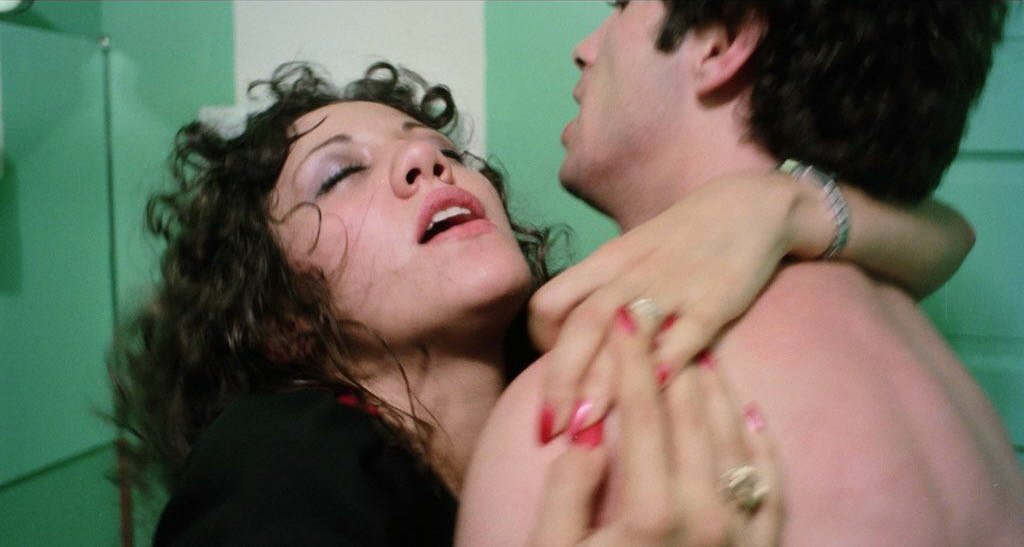
9 Lives of a Wet Pussy (Abel Ferrara, 1976).
As the 9 Lives episode makes clear, this state of flux is not merely a thematic concern but Ferrara’s baseline for operations on set. Vincent Gallo once alleged that Ferrara was too busy smoking crack in his trailer to direct The Funeral (1994). Zoë Lund would only shoot her monologue in Bad Lieutenant (1992) stoned, with the heroin needle hanging out of her arm. One often gets the sense in the director’s pre-sobriety films that the anarchy reigning in front of the camera is a direct extension of the anarchy behind. The curious omission of Dangerous Game (1993), The Blackout (1997), and Go Go Tales (2007) from Scene would seem to suggest some stories still cannot be told, if they can even be remembered. Ferrara’s recollections of New Rose Hotel, however, document a behind-the-scenes drama that precisely mirrors his film.
New Rose Hotel’s tech-future setting is almost irrelevant: It’s a film about the courtship of Willem Dafoe (as X, an obvious proxy for Ferrara) and Asia Argento (as Sandii, an obvious proxy for herself). In William Gibson’s ten-page neo-noir story that serves as the film’s source material (Ferrara describes it well: “Every word counted and the sum was infinite”), X trains Sandii in the art of seduction in order to lure the scientist Hiroshi from one tech firm to another. Inevitably, Sandii’s sexuality is not to be contained by X’s tutelage nor, of course, his love.
Off-camera (though sporadically captured in Argento’s 1998 making-of documentary, Abel/Asia), Argento had fallen in first with Dafoe, and then with Ferrara himself. Their necessarily secret relationship quickly became violent and desperate. When it came time to shoot X and Sandii’s sex scene, Ferrara stormed off set. New Rose Hotel ends with X replaying his relationship with Sandii on loop in his mind, masturbating alone in an airport pod hotel, wondering where he went wrong now that she’s disappeared with Hiroshi. The film’s shoot ended with Argento disappearing before Ferrara’s planned airport marriage proposal. Later, he discovered that she had gone to meet Vincent Gallo for the premiere of Buffalo ‘66 (1998). The frame’s border is an especially dubious boundary in a Ferrara film, and never more than here. His characters are extensions of himself, his sets extensions of his life. The choice to risk such incoherence may not be a choice at all.
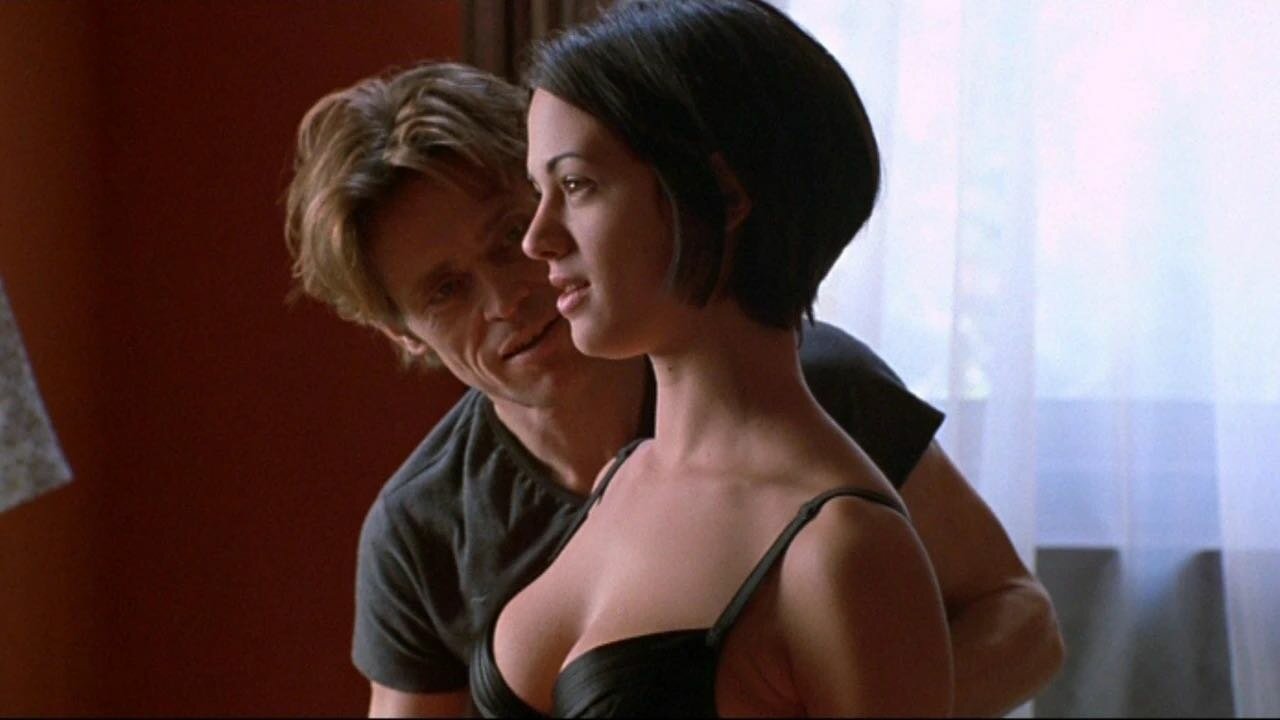
New Rose Hotel (Abel Ferrara, 1998).
The New Rose Hotel chapter of Scene, like the film itself, is suffused with regret and irresolution, impeding the addled teller’s tale at every turn. The revelation, as Ferrara writes, that “Asia is in recovery with me now,” concludes the chapter like a splash of cold water to the face. Indeed, Scene is peppered with these intrusions from a more somber, sober Ferrara into his junkie’s memory, like the edge of a mirror creeping into the frame. A closer metaphor from Ferrara’s own cinema might be the aforementioned sequence from Body Snatchers, wherein biologically half-formed replacement selves gestate under every bed, threatening to crash through every ceiling. The 9 Lives chapter concludes with him writing, as if his father stood over his shoulder: “My mother raised me to respect women and respect myself, and in this film we crossed that line.” By the time he’s approaching Bad Lieutenant (in a chapter simply called “Crack”) his grip on the pen seems to have tightened considerably. Following a set of instructions for burning a crack rock in a spoon, he ends the paragraph: “Don’t try it. Don’t even think about it. Rip this page out of the book and burn it.”
And yet, rather than impede his junkie-Proust’s cascade of memories, these windows to the future contribute to the play of light and shadow in Scene, dissolving the space between the memory and the rememberer. Nearing his rock bottom around the time of ‘R Xmas (2001), one can sense Ferrara’s Buddhist nonattachment straining under the weight of too many regrets: “Today I can make amends to my daughter Endira ... but Lucy does not speak to me or her mother. I can understand why. I can only hope one day that will change.” That sobriety is a battle you fight every day—one piece of received wisdom among many available to those in recovery—is realized with startling clarity on Scene’s every page. When, after a number of sordid episodes, he finally washes up sober in Paris, one feels a healthy exhaustion descend like a kiss of forgiveness. He writes: “I lay down in bed in the Marais and slept the sleep of a normal person.” When Ferrara finally gets to the well-worn “Inside you there are two wolves…” maxim, rather than scoff, I shivered.
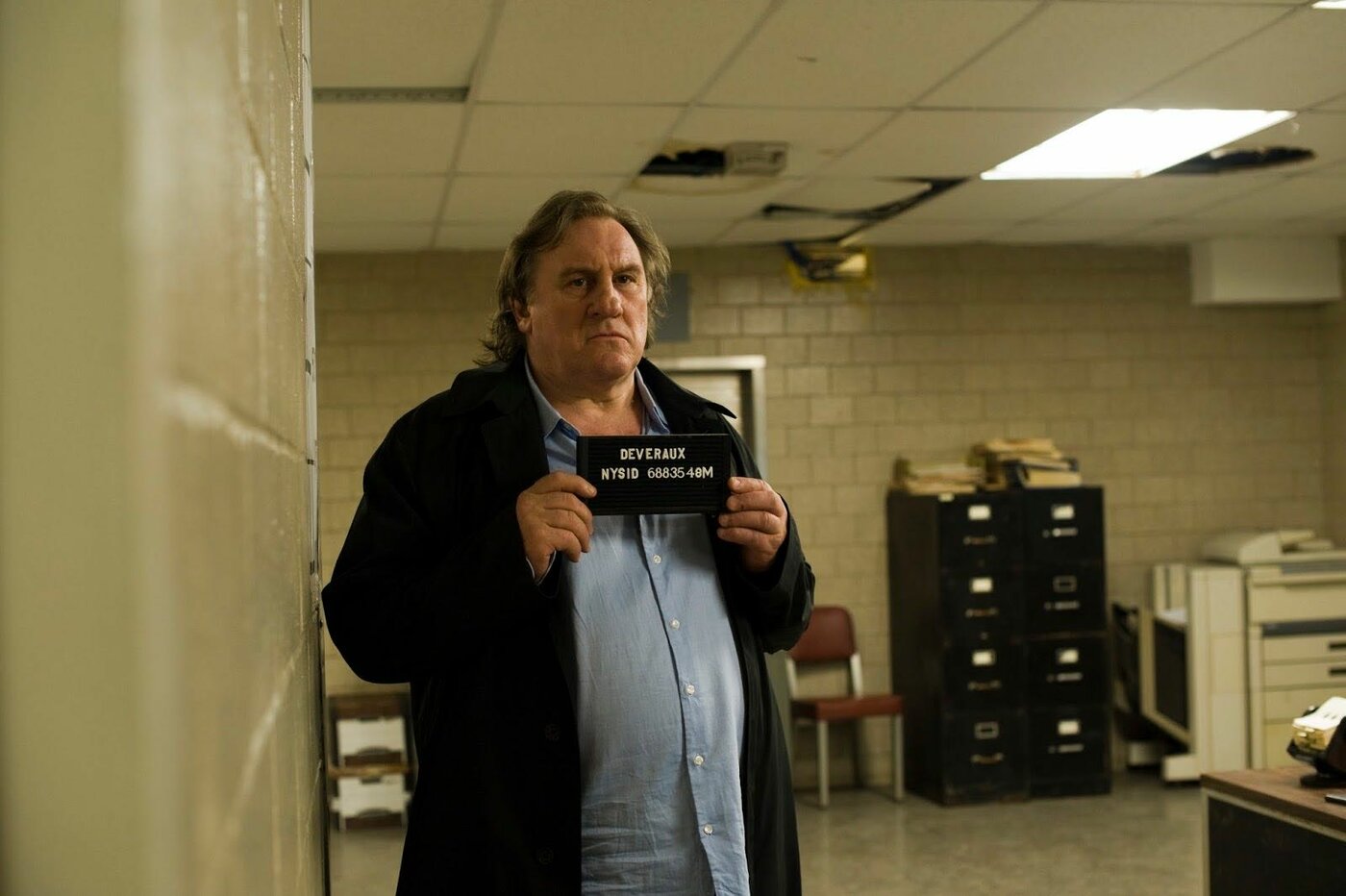
Welcome to New York (Abel Ferrara, 2014).
Ferrara bounces between decades in Scene, the nonconcern for linearity apparent since Dangerous Game evidently unaltered by his sobriety. Welcome to New York (2014), his first work out of rehab, earns three chapters spread across the book’s conclusion, jolting back and forth in time. Meeting the film’s star, Gérard Depardieu, deep in the throes of alcoholism, he hears about the early death of the actor’s son, Guillaume, after a long struggle with heroin addiction. “Gérard never gave up hope that his son would somehow make it through,” Ferrara writes. Pages later, he’s waxing romantic about a friend walking out into a blizzard to hitchhike to Binghamton for a screening of Pasolini’s Accattone (1961): “He left with a baggie of cheap pot and a jug of even cheaper red wine stuffed in his shoulder bag.” There’s no rise and fall to structure Scene; highs and comedowns are blurred past the point of recognition. “Why some of us make it and some of us don’t is unknowable,” Ferrara admits. Gérard’s struggles would compound after their meeting; within a year, Ferrara would be directing his own Pasolini biopic.
A force of gravity tugs mightily on every sober day, and Ferrara’s effort to stand upright, even as he plunges headfirst into the past, lends his memoir its strange, discordant harmony. His reality may have changed, but his commitment to it has not. If Poe has stopped working for him, it’s because he now lives with his guilt and regrets in center frame.