
The Action Scene explores the form, history, and visceral power of action cinema through its set pieces.
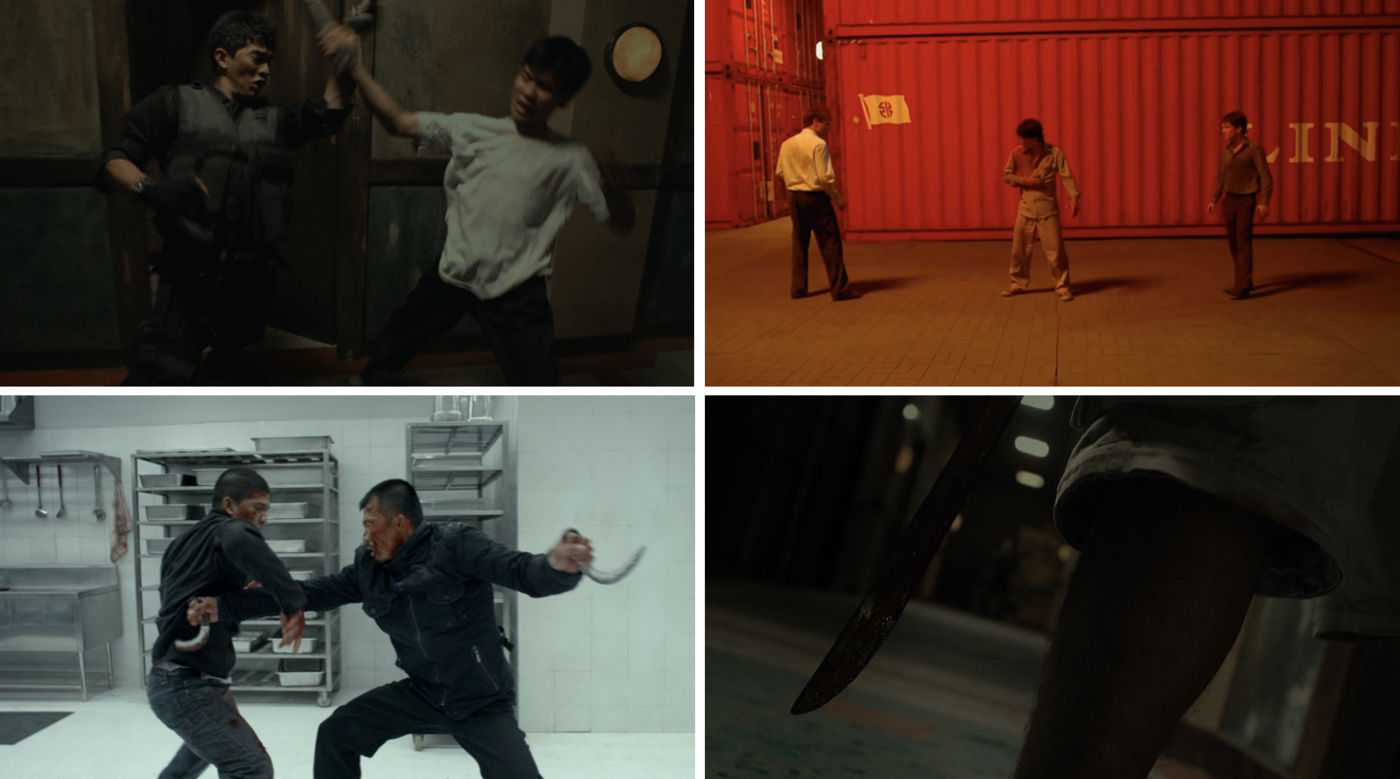
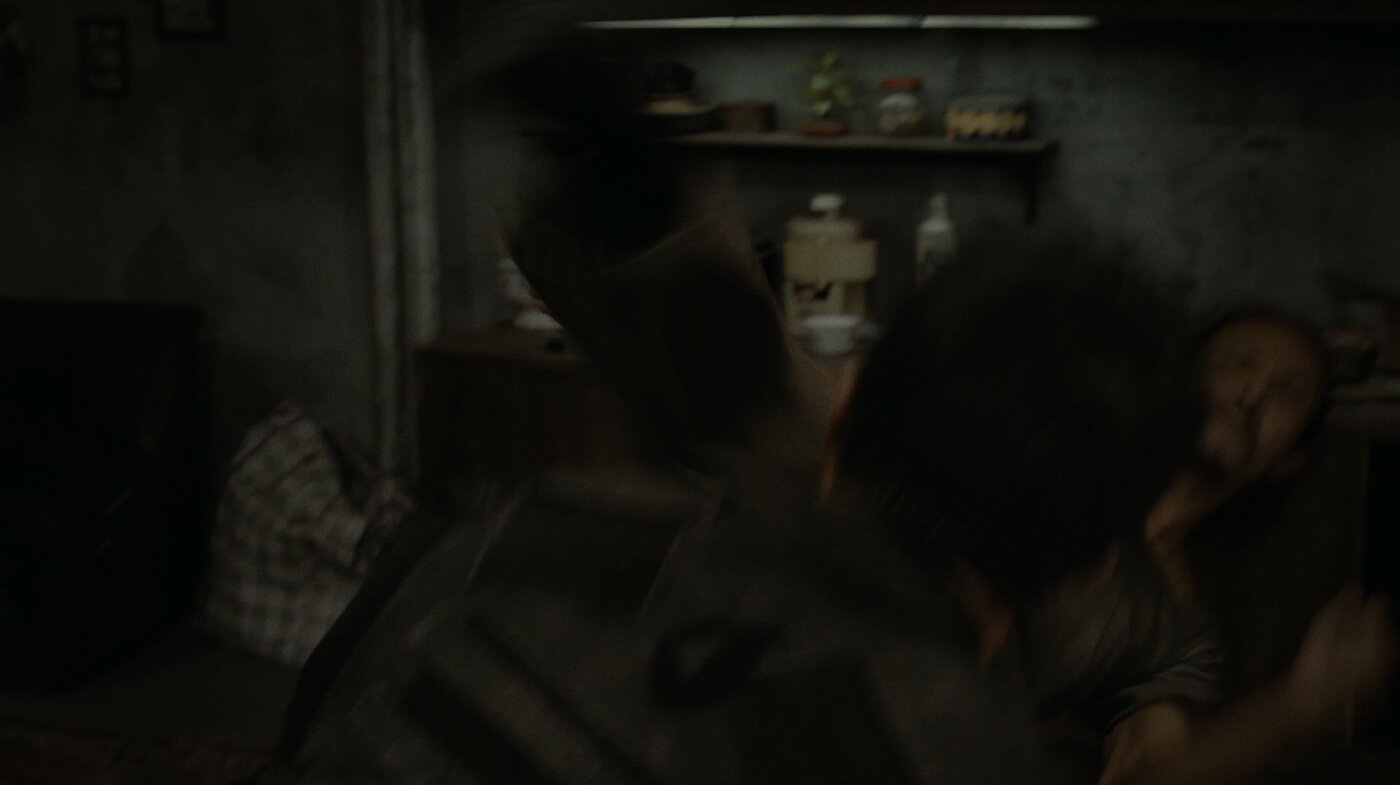
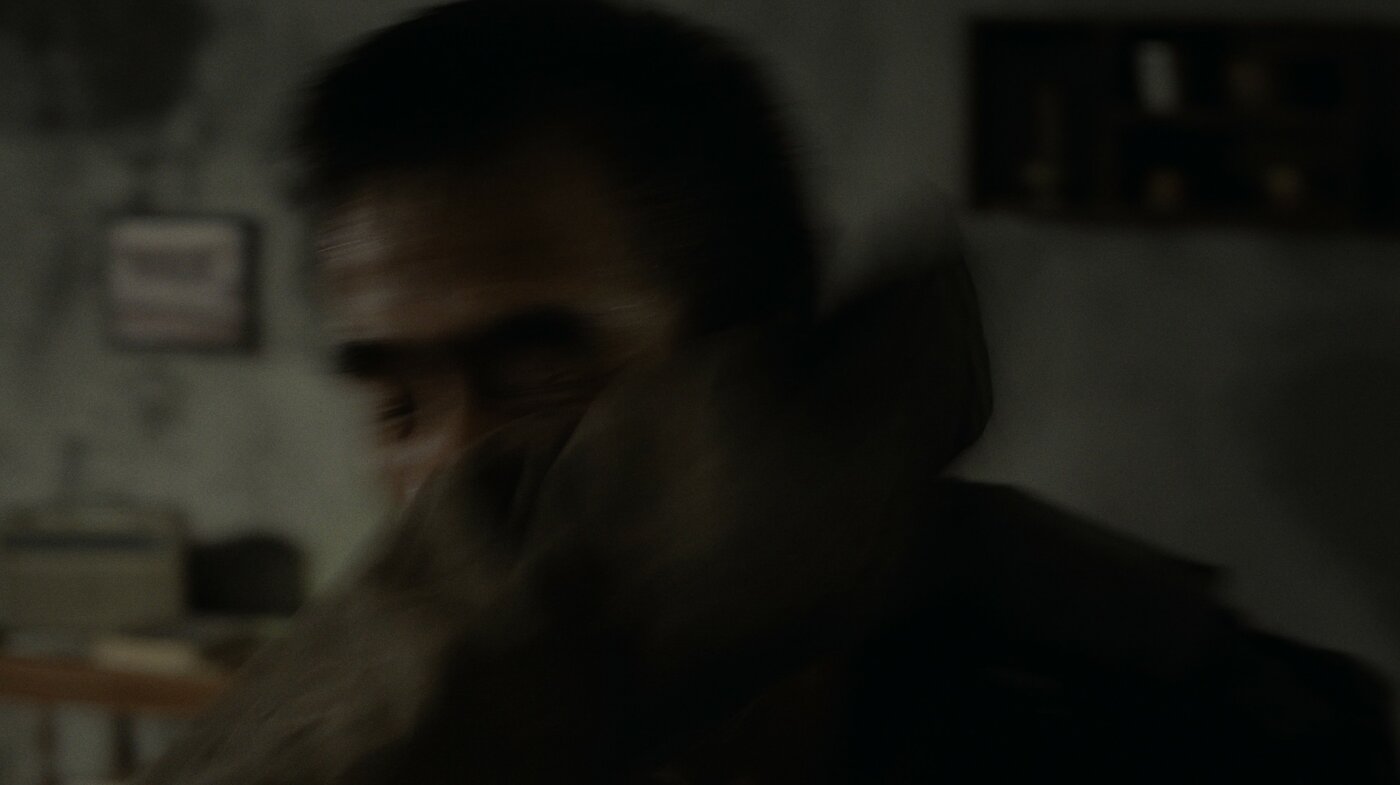
Clockwise from top-left: The Raid (Gareth Evans, 2011), Merantau (Gareth Evans, 2009), The Raid 2 (Gareth Evans, 2014), The Raid (Gareth Evans, 2011).
It needs virtually no introduction. Fifteen years after its world premiere in the Midnight Madness section of the 2011 Toronto International Film Festival, The Raid (2011) has so shaped the landscape of contemporary action cinema that it’s birthed its own prepositional descriptor: “like The Raid” adorns sundry headlines to describe any action film featuring some combination of a single-location setting, gritty atmosphere, barbarous bloodletting, and no-holds-barred mixed martial arts. The film’s seismic success—along with that of its sequel—jump-started global interest in its director, its stars, Indonesian action cinema, and, building on the popularity of Thai martial arts movies from the previous decade, Southeast Asian action cinema more generally.
It all began in 2007 when Welsh director Gareth Evans, shooting a documentary in Indonesia on the local martial art pencak silat, visited a silat school in the province of West Sumatra specializing in Silek Harimau, or “Tiger style.” Impressed by the physicality and presence of one of the students, Iko Uwais, Evans approached him with an offer to make a movie. Conceived and pitched to financiers as a vehicle for “reclaiming” silat and launching Uwais as a star, their first project, Merantau (2009), marked a pointed departure from silat’s local association with cheap, antiquated, often fantasy-based and VFX-infused television programs.1 Centering on the indigenous tradition of “merantau,” in which young men leave their families to venture out into the world, acquiring experience and knowledge, the film aimed for a certain authenticity, rooting its choreography in actual Silek Harimau moves and their practical application. Despite moments of extravagance—for instance, a high-fall off of construction scaffolding filmed in a single take, the floatiness of the descent exposing the use of wires—the fight scenes are largely grounded, eschewing the acrobatics seen in other martial arts pictures.
Iko Uwais and Yayan Ruhian fight using Silek Harimau in Merantau (Gareth Evans, 2009).
As a screen-fighting form, silat’s movement profile comprises what Evans describes as an interplay between “fluidity” and “aggressiveness”—between flowing maneuvers and sharp contact points,2 Silat’s percussive snapevokes the knee- and elbow-heavy Muay Thai and Muay Boran popularized by Tony Jaa—a key predecessor for Uwais as a Southeast Asian martial arts star who broke onto the international scene. But whereas Jaa’s fight scenes from the 2000s often decelerate dramatically around big stunts—slow-motion and overlapping editing, which replays part of the stunt from a different angle, appear in abundance—Merantau displays an aesthetic of perpetual motion, each strike flowing into the next with minimal pausing or posing between hits. In an interview about The Raid 2 (2014), Evans notes how he and his team “never loop[ed] a shot, showing it more than once. [It was] only that one moment and in real time”3—a practice that emerged almost fully formed with Merantau.
Unable to get funding for his second, more ambitious film, which would go on to become The Raid 2, Evans pitched The Raid as an interim project, the now-legendary single-location premise initially proposed as a cost-saving device. The Raid intensifies—and reworks—Merantau’s principles of realism and perpetual motion when a police squadron is tracked as it raids a drug lord’s apartment complex, and the officers are forced to fight for survival when discovered. Once more, there is minimal slow motion and overlapping editing, generating the impression of a real-time onslaught (“it’s just ‘attack, attack, attack’”4). Silat does appear, but as part of a medley of other martial traditions; for example, the squadron captain Jaka, played by national Judo champion Joe Taslim, executes grappling and throwing maneuvers that play to the actor’s strengths. If Merantau’s realism references an existing archive of silat moves, The Raid’s realism feels more “universal,” subordinating “proper” martial arts form to the desperation of a kill-or-be-killed scenario, in which any maneuver from any tradition is fair game if it helps the fighter survive. This universalism was carefully orchestrated; in Uwais’s words, “we concentrated on making a silat movie that we could export to other countries.”5 Although still a platform for spreading awareness for silat and Indonesian culture, The Raid minimizes a focus on silat’s relationship to local tradition and national heritage, leaning instead into action-movie iconography that would be legible to an international audience.
Synergy between camera, cutting, and choreography in The Raid (Gareth Evans, 2011).
Among the film’s most celebrated realist flourishes is the handheld camerawork by cinematographers Matt Flannery and Dimas Imam Subhono, which sprints the tightrope between clarity and chaos. Indebted to the Jason Bournemovies directed by Paul Greengrass and the broader 2000s trend for frenetic, “documentary-style” cinematography (Evans has also cited Romain Gavras’s 2010 music video for M.I.A.’s “Born Free” as a primary influence6), the camera pitches from room to room alongside combatants, conferring a sense of breakneck immediacy. However, unlike the Bourne films and their offshoots, in which the combination of jumpy editing and unsteady framing often transforms the image into an impressionistic frenzy, in The Raid choreographic beats are clearly communicated through clean continuity editing, emphatic insert shots, and gaze-directing tilts and pans, sustaining a sense of geography and intricate cause-and-effect. This balancing act incorporates the best of both worlds: the immersiveness of the embodied camera, which seems to place the viewer in the scene (a pseudo “first-person,” more “subjective” kind of perspective), and the vicarious thrill of seeing other bodies do extraordinary things (a “third-person,” more “objective” type of presentation).
There are moments in the movie when filmmaking and choreography seem to alchemically fuse, as if each were tailor-made for the other. Multiple examples appear in a brawl between Taslim’s Jaka and the drug lord’s top enforcer, Mad Dog (Yayan Ruhian, a silat instructor and demonstrator who makes a brief but memorable appearance in Merantau). The fight commences with a fusillade of blows, captured in medium shots. Cut to a split-second wide shot of Mad Dog launching himself in the air, his momentary weightlessness underlined by the frame opening up, inducing a similar feeling of airiness and levitation in the viewer. Once contact is made, the shots tighten and accelerate again, as if bombarding us with blows as well. Seconds later, a three-shot combo shows Jaka ducking low in frame to evade Mad Dog’s punch (first image below); Mad Dog kicking toward the camera as Jaka dodges frame-left (second image); in the same shot, Jaka ducking again to evade Mad Dog bending his leg back (third image); then Mad Dog extending his leg into another kick (fourth image), which connects with Jaka’s face in close-up (fifth image).
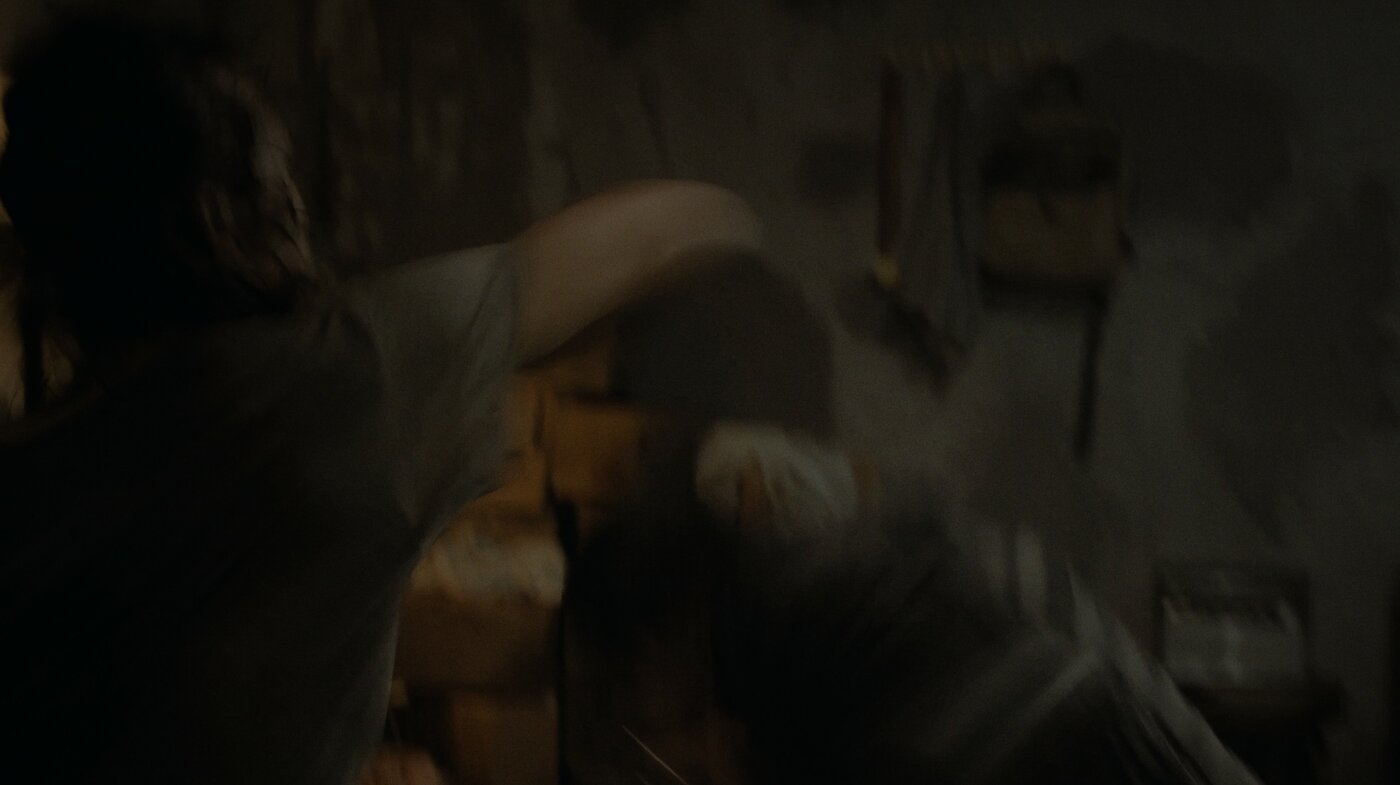
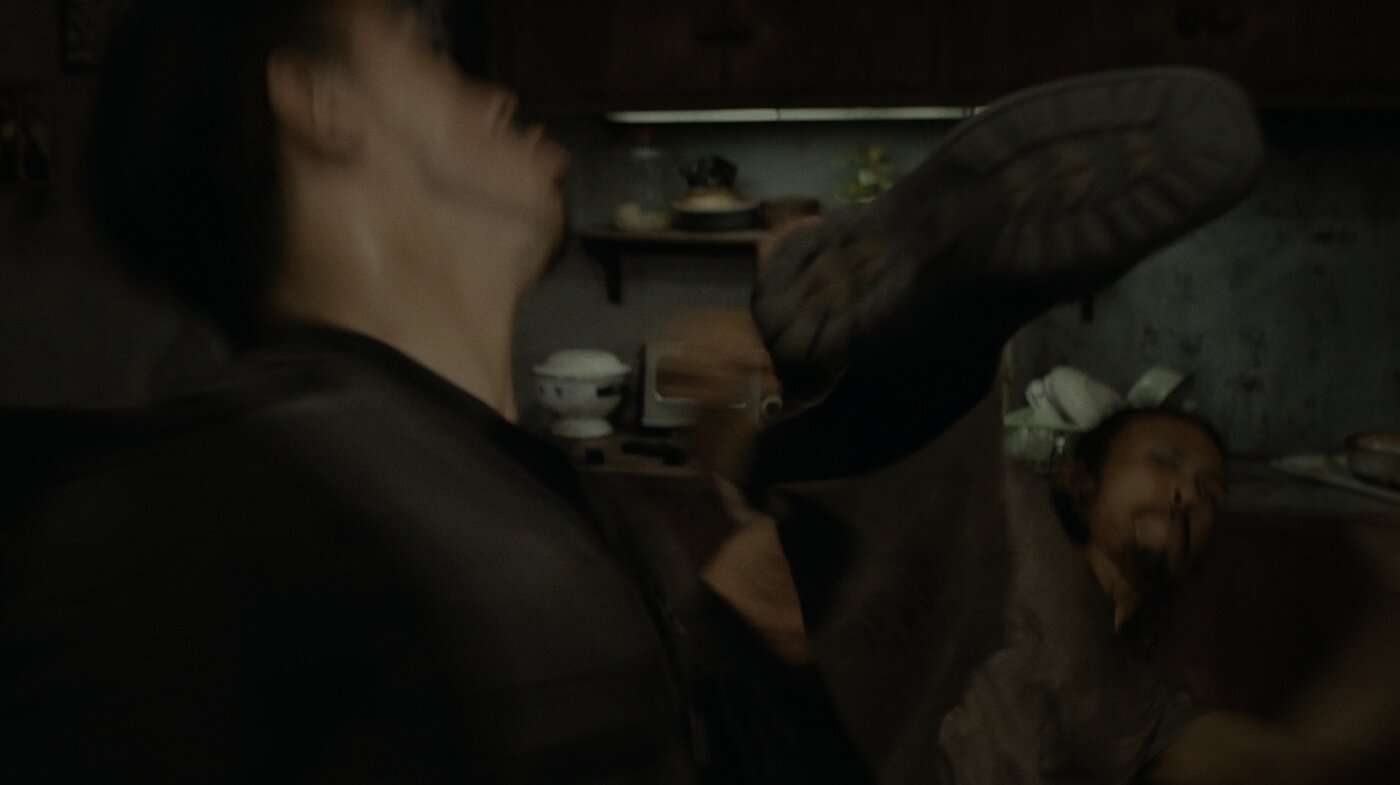
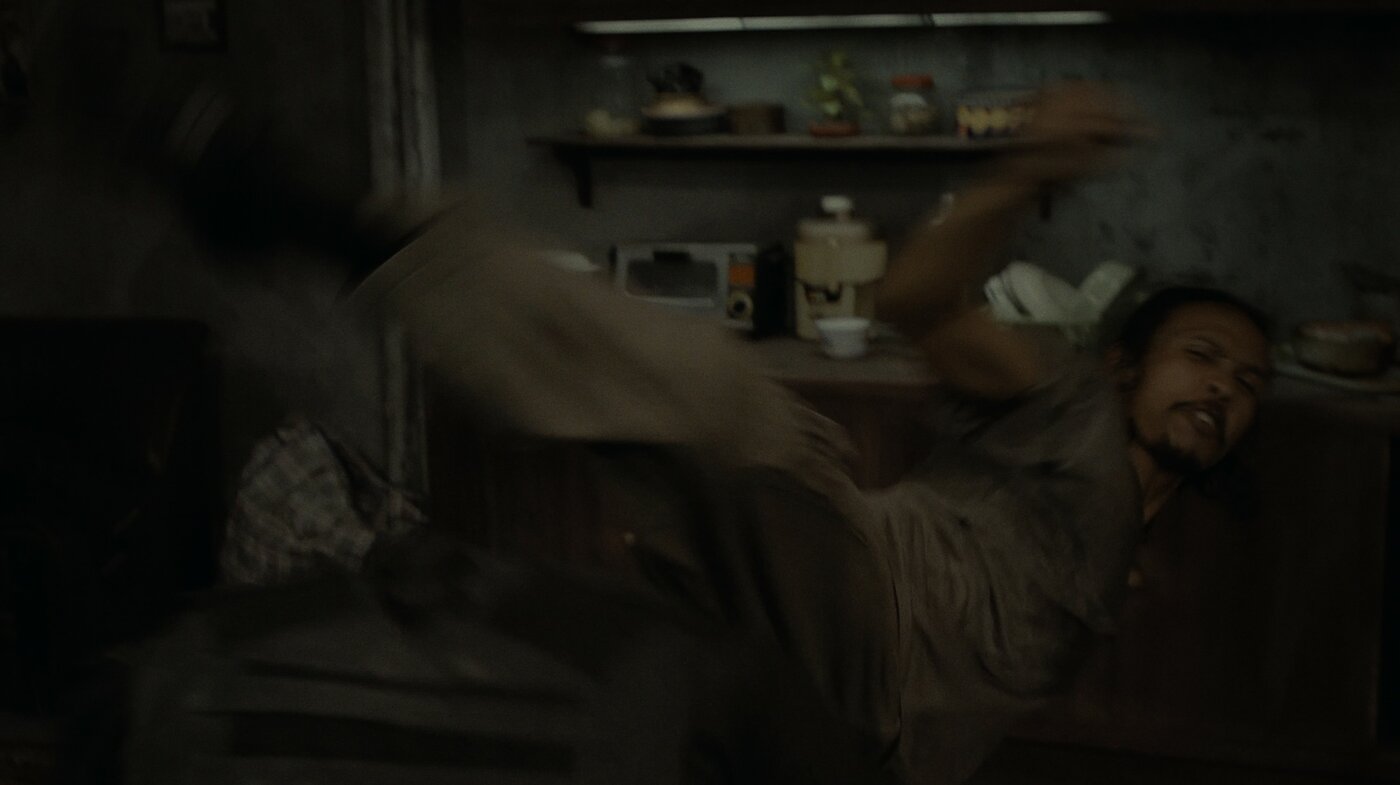
A thrilling three-shot combo in The Raid (Gareth Evans, 2011).
Without being literally “from” either Jaka’s or Mad Dog’s point-of-view, these trio of shots nonetheless approximate it: In the first shot, Mad Dog’s punch arcs forward, almost like we’re throwing it ourselves, while the kick in the second shot seems to nearly strike us, as if we were the intended target. The framing brings us as close to the fighters as they are with each other, heightening a sense of claustrophobia and physical danger. Despite this, the match-on-action cutting and center-framing—the focal point of each shot occupies the same visual region as the preceding shot’s, saving the viewer from having to search the frame—makes the action supremely easy to follow across cuts.
The fight scenes in The Raid can grow exhausting, even tedious, so relentlessly does blow after blow rain down within homogenous rooms and hallways. Moment to moment, however, there’s an ongoing synergy between the framing, editing, and choreography, which complement each other so well that, often, it’s easy to lose oneself in the flow of violence, forgetting the filmmaking choices that shape this flow. The Raid 2 contains similarly propulsive passages, but it also cranks up the baroque artifice. Opening with a static long shot of a grassy field that decelerates the first film’s run-and-gun pacing to slow-cinema extremes—“I wanted to tell the audience, ‘this is not Raid 1’’’7—the film picks up mere hours after the original ended, observing as Uwais’s cop-protagonist Rama goes undercover to bring down a crime syndicate. From there, the formal and narrative flourishes proliferate. Bird’s-eye framing presents a mud-caked prison riot as a writhing, indistinguishable mass of bodies, like some medieval painting of hell. When a character is thrown through a window, the camera somersaults with him and lands on its “back,” the frame turned upside down. Two characters—a sibling duo, one wielding a bat, another a pair of hammers—feel like they stepped straight out of an anime, and, despite dying gruesomely as Mad Dog in the original film, Ruhian inexplicably returns in a minor role.
Innovative vehicular action in The Raid 2 (Gareth Evans, 2014).
If The Raid is focused and contained, The Raid 2 is swing-for-the-fences epic action cinema, sprawled across more than two years of story time and seemingly half of Jakarta and with whiz-bang filmmaking to match. The film’s celebrated car chase is a prime example of the latter. Circumventing a host of resource limitations—as Evans notes, Indonesia lacks the infrastructure for vehicular action, such as the means to easily secure a stretch of road and redirect traffic,8 and budgets tend to be a fraction of Hollywood’s, curbing the possibility of large-scale property destruction9—the sequence is a feat of innovation. Sandwiched between thugs in the backseat, Rama starts punching and kicking every which way, the film switching to an overhead shot of the car’s interiors, laid out like a design blueprint. As the fight continues, the film cuts between two planes of action—the scuffle in Rama’s car and bumper-car chaos involving a trailing vehicle—and the choreography abounds with (literal as well as figurative) swerves. A henchman, knocked halfway out a car window, cracks his head against a passing semi, leaving a bloody spot on the trailer paint. Dodging a kick, Rama rakes the assailant’s leg across shards of glass from a previously broken window. In the film’s formal showstopper, a long take travels between three moving vehicles by threading through the windows—the result of stuntmen literally handing off the camera like a football.
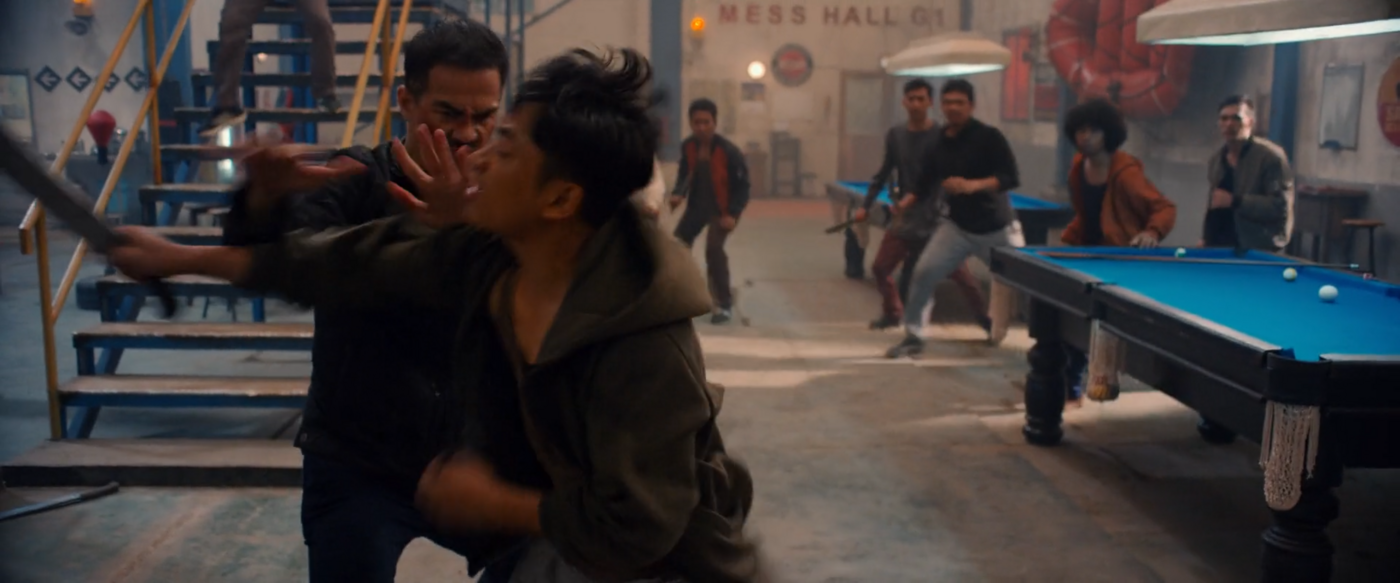
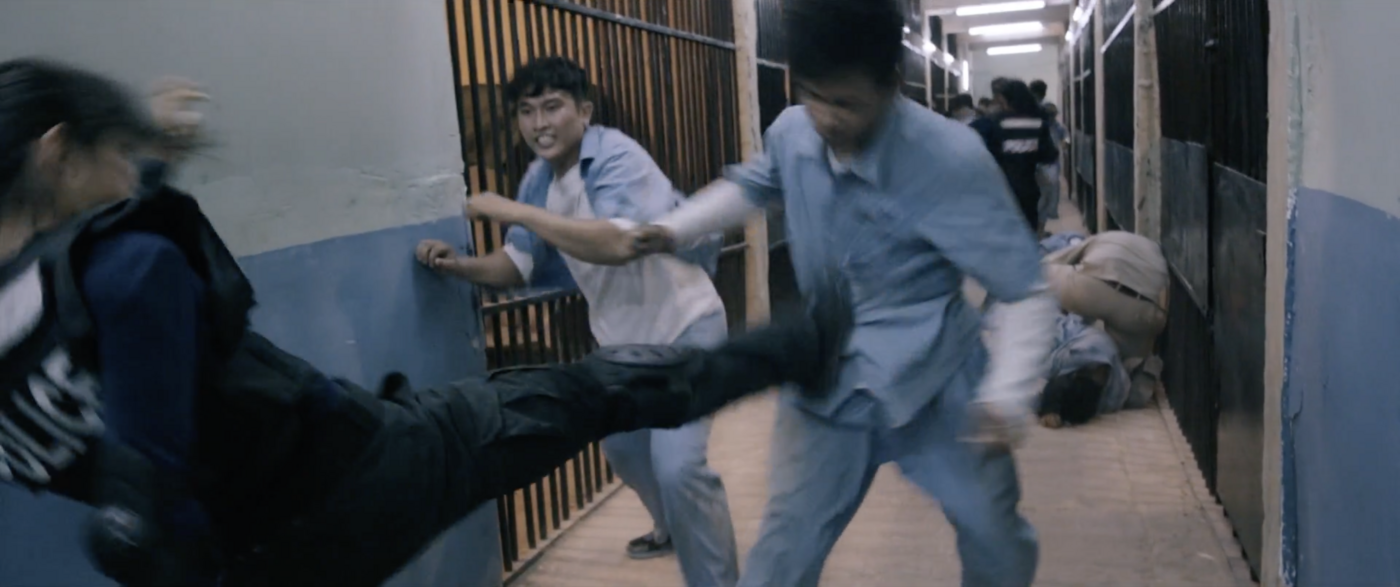
Top: The Night Comes For Us (Timo Tjahjanto, 2018). Above: Jailbreak (Jimmy Henderson, 2017).
Since the series’ resounding success, the cast and crew have branched out, plying their trade around the world and indelibly shaping the landscape of contemporary action filmmaking. Uwais and his trusted stunt crew—the “Uwais Team”— have designed action for a range of works, including indie sci-fi actioner Beyond Skyline (2017), the highly underrated Mile 22 (2018), and the Grand Guignol, horror-adjacent one-two punch of Headshot (2016) and The Night Comes For Us (2018), helmed by Timo Tjahjanto, Evans’s heir apparent in hyper-violent Indonesian action cinema. Uwais stars in all four of these and has appeared in numerous others, such as Triple Threat (2019), The Expend4bles (2023), and Timur (2025), his directorial debut. Evans has pivoted away from Indonesian-language projects and silat choreography but retained his signature, blistering visual style, as seen in Havoc (2025) and the first season of Gangs of London (2020–). Ruhian and Cecep Arif Rahman of The Raid 2 make a cameo appearance in John Wick: Chapter 3 (2019), a series that has become a showcase of action cinema’s who’s who, spanning the likes of Donnie Yen, Scott Adkins, Mark Dacascos, Hiroyuki Sanada, and Jung Doo-hong. Indonesian representation within this context feels like a veritable induction into action cinema’s hall of fame. A comparable feeling of significance attends Ruhian’s and Taslim’s inclusion in The Furious (2026), which similarly assembles some of contemporary action cinema’s leading talent, both behind and in front of the camera. Additionally, the Raid films have helped raise the international profile of Southeast Asian action in general. Films like the Cambodian Jailbreak (2017), the Filipino BuyBust (2018), and the Malaysian Wira (2020) were clearly inspired by the narrative and aesthetics of the first Raid especially, whereas the whirligig dance between camerawork and choreography in the Vietnamese Furie (2019) and Furies (2022) feels reminiscent of The Raid 2.
In retrospect, The Raid 2’s geographical expansion of the original’s scope—from a single apartment complex to various corners of Jakarta—feels like extratextual foreshadowing. Since 2011, the series’ stars, filmmakers, and silat-style combat have left their mark well beyond Indonesia’s borders; in the new millennium, only a handful of martial arts films—Crouching Tiger, Hidden Dragon (2000), Ong-Bak (2003), John Wick—can claim a comparable level of international reach and renown. Inextricably woven into the DNA of contemporary action cinema, the Raid series continues to shape the genre’s evolving textures and sensibilities over a decade out, its influence showing no sign of abating.
1. “Interview: ‘The Raid: Redemption’ Director Gareth Evans Talks His Realistic & Brutal New Action Film,” Complex, March, 20, 2012, https://www.complex.com/pop-culture/a/complex/interview-the-raid-redemption-director-gareth-evans.
2. “Interview: ‘The Raid: Redemption’ Director Gareth Evans Evans Talks His Realistic & Brutal New Action Film.”
3. Peterseim, Locke. “Interview: The Raid 2 Director Gareth Evans And Star Ike Uwais,” Open Letters Monthly, April 3, 2014, https://www.openlettersmonthlyarchive.com/hammer-and-thump/interview-the-raid-2-director-gareth-evans-and-star-iko-uwais.
4. Peterseim.
5. Zack Kotzer, “Interview: The Raid: Redemption Stars Iko Uwais and Joe Taslim,” That Shelf, March 22, 2012, https://thatshelf.com/interview-the-raid-redemption-stars-iko-uwais-and-joe-taslim/#google_vignette.
6. Rob Carnevale, “The Raid - Gareth Evans Interview,” IndieLondon, https://indielondon.co.uk/Film-Review/the-raid-gareth-evans-interview/.
7. Peterseim.
8. Don Kaye, “Interview: The Raid 2 Director Gareth Evans,” Den of Geek, March 31, 2014, https://www.denofgeek.com/movies/interview-the-raid-2-director-gareth-evans/.
9. Peterseim.