“Ad Infinitum” is the fall 2025 edition of the Notebook Insert, our seasonal supplement on moving-image culture.
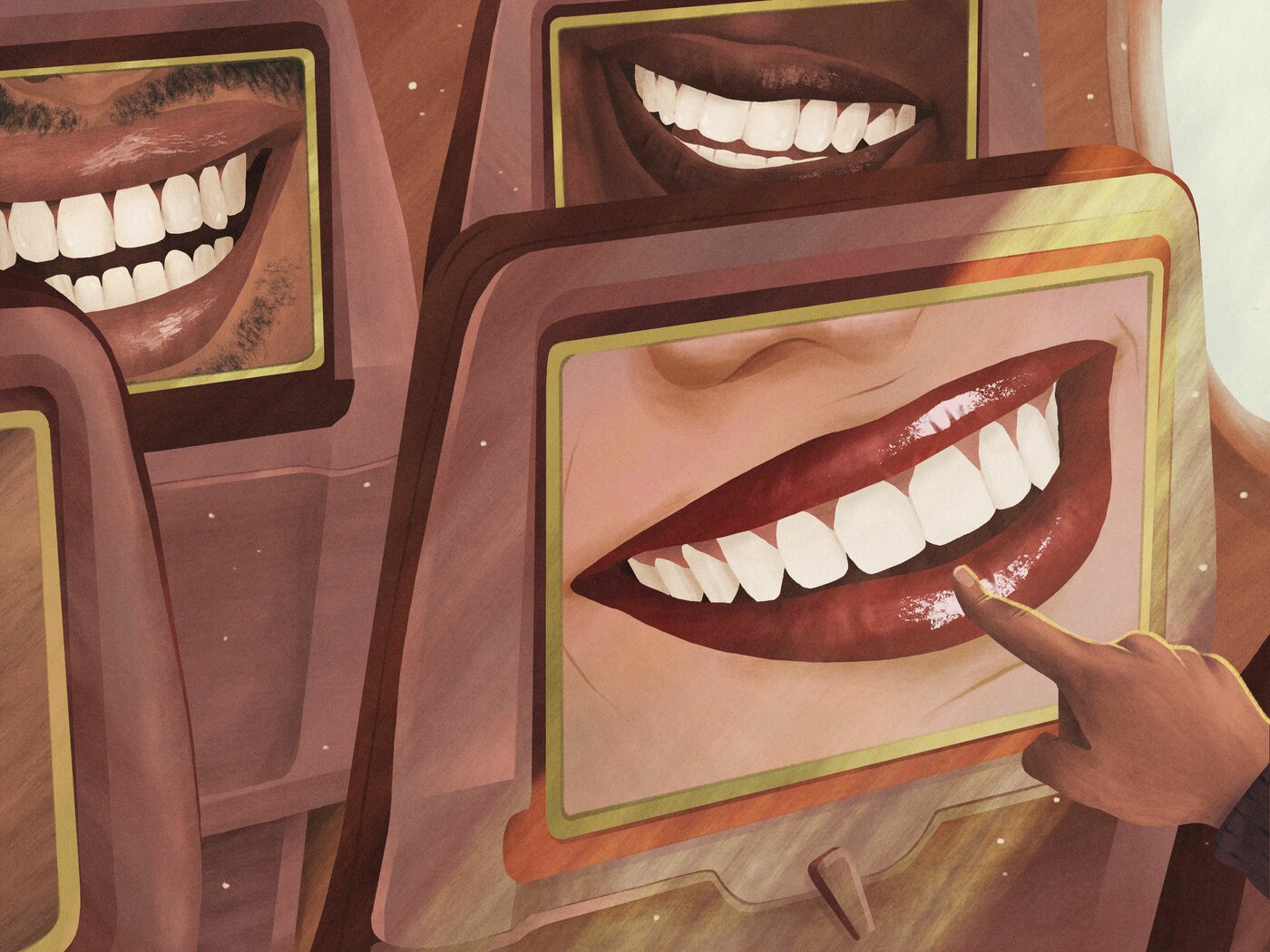
Illustration by Michelle Urra.

The surprise flew Delta. My family was cruising at 30,000 feet, and as far as I knew, things were perfectly fine: clear skies, everyone munching on Sunchips and Biscoff wafers, easygoing Miami days ahead of us. I’d ordered a Mr. & Mrs. T Original Bloody Mary Mix, hold the booze (before noon, it tastes sharp and healthy while reminding me of good times to come), and settled into my paperwork—an endless heap of grants, screenplays, student grading, and emails. I’m a so-called filmmaker, but I’ve got a family, and I’ve gotta make that paper.
Suddenly, my seven year-old daughter screamed bloody murder. She was clinging to my wife like she’d been touched by evil. She’d seen something horrible. I quickly understood it was a movie—someone else’s movie flashing on a screen angled between the seats with a direct line into her soul. There was a beaten and bruised woman locked in a hospital room getting eviscerated by a grinning demon. A slack-jawed Gen-Zer watched this morning programming, his temples pinched by expensive Bowers & Wilkins Px7 S3 Wireless Over-Ear Noise-Canceling Headphones that rose and fell with every impassive munch of his complimentary Cheez-Its while human entrails splattered onscreen.
It was all too much. I chased down the flight attendant to complain. Meanwhile, the doofus switched to a romantic comedy and a new bag of snacks. I wanted to eviscerate him. The flight attendant nodded grimly. “In-flight entertainment,” she said. “I can’t tell anyone to stop.” Then she leaned in to sympathetically impart two cents’ worth of high-mileage intercoastal experience: “I’ll tell you what: Sometimes I can’t believe what they show these days. I’ve seen it all. Sometimes even…” She glanced around, then whispered, “straight-up pornography.” She made the sign of the cross. One thing I know is that it’s not a good sign when a flight attendant makes the sign of the cross. The situation had gotten out of control. My daughter was sobbing in her mom’s lap. It felt like she’d been marked for life. As it turned out, she had been marked for life. She’d witnessed one of those indelible images that can’t be erased from the mind—an image that will follow her to the end of her days.

35mm slide featuring publicity photograph of Amadeus (Miloš Forman, 1984) by Jaromír Komárek. Scan courtesy of the author.
I know this is true because it happened to me. And it happens to most people, at one point or another in childhood. I vividly recall being four or five and walking in on my parents as they settled into Amadeus (1984), catching the opening suicide attempt of Antonio Salieri (F. Murray Abraham), a moment I describe in my movie, Still Film (2023). To this day, I could paint a portrait of his face in blood-red oils. And so it went with my daughter: After that flight, she began experiencing increasingly terrifying and inexplicable events. Overwhelmed by the escalating horrors and the pressures of fame, Skye is forced to face her past—oh, wait, that’s the logline for Smile 2 (2024), the wretched movie that assaulted my daughter’s developing brain on a Boeing 737-300 passenger jet (with Split Scimitar Winglets).
The reverberating impact has been a trauma that manifests as a fear of all kinds of moving images, and particularly the advertisement. The pop-up. She cannot abide the sudden interruption of regularly scheduled programming with something unpredictable, random, and, quite likely, extremely inappropriate. It has affected her at home, in restaurants, and at school. She swears that an ad for Smile 2 popped up on her classroom’s digital monitor during a math lesson. She spent the afternoon with the nurse, counting down the minutes until school was dismissed. It feels like our daughter, with the infinite wisdom of children, is telling us something about the corrupted society in which we are raising her. Hopefully, it’s a phase.
Like most people, I hate ads and marketing and promotion. I especially hate television commercials, probably because they skim too close to the medium in which I work. It’s easy enough for me to trace my hate to the manipulative purpose of advertisements, laid bare in the root of a word meaning “to turn” (Latin: advertere) one’s attention to itself. Advertisers are in the business of forcing people to think about what they have no interest in thinking about, notably via war-like “campaigns.”
Movies manipulate in a similar way, of course, but their audiences consent to the framework of not-knowing. The cost of a ticket to a cinema (or of a MUBI subscription) is literally a waiver by which we temporarily relinquish our right to our own attention, and that gamble is part of the pleasure. Movies aren’t meant to be seen by mistake. Adverts, on the other hand, play cheap and dirty, like a man on the subway waiting for your eye contact, hand in pants, licking his lips. Adverts, in all media, want a piece of you and don’t care what psychic price you pay. Some ads are worse than others, but the majority are tacky, stupid, ugly, lazy, false, and, most crucially, vehicles of bad faith—their grinning makers lying not only about the value of the product being sold, but to themselves about the degrading impact ads have upon society by their mere existence, like cargo shorts on middle-aged men, or the lack of basic etiquette around in-flight entertainment.
I know I’m sounding persnickety and old-fashioned. Like a walking, talking, dog-eared copy of Adbusters magazine. Admittedly, I’m an older Millennial filmmaker baptized in, yet not wholly purified by, the lifted fogs of the “anti-sellout” sentiments of his Gen-X forebearers. It’s a concept that is hardly worth discussing with people under 25, for whom everything has long since been sold out from under them; a concept lost in translation. Speaking of, I haven’t watched Lost in Translation (2003) since it was first released, though I recall that the plot centers around what used to run as an unquestioned truth: that acting in commercials was embarrassing and the sign of a career in crisis for movie stars of a certain pedigree. It just looked bad to be seen hawking booze or tampons or laundry detergent, at least by your fellow countrymen. Despite the practice now normalized across the globe, I’m still surprised when I see an old and rich George Clooney cosplaying for Nespresso Original Coffee Pods and Capsules, though I have no excuse for naivety of any flavor. The internet has obviously obliterated the old Gen-X taboos, and, like my flight attendant’s pornographic encounters, any semblance of grace. After all, everybody does it now (OnlyFans?). Ads are embedded everywhere, all the time, in these times. “We will sell no wine before its time,” drools Orson Welles in a perfect synergy of form and content in his promotions for Paul Masson Vineyards, a deeply despairing genius drunk on the Carlsberg lager, Domecq sherry, and Californian wine he promoted for quick cash upon his return from European exile in the 1970s.
I am no scholar of how advertising has evolved over the years. I’m often in a state of befuddlement as to how fellow filmmakers convince themselves that making advertisements is somehow complementary to their artistic goals. Indubitably, it’s all about the money, but let’s pretend for a moment that it’s more than that. Take Errol Morris, one of America’s preeminent Oscar-winning documentary filmmakers. He has long been addicted to making commercials for the biggest corporations in the land, most recently a series of Chipotle Mexican Grill spots called “Behind the Foil” that attempt to equate the “authenticity” of apparent documentary form—a cinéma vérité-style handheld camera; a kindly director asking questions off-camera; “There’s no trickery here! No foil to speak of!”—with the same quality in the hand-mashed, hand-tossed guac and chips you can order for eight dollars in Maspeth after a quick pop to Home Depot. Nevertheless, his campaigns are fundamentally structured around jump-scaring Chipotle employees in the middle of work with some of the most awkward on-camera inquisitions I’ve seen since the Clinton era.
As the tagline goes, “The difference is real.” And it really feels like these Chipotle employees are being tortured, for real, as pale and stiff as a middle-aged filmmaker food-poisoned in Maspeth after a quick pop to Home Depot. Even when commercials made by famous filmmakers are quite good—witty and impressively crafted, like the big-budget campaigns of Jonathan Glazer or Wes Anderson in the late ’90s and early aughts—there’s still something pathetic about them: the fact that all this labor exists in subservience to a product. I find myself pulling my hair and wordlessly mouthing, “Just cut the shit, guy!” Literally cut it: the final seconds of every ad when the plug is made for Amex or Wrangler or Guinness or whatever (and I use Amex and wear Wrangler and drink Guinness). It’s that little “Surprise!” that makes it all crumble into lameness. “You’re better than this!” I scream, my face contorted in a rageful grimace that I suppose, with the right spin, could be mistaken for a smile.
Jonathan Glazer in particular is a filmmaker whose work I’ve had a hard time getting into due to its “glaze”—I’ve wanted to like his stuff, but there’s a slickness that is very commercial-feeling, like expensive engines that function only on high-quality, synthetic fuels afforded through a lifetime of working with Volkswagen, Nike, Stella Artois, Mazda, Audi, Prada, Apple, Motorola, Cadbury, Barclays, ad infinitum. Paradoxically, I believe this is why his The Zone of Interest (2023) was a very effective movie: My hot take is that it is a commercial for Auschwitz-Birkenau Concentration and Extermination Camp (™), until it snaps into reality at the very end.
I was zoning out about The Zone of Interest not so long ago, sometime before my daughter’s encounter with the devil, while riding the Metropolitan Transportation Authority’s L train subway line during rush hour. A younger couple was canoodling behind me, drinking Youthquake and Strawberry Sea-Tox Wellness smoothies from Juice Generation and whispering sweet nothings into each other’s ears and, due to the bloodless compression of thick humanity on the train that afternoon, into my ear as well. Their heavy-lidded, protein-sated eyes drifted to a poster for The Substance (2024), widely promoted by distributor MUBI that season. “Oh, look. I want to see that,” said the woman. Then she crinkled her nose, “MUBI? Not Tubi? What’s MUBI? How many streaming services are there?” I couldn’t tell if this was a win or a loss for MUBI’s marketing team. Probably both. MUBI, or not Tubi? That is the question, and it is one I have pondered while considering my distaste for advertisements because—here’s a confession I should be more embarrassed to make than I am—I’ve been watching a lot of Tubi lately.
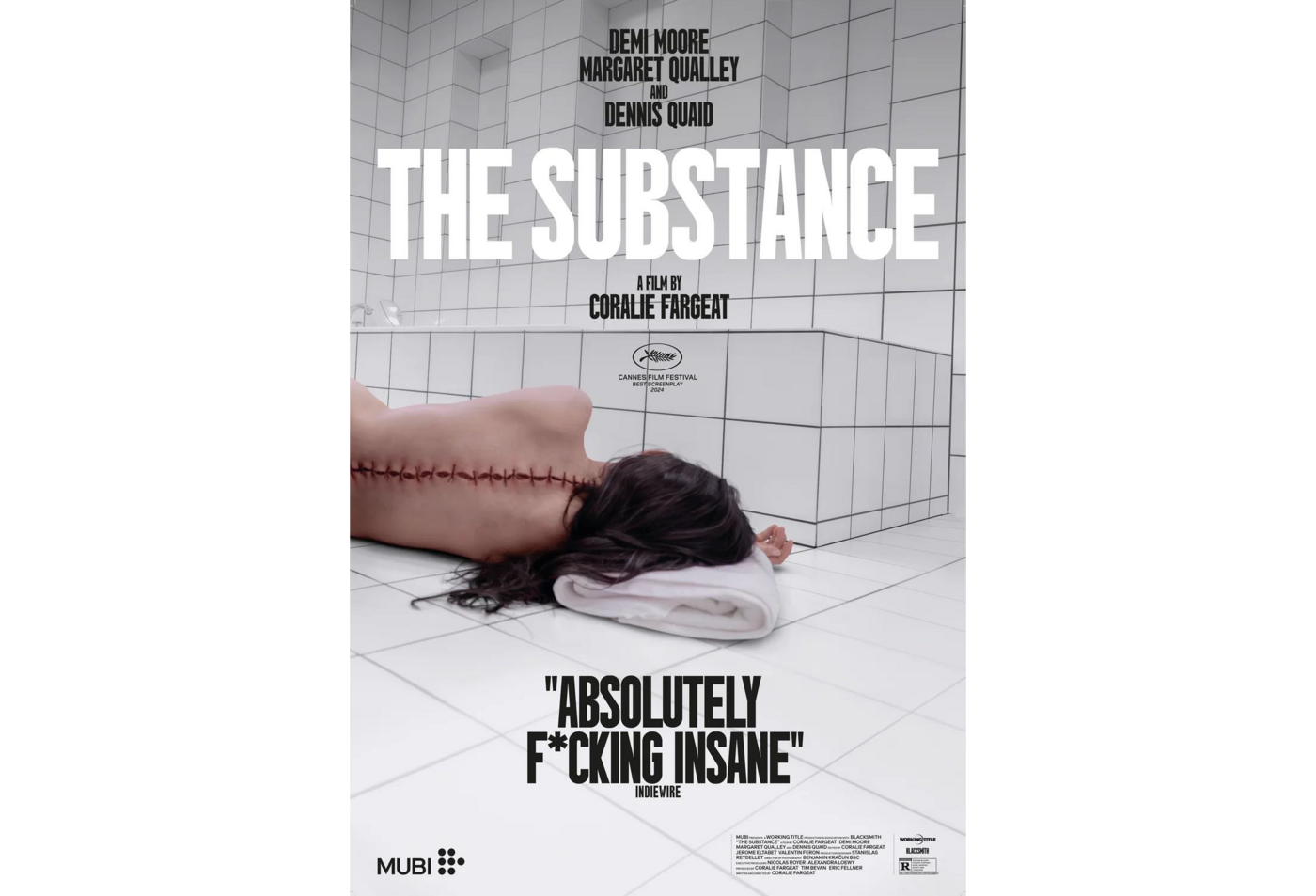
Poster for The Substance (Coralie Fargeat, 2024), a MUBI Release.
I got to wondering if MUBI is the streaming service we want, but Tubi is the one we deserve. Tubi is just, like, always there. It’s got an astoundingly weird and eclectic selection: Charles Burnett movies improbably available? Burt Lancaster in The Swimmer (1968)? The Defiant Ones (1958) with Sidney Poitier and Tony Curtis as a Black man handcuffed to a white racist, respectively, who will soon become fast friends, which is how I often feel about my relationship with Tubi: shackled to a brute. The “over-the-top” ad-supported streaming service is completely free: Ads play unrelentingly before, during, and after every program. And over-the-top it is: Bloated. Repetitive. Adding minutes upon minutes of running time to each feature film, which are themselves plagued by low-grade artifacting and compression.
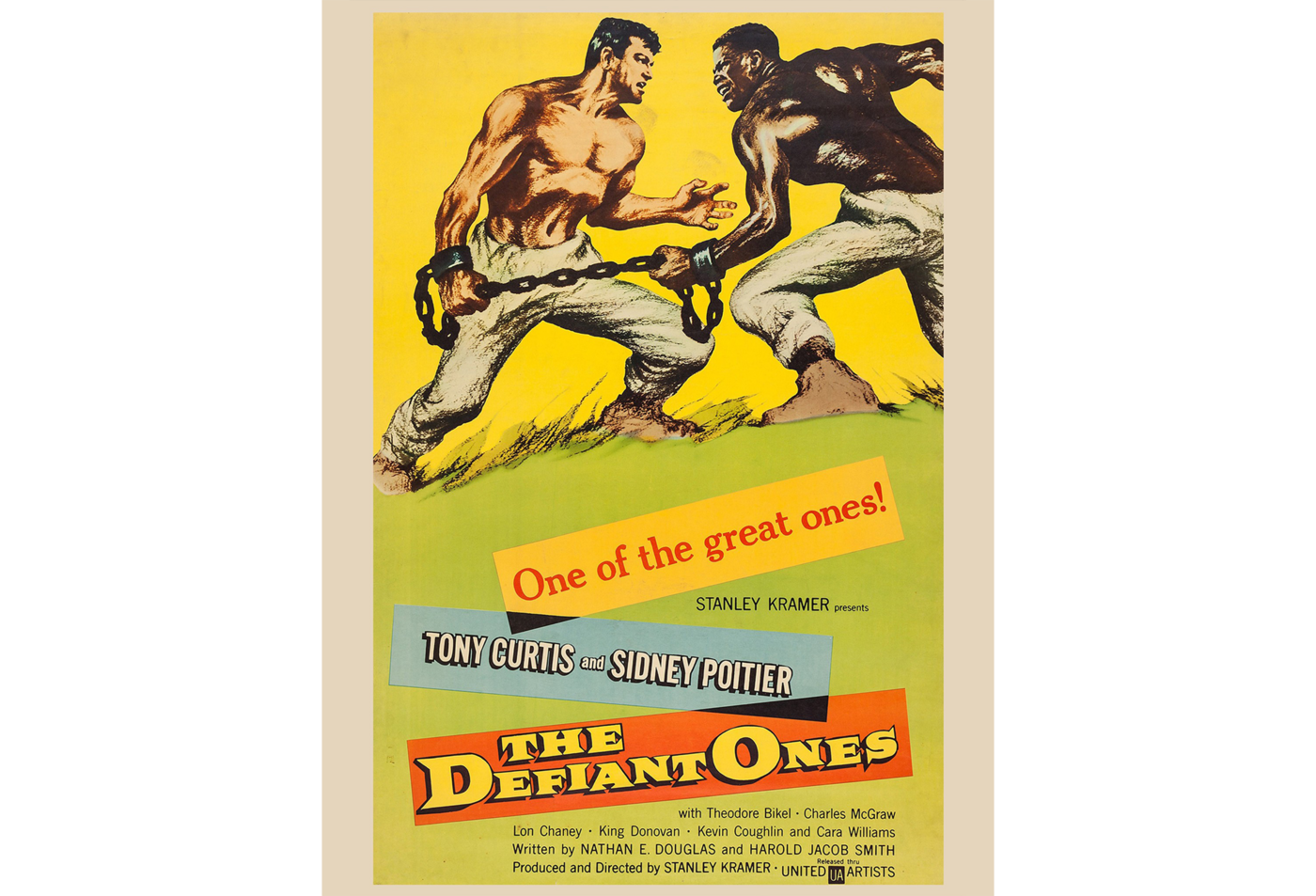
Poster for The Defiant Ones (Stanley Kramer, 1958), a United Artists release.
Yet strangely, almost magically, the repetition of Tubi’s ads somehow drains them of their power to compel and seduce and convince and lie. Seeing the same bank of ads seven or eight times without mercy makes a viewer hardened and resistant, even numb. There is no risk of surprise. While watching Tubi, I always try to mute the ads and go brew another cup of Variety Coffee Roasters Mean Streets Dark Roast (Colombia) and hope I make it back without missing too much of why I was there in the first place. This gives rise to what I call the Tubi Test (similar to the Turing Test): based on the visuals onscreen, trying to figure out if the ad (on mute) has ended, and whether the chosen movie has returned (time to unmute and pay attention). If the junction is not apparent, what does it say about the movie?
The Tubi Test is very usefully applied to commercials made by famous filmmakers who have chosen to sell their particular style to the highest bidder. I tell my film students (and myself, repeatedly) that there is a very real danger in the crossing of stylistic circuits—inviting one’s cultivated audience to interpret one’s movies (ostensibly, where the real “passion” is located) as simply extended-cut commercials within the mechanisms of capitalism. Is every Wes Anderson movie a big American Express expense account for prop and set design? Every Spike Lee joint an invitation to spend one’s final hours before a lengthy prison sentence getting properly sized for Nike sneakers? Every David Lynch movie the feverish purgatory of waiting for the results of a Clearblue Easy One-Minute Pregnancy Test? Should it be as hard to unsee a David Lynch commercial as it is to unsee a David Lynch movie?
Despite all my grousing about selling out, I believe that there is a clear blue future ahead and that all my concerns may be close to a resolution. We’ve now entered the mandatory “artificial intelligence” portion of this essay. I think that AI may save us from commercials—well, not liberate us from their existence, but unshackle filmmakers (at least those who view movies as art) from the temptation to participate in such Faustian bargaining because, in this dawning of the age of generative AI, it no longer seems like there’s any good, financially sound reason to hire people to make advertisements (especially expensive, high-shelf people like David Lynch, who smartly got out while he was ahead). AI excels at producing the tacky, stupid, ugly, lazy, and false—but, most crucially, without the bad-faith participation, since human contradiction has been eliminated. AI is simply better at producing the deadened smile of promotion, and the market knows best.
Looking back at one of the most famous TV ads of the past twenty years, I swear it was an oracle, predicting the rise of generative AI, if we had only known what to call it. I speak of the infamous Bob Dylan Apple iPod + iTunes ad from 2006 (don’t even get me started on his bone-rattlingly weird Victoria’s Secret ad from 2004). I remember when the Apple ad first dropped. I was shocked. I wanted to do myself in, Salieri-style. “You’re Bob Dylan,” I cottonmouthed. “What is going on, here, Robert? You don’t have to do this shit!” Yet there he was, picking away in a sleek semiotic mash-up; a smashed-guac precursor to ChatGPT prompts: a back-lit Black woman; a black-lit Zimmerman; a white and clean heavenly void; the blues-inflected promise of technological syncretism. By way of perfectly crafted, take-no-prisoners cultural appropriation and perfectly produced, consensus-driven, four-quandrant, all-audiences image-making, it was exactly the ad that “generative AI” would have produced in 2006, had it existed. It was a surprise then. Today, we have no excuse to be surprised. We’re living in Modern Times.
Back to the future. I had a dream the other night about Errol Morris. Or rather, his son, circa 2002. It was a strange thing and deeply unsettling. I was leaving late at night from some sort of bar mitzvah, or maybe just a bar, making my way down wet cobblestones to find my car, when a teen boy came stumbling out of the party. He wasn’t OK. He was shaking and ill. He fell to his knees and began retching. I picked him up and instinctively gave him a hug, “It’s going to be OK, kid,” I said as a large shadow loomed behind us in the doorway. Errol Morris emerged with a look of great worry documented all over his face. I figured his son had stolen a few too many sips of Manischewitz Concord Grape wine at the party, or maybe he was just then beginning what would become an illustrious career in pharmacology podcasting. I knew his father cared for him. Why would he have used the boy like a living parlor trick in an advertisement for the first-generation Apple iPod if not to pay for his college education at the New School and beyond (theoretically investing in my future salary as a New School professor)? But the bottom line was that the boy was sick, and somehow his father was responsible, a young Icarus for whom the difference between high and low, art and commercial, was never properly modeled—and who was thus doomed. That’s the only rationale I could dream up—to play with that kind of fire. Of course, I really shouldn’t blame the old doc master. At the end of the day, he was a father trying to do the best he could in an imperfect world. Morris took Morris and escorted him home. I dusted myself off and woke up.
As for my daughter, she’s managing. We’re figuring out tools and tricks to navigate a world full of screens and commercials and shocking posters and aggressive marketing. I’m still struggling to explain the weird-looking, ghoulish lawyers on the billboards in our neighborhood. The jolting YouTube ads when she catches my wife or me spacing out on our Apple iPhone Mini 13 and iPhone 16, respectively. The only TV channel we can safely watch in our household is the existentially threatened PBS (Kids) which, as public television, has always identified itself as an ad-free zone of interest in a manner that has never been quite true. PBS specializes in the strange form of the “not-quite-a-commercial”—corporate sponsorships bumpered before and after programs (with no mid-program interruptions) that promote value-driven consumer solidarity.
One sponsorship bumper I remember quite well, and recently rediscovered on YouTube (font of universal knowledge; pit of advertising despair). It originally aired when I was about 21 years old; a not-quite-commercial less disturbing than disturbed: Twangy, Neil Young-y guitar. A misty lake at dawn. A kindly man asks in voiceover:
Q. What can the elusive Red-Legged Kittiwake teach us about unbiased wealth management?
A. It exists.
Ah yes, pearls of wisdom from Wachovia, the bank dissolved in 2008 through a government-forced sale during the global financial crisis, one of so many institutions that failed to watch ova ya. What they failed to mention is that the Red-Legged Kittiwake isn’t simply elusive, it’s a classified vulnerable species, just like the Corporation for Public Broadcasting and all noncommercial media in the United States under the Trump Administration. The bigger point, I’d conclude, is that danger is everywhere. No one watches over you, kids, especially nowadays, except to sell, surveil, collect, extract, and report. The smile is everywhere, and as every child knows: A smile is just a frown turned upside down.

Continue reading “Ad Infinitum.”