“Ad Infinitum” is the fall 2025 edition of the Notebook Insert, our seasonal supplement on moving-image culture. Below, our editors introduce the week’s publishing with some thoughts on advertising’s power to instill desire and prey upon our human frailty. Click here to skip to the table of contents.
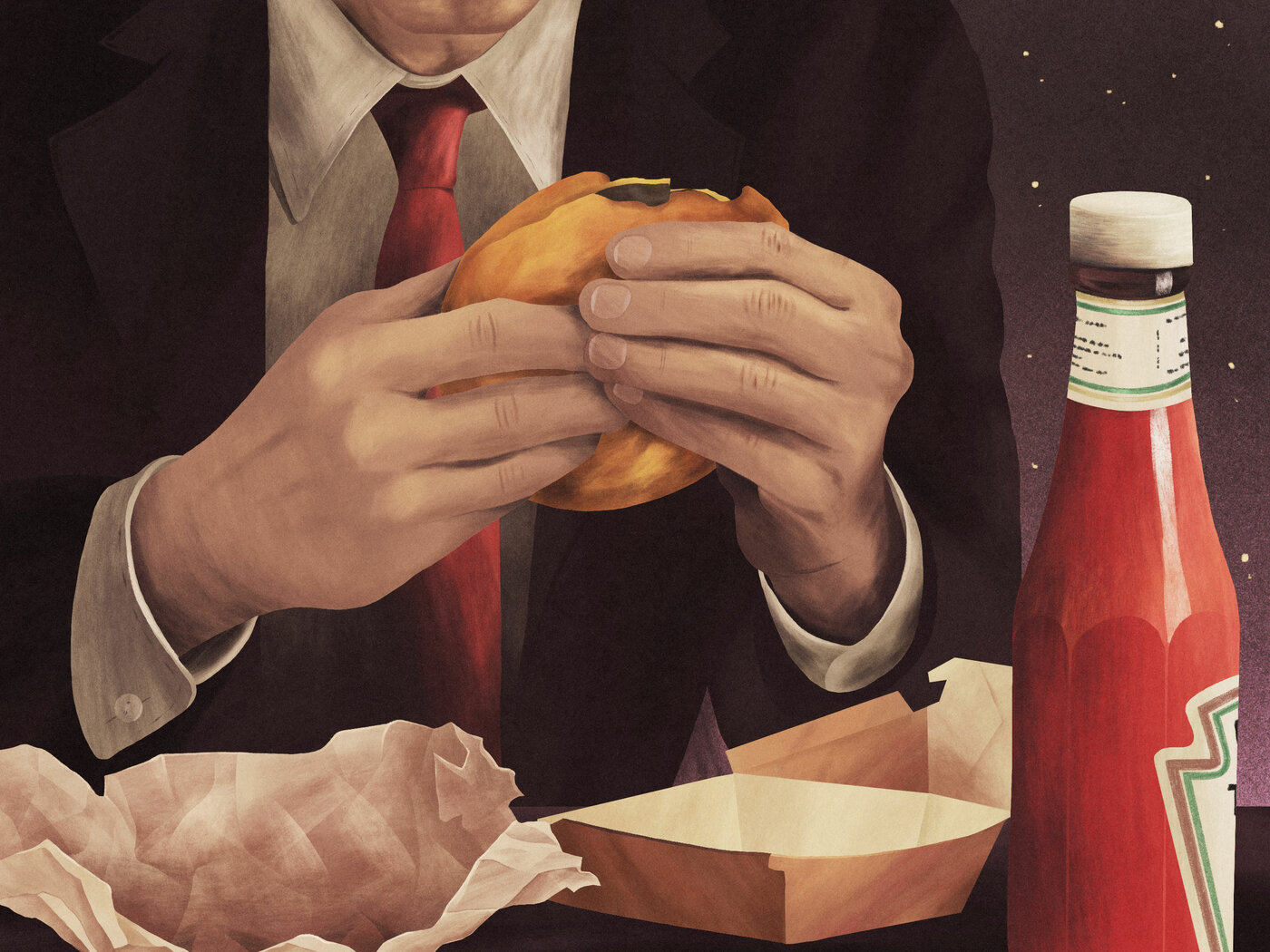
Illustrations by Michelle Urra.
CHLOE LIZOTTE: When I was ten, my dad and I were obsessed with a TV commercial for a Brockton, Massachusetts, Toyota dealership anchored by what seemed to be a father and adult son duo. Papa had a white, fluffy mustache and a horrible inkjet dye job; son’s slicked-back ’do anticipated the “just fuck me up” haircut meme. The secret ingredient was loud, tacky synthesizer music, which underscored vacant sloganeering: “When it comes to Toyota, you’ve got a lot of choices,” the duo announced amid B-roll of them walking with customers alongside nondescript 4x4s, and at least one shot of them mopping up the showroom floor alongside the service workers. Finally, their catchphrase, so forgettable on the page but inscribed forever into my heart: “Step up to Copeland Toyota.”
Whenever the spot came on, one of us would yell across the house to send the other sprinting into the room to catch the end. The magic of this commercial—which is unfortunately now lost to the sands of time, though lesser sequels survive—is that it harnesses a crazed energy to sell the viewer something ordinary. Here were two men who were not trained for camera at all, awkwardly going through the motions of creating a promo video. Each viewing prompted new questions. Why is this synthesizer music so loud as we peer inside a drab dealership—is mopping really the coolest action shot they could come up with, the only prop work in the spot outside of phone calls in drab cubicles? The Copelands had clearly absorbed the beats and textures of traditional commercials, but could not replicate them normally.
One such lesser sequel.
To bring the ritual full circle, my dad and I decided to make the 40-minute drive to visit the dealership in real life. The parking lot was familiar, but viewed from ground level, rather than from the vantage of a helicopter, it lacked a certain gravitas. The dealership building was indistinguishable from the one closer to our house. Like outsider art, the commercial thrived for being both touchingly human and so far beyond regular life. Somehow, the ad subverted its own function while fulfilling it perfectly: It wasn’t peddling an aspirational lifestyle, per se, but I wanted to live in it, and, crucially, I never forgot it.
The desire to live in a hokey TV ad, against the grain of its intentions, seems a worthwhile impulse to explore—one that does not necessarily fade as the open-minded child grows into a capitalism-fatigued adult. The previous issue of the Notebook Insert considered new frontiers in immersive filmmaking and virtual reality, so naturally, we’re now turning our attention to everything that surrounds the artistic works: Commercials smother us, punctuating our televised narratives, catching us in moments of emotional weakness and asking us to open our hearts and wallets. Television has always existed to accommodate these interruptions—a topic taken up two Inserts ago—in a way that cinema, surprisingly, has not; it seems like an oversight that no one thought to put ad breaks between reels. Instead, we have obligatory preshow trailer blocks and rampant product placement during the movies themselves.
The real world is often optimized for broadcast. Go to Times Square on New Year’s Eve, and you’ll encounter a sea of Planet Fitness–branded purple top hats, or go to the ballpark to find brand names encircling the perimeter of the field. Writing for The New Yorker in 1947, Robert Rice describes watching a baseball telecast sponsored by Post 40% Bran Flakes, each commercial break devoted to the cereal’s monotonous, family-friendly messaging. This quaintly corralled bombardment presages present-day advertising—logos everywhere, brand reps manic—but the story of advertising stretches even further back.
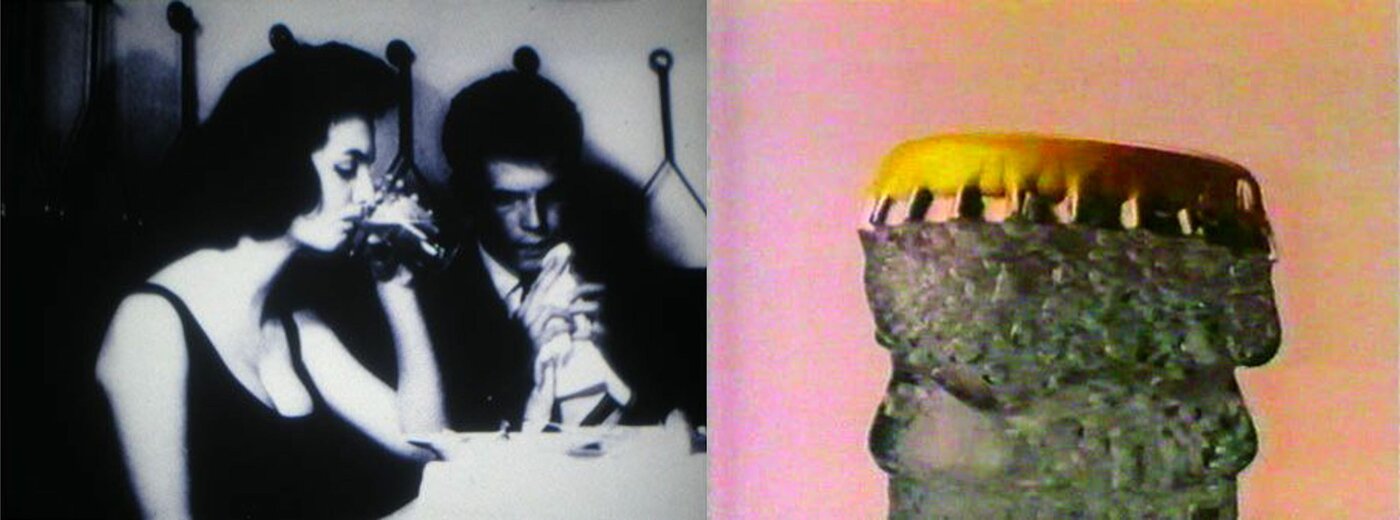
Left: Schwechater (Peter Kubelka, 1958). Right: Schweppes Ad (George Barber, 1993).
MAXWELL PAPARELLA: Ancient advertisers painted signs, drew up flyers, and cried out someone else’s bills of goods in the square. In China, bamboo flautists composed songs to sell candy. From their earliest years, print periodicals relied on advertising to offset their production costs. The modern world has added electricity, recorded media, and a rich literature of psychological persuasion to the marketer’s toolkit, but much has remained the same: seize a person’s mind, if only for a moment, and plant there a seed of desire.
In the age of mass media, film artists have unavoidably engaged with advertising, whether as paid gig, found material, or bête noir. The development of animation was motivated by its utility in advertising, as Eliška Děcká details in this issue, focusing on the visionary work of the small IRE-Film studio in 1930s Czechoslovakia, ads for soap and margarine that prefigure the experimental films of Len Lye and Harry Smith. Indeed, marketing is close to the heart of the avant-garde cinema. The earliest metrical films of Peter Kubelka, Adebar (1957) and Schwechater (1958), were commissioned as commercials (for a dance club and a beer brand, respectively), rejected, and recouped as artworks. Decades later, Britain’s Scratch Video scene yielded a thirst-provoking point of comparison: George Barber’s Schweppes Ad (1993), made with a video mixer rather than a film splicer.
Other artists have bought airtime for explicit interventions, such as Richard Serra and Carlota Fay Schoolman, whose Television Delivers People (1973) reminded viewers in Chicago and Amarillo, Texas, that “in commercial broadcasting the viewer pays for the privilege of having himself sold.” In 1977, one of four commercial spots produced by the performance artist Chris Burden disclosed to Angelenos an itemized account of his modest business income and expenses, the highest of which was “television advertising.” Stan Douglas’s TV Spots (1987–88) and Monodramas (1991) used 30- or 60-second increments of Canadian television for enigmatic fictions: a young couple trade the beginnings of a familiar argument, a white man mistakes one Black man for another. Some concerned viewers apparently called the station to ask just what was being advertised. In the coming months, a series at New York’s Anthology Film Archives will survey some of these works and many others in a series called “Avant-Garde Ads.”
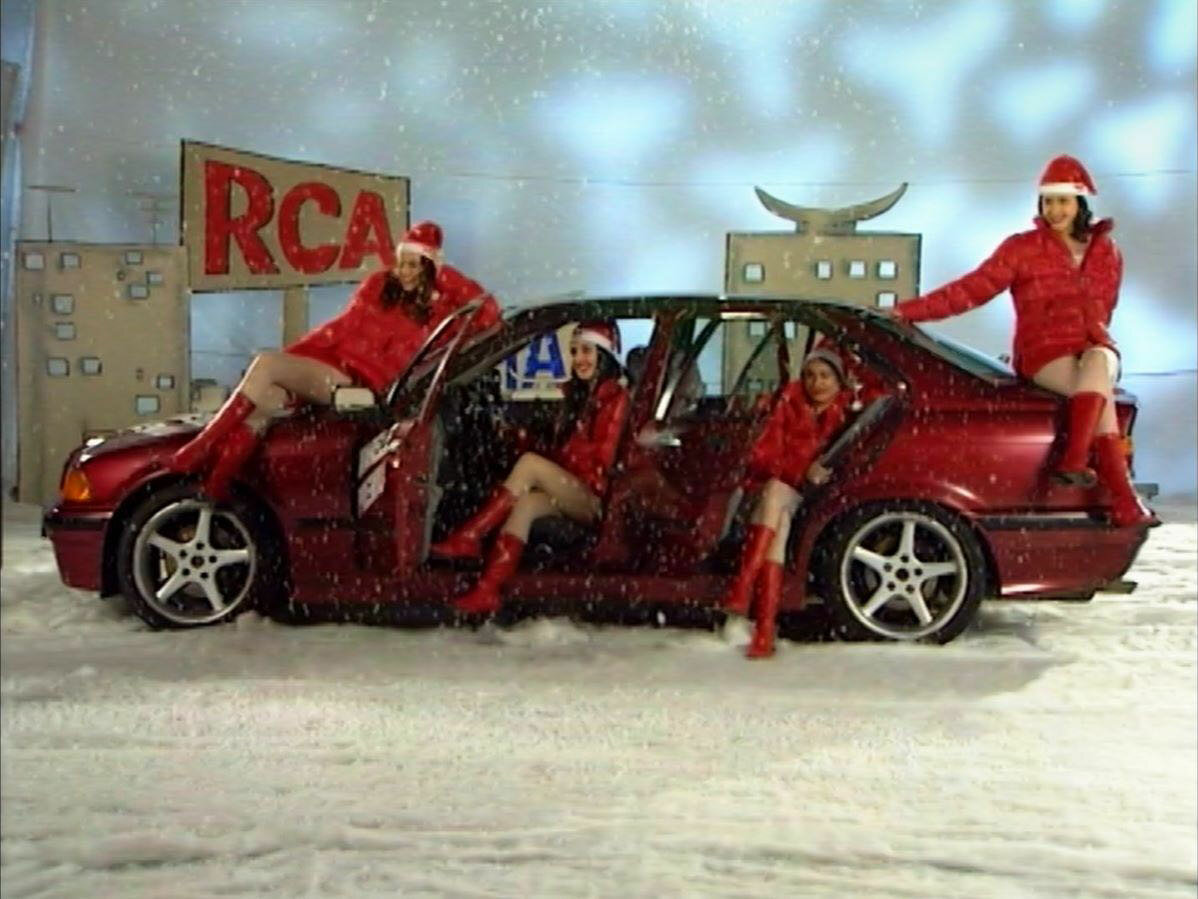
Eight Postcards from Utopia (Radu Jude and Christian Ferencz-Flatz, 2024).
After the fall of authoritarian regimes in the Eastern Bloc, advertising came to their rapidly privatized economies with a vengeance. Radu Jude and Christian Ferencz-Flatz’s Eight Postcards from Utopia (2024) is a supercut of Romanian commercials; one section, “The Ages of Man,” follows a composite character from the cradle to the grave, always being sold something. This week, Sierra Pettengill presents in these pages examples of American advertisements gloating over the dissolution of the Soviet Union, from a “Communist party favors” giveaway by Barq’s root beer to Gorbachev’s infamous turn in a Pizza Hut commercial.
In narrative film and television, the figure of the midcentury ad man has loomed large, from Putney Swope to Don Draper. Conversely, the artist is an occasional stock character in advertising, often lampooned, but nonetheless bestowing the imprimatur of high taste, even in low places. (One subgenre involves speculation as to how da Vinci convinced a dour model to produce Mona Lisa’s faint smile—alternately plying her with chocolate, a Big Mac, or mineral water.) Celebrity artists sometimes get involved with advertising, endorsing a product with their name and likeness, willingly or otherwise. Orson Welles spent his later years shilling everything from shredded wheat to frozen peas. In 1982, Andy Warhol ate a Burger King hamburger in front of Jørgen Leth’s camera in 66 Scenes from America. In 2019, the company licensed the first 45 seconds of the footage for a spot that played during the Super Bowl (“#EatLikeAndy”).
LIZOTTE: One wonders what Warhol would have made of our current moment, in which advertising is both an omnipresent nuisance and harder than ever to detect. One minute, you’re waiting for that fifteen-second countdown clock to run to zero so that you can tap through to your YouTube video; the next, your browser short-circuits as a Variety article rearranges itself to make way for unsightly commercial banners, the sentence you’re reading in free-fall, the scroll bar frozen. As Celia Young describes in her Multiplex contribution, the subways are full of video billboards flashing with “filler content, a cousin of internet clickbait.” And in the Insert’s bravura opening essay, James N. Kienitz Wilkins notes the abundance of autoplaying videos on our mobile screens, which, in our post-pop-up-blocker world, are somehow more intrusive than ever. Film funding is sometimes tethered to brand curation: Saint Laurent Productions has brought us the latest films from David Cronenberg and Claire Denis and outfitted their stars; it’s a mark of sophistication for Chanel to sponsor MoMA’s film program. Then there is influencer marketing, which has made it impossible to trust the personal framing of a vlog, let alone any social-media interaction—any casual mention of a product has surely been sponsored (or will be).
In the early days of Twitter, there used to be something funny about this. My friends and I once chose an energy drink with a sub-1k follower count to @ relentlessly, begging to be anointed brand ambassadors, making deep-fried memes that were hilarious to us simply because this drink was not, could never be, a real-world conversation piece. What if we wielded the language of brand curation to will such a monocultural takeover into being? Soon enough, though, brands like Wendy’s and Steak-umm began to co-opt this type of co-optation, posting their own memes and speaking with the voices of too-online civilians. This was part of a wider trend toward irony-poisoned, self-aware advertising, coinciding with millennials aging into their thirties and forties.
A particularly horrid offender is GoDaddy’s “Walton Goggins Goggle Glasses” Super Bowl campaign, in which GoDaddy makes it possible for Goggins (Goggins) to confidently enter the creator economy and launch a website for $150+ ski goggles. This business is real and Strategist-endorsed, a grift set in motion by the ad. “We sought something quite specific—an actor with incredible range who has played many roles, who fit our brand in personality and voice, and someone with an entrepreneurial spirit—including an idea or passion they wanted to bring to life but hadn’t yet,” remembers GoDaddy’s Executive Creative Director Adam Novak. “Walton is a creative inspired by many things, and fashion is surely one of them…. He’s spoken a lot about his passion for sunglasses (People.com, Hollywood Reporter), so the conversation naturally evolved into goggle glasses. The domain gogginsgoggles.com was available, so we secured that for Walton’s business, and the partnership took off from there.”
My friend group’s gonzo soda blitz was inspired by the work of Tim Heidecker and Eric Wareheim: masters of the commercial parody, spiteful of corporate drivel, affectionate toward unpolished local TV heroes à la Copeland Toyota. To make ends meet, they soon made the leap to real advertisements, crafting spots for Totino’s Pizza Rolls and Purple mattresses in their public-access-meets-chromakey aesthetic (credit is also due to editor Doug Lussenhop). These commercials, on which they had final cut, could sit neatly alongside the “Avant-Garde Ads” Anthology series; the duo quietly directs plenty of other advertisements, including Old Spice’s celebrated Terry Crews campaign. There are countless ripoffs of their distinctive aesthetic, but using a celebrity in the vein of Goggins Goggle Glasses chases the long, inimitable shadow of the duo’s sketches; I think first of Jeff GoldBluMan Group. In appropriating this filmic language, GoDaddy guts the awkward humanism central to their work, producing a soulless parody of a parody, a product that sells a product. In contrast, Heidecker and Wareheim are preoccupied by the emotional and artistic hijacking of transactional media, a core paradox our writers wrestle with across this issue.
PAPARELLA: Generations of auteurs have cut their teeth on commercials, whose constrained durations, extravagant budgets, and single-minded mission can paradoxically present an opportunity for formal experimentation. Those of Spike Jonze, Michel Gondry, Chris Cunningham, and others have even been collected alongside their music videos and short films in handsome Director’s Label box sets. In this issue, Tarsem, another member of that rakish cohort, reflects on his star-studded gladiatorial Pepsi spot and how he treated ad work as a testing ground for his fabulist visions.
Commercials aim for saturation, intending to be seen to the point of sickness for some weeks and then never again. They cunningly appeal to our most base desires, and if they make us ashamed of ourselves, so much the better. The vision of life they deliver is often a better one than our own, no matter what else we might say about it: Love is in the air. Work is meaningful. Families are happy. That we know their promise to be a false one is implicit, and inconsequential. They speak in the libidinal code of our hidden humiliations and impossible desires, and this is why we hate them. They are stupid, trite, vulgar, absurd, inane, grotesque, insufferable—and so are we.
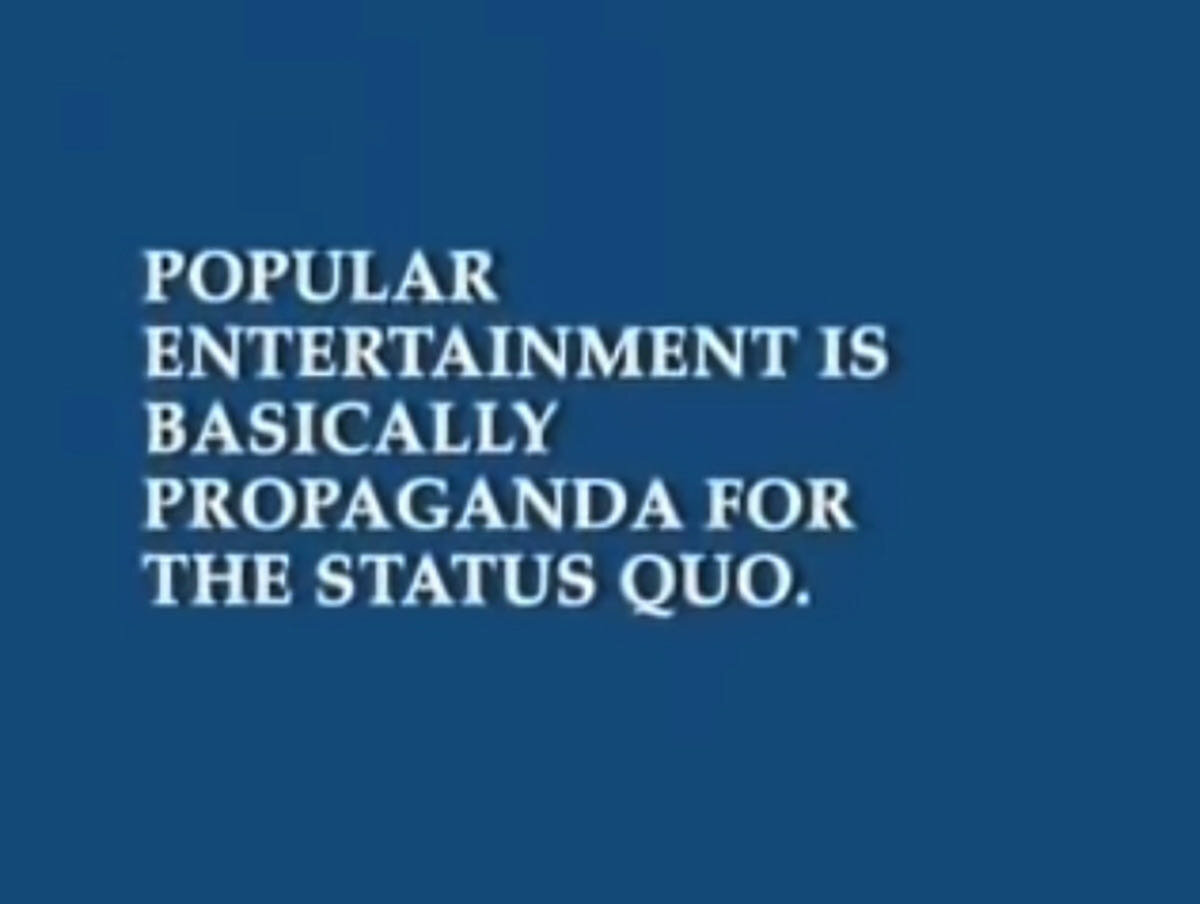
Television Delivers People (Richard Serra and Carlota Fay Schoolman, 1973).
Media literacy may allow us to examine such feelings, write such an explanation, commission these features, but it does not exempt us from the influence advertising exerts. More often than I care to admit, a commercial will make me cry. Their sentimentality is calibrated to assault the defenses of the human heart. When successful, the effect is not unlike watching a movie at high altitude. The provocation of this issue is that it may be useful to examine the media that has strategically positioned itself beneath our estimation, even if we can never transcend it. In the Multiplex column, our contributors prod at the formal strategies and cultural context of various case studies: Debashree Mukherjee warns against the nationalist fervor so easily evoked by advertising’s collective address; Mark Asch studies the troubling ironies in a Ford-sponsored television broadcast of Schindler’s List (1993); Olivia Popp probes the traditional German appetite for Heimatlich via supermarket commercials; Nicholas Henriquez identifies a device used as readily to push pharmaceuticals as it is in actual torture; and Nathan Lee frames the bracing video montage Jean-Luc Godard turned in as a trailer for the 2008 Viennale as a distillation of his oeuvre.
Capitalism at least produces compellingly opiatic representations of itself while driving the planet to the brink of destruction. That these representations are often unsatisfactory or self-contradictory is part of their perverse appeal: We take our place among the discontents, needing badly a salve for our addled condition—maybe this psilocybin face cream? Or maybe I’ll watch a movie… This issue is about advertising, but many of these observations might apply to any production of the culture industry. As the rolling screed of Serra and Schoolman’s Television Delivers People has it: “POPULAR ENTERTAINMENT IS BASICALLY PROPAGANDA FOR THE STATUS QUO.”

In this issue:

“The Hidden Smile Lies” by James N. Kienitz Wilkins
Fevered visions from an ad-glutted world, in which everyone is sold before their time.

“Advertising and the Dark Arts” by Tarsem
The director of The Fall on his gladiatorial Pepsi commercial, his Chess.com addiction, and Michelangelo as a brand ambassador.
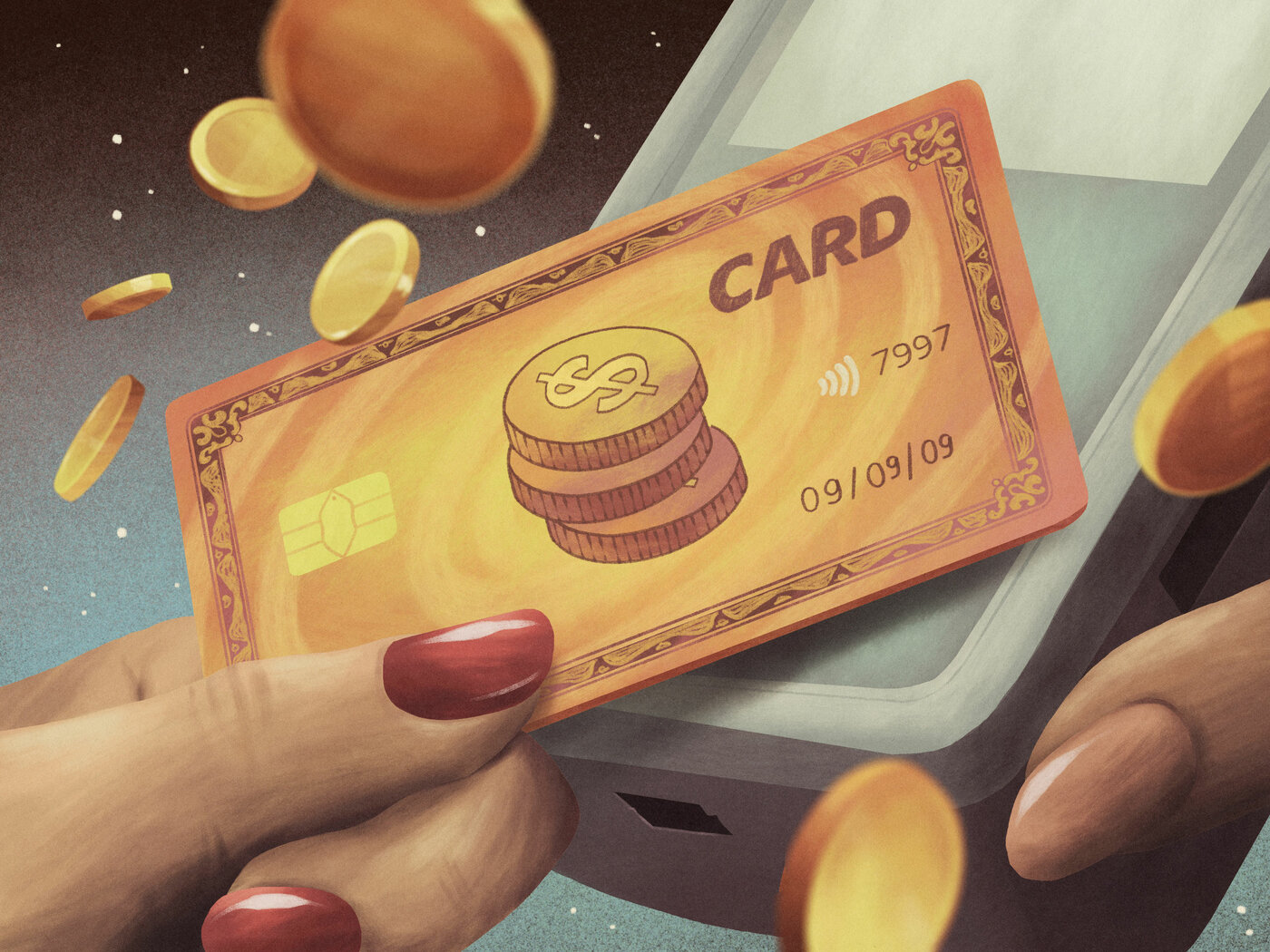
“Spot Treatment,” with contributions by Celia Young, Nicholas Henriquez, Debashree Mukherjee, Olivia Popp, Mark Asch, and Nathan Lee
Case studies in guile, from a post-independence Indian scooter ad to the awkward cousin of clickbait.

“Commercials at the End of History” by Sierra Pettengill
As the USSR crumbled, capitalists took a victory lap for consumerism on American airwaves.

“A New Imaginary World: On Early Animated Ads” by Eliška Děcká
In 1930s Czechoslovakia, commercials were a laboratory for what the medium of animation could be.
