NAZA (Yuval Abraham and Rachel Szor, 2026).
To watch my first film at the 83rd Venice Film Festival, I wore a VR headset. I say “watch” when the more accurate verb would be “experience,” at least going by the fest’s preferred vocabulary for what goes down on Lazzaretto Vecchio, an island a stone’s throw away from the Lido. Once used as a checkpoint for Holy Land pilgrims, and then—after the plague reached the lagoon in 1423—a leper colony, it is, in 2026 AD, now home to the virtual reality sidebar. The architecture has barely changed through the centuries. Dotting the high-ceilinged corridors that used to house the city’s moribund, festival guests can find various booths, each promising its own immersive experience: a multi-sensory journey through the sounds and visuals of David Bowie’s world, a trip to the Galápagos narrated by Margot Robbie, a chance to relive the first expedition that climbed Mount Everest in 1953, Sherpas in tow.
I’ve been coming to Venice for twelve years, but busy screening schedules on the Lido have always made my trips to Lazzaretto all too brief;; this time too I could only carve an hour on my first day. What I saw, however, made it difficult to watch anything else. Directed by Faiz Abu Rmeleh and Karen Manor, Raj’in (We Shall Return) (all titles 2026 unless otherwise noted) documents the ethnic cleansing of West Bank Palestinians by Israeli settlers and armed forces. It alternates 360-degree footage of life under occupation with 2D phone clips bearing witness to the invaders’ violence—unnameable brutalities perpetrated against men, women, children, and animals, each video screening while the rest of your visual field is cloaked in darkness. Headset on, eyes and ears physically unable to turn away from all those horrors, the immersive, you-are-there approach was perfectly suited to the film’s design. By bridging the gulf between people made to suffer those unspeakable depravities and outsiders watching them at a remove, Raj’in doesn’t just render the ongoing genocide against the Palestinians unnervingly vivid, but re-humanizes its casualties, at a time when mainstream news coverage tends to write them off as cold statistics.
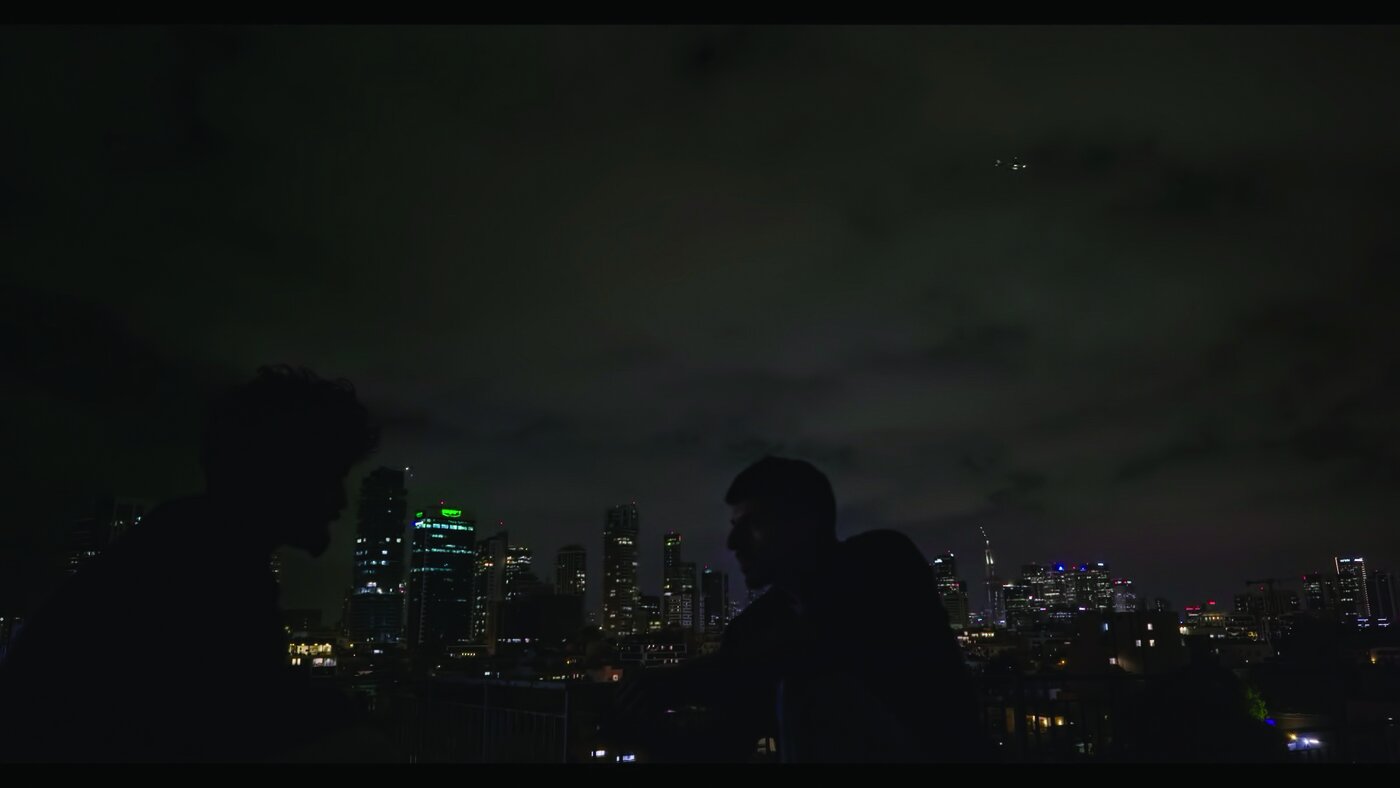
I kept thinking about this all through my time on the Lido, and especially when Yuval Abraham and Rachel Szor’s NAZA premiered in the official competition. Mostly, I thought about an interview artistic director Alberto Barbera gave just days prior, hinting that the film was given a late slot because he didn’t want politics “to become the only topic of conversation at the festival, overshadowing the other movies.” It felt like a decision unworthy of an event whose prerogative should be to invite debate—no matter how difficult—not recoil from it. NAZA wasn’t just one of the official competition’s standouts, but one of the edition’s most consequential entries. Shot in the aftermath of October 7, it gathers testimonies from 24 Israeli intelligence officers in an attempt to reckon with the genocide in Gaza: the measures taken to erase an entire people, and the narratives the perpetrators peddle to justify those atrocities. Filmed at night and on rooftops scattered all around Tel Aviv’s affluent city center, the documentary unfurls as a string of conversations between Abraham and his subjects, their faces and voices digitally altered to protect their identities, so that while the director remains visible—aglow in the chalky light spilling out of nearby buildings—his interviewees are shrouded in impenetrable darkness. That’s a fitting choice for a film that’s often unbearable to watch.
NAZA, named after the acronym used by Israeli officers to denote the collateral damage left by IDF strikes, only shows the consequences of these attacks at the very end, with clips recording the aftermath of an air raid on the Strip. It’s a devastating coda, but so is everything else that precedes it. There is something terrifying about the ease with which these soldiers embraced the narrative that “there are no innocent people in Gaza,” and saw themselves as part of a system that required no moral judgment, just successful and ruthless decision-making (“the goal was quantity, not quality,” an officer says in reference to strikes where the NAZA dwarfed the number of Hamas targets). Late into this horrifying confessional, a soldier admits he’s helped carry out a genocide, and another that he doesn’t see much of a difference between Israel and Nazi Germany. As their words echo in this sepulchral night, Abraham and Szor linger on the buildings around them. Behind their windows, life in Tel Aviv goes on as normal: people sleep, do yoga, run on treadmills, watch Netanyahu announce the army has blocked trucks carrying humanitarian aid into the Strip. It’s at these interludes that NAZA reminded me of The Zone of Interest (2023)—incidentally, Jonathan Glazer here served as executive producer—another incendiary vivisection of the banality of evil, and all the lies we tell ourselves to deny it and carry on.
Imperium (Sergei Loznitsa, 2026).
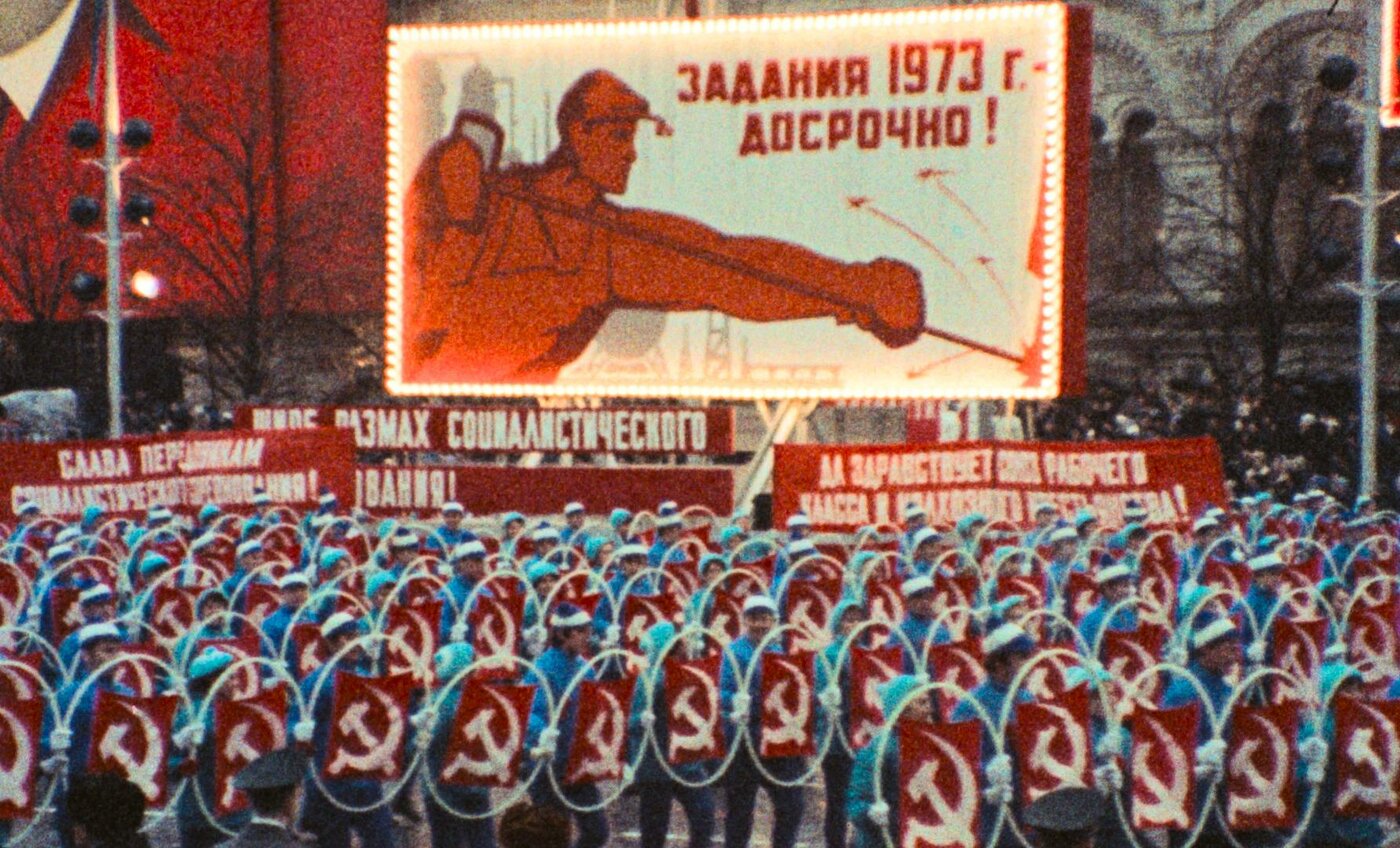
NAZA was only one of several astonishing documentaries in an edition where works of non-fiction largely outshone their fictional counterparts. For another indelible case in point, there was Sergei Loznitsa’s Imperium, a sprawling, three-hour travelogue across the USSR patched together from forgotten footage recorded by an Italian crew between 1970 and 1973. The material—presumably intended as filler for a more conventional doc—is the sort of stuff Loznitsa’s archival projects have long homed in on: glimpses of life in Soviet Russia where crowds take precedence over individuals, and quotidian activities are resurrected with voracious curiosity. As befits the director’s MO, there are no talking heads or title cards, save for the geographical coordinates orienting us along a journey that starts in Moscow and stretches to the farthest ends of the Union. An empire projecting a delusion of homogeneity is here revealed as something much more permeable and syncretic. Buddhist monks in orange robes and blue-tinted shades strolling around temples in Kalmykia; Christians flocking to centuries-old churches in Armenia; women boasting their traditional clothes somewhere in Turkmenistan; models strutting with their Italian-style coats in Riga. A miraculous alchemy binds the original directors to the man editorializing their material several decades later. The Italians didn’t just provide Loznitsa with a time machine spanning 60-plus hours of footage, but also shared his keen eye for incongruous images, wherein the cultural uniformity flaunted by Moscow is routinely complicated by endemic symbols and traditions. The result is a riveting snapshot of a bygone world that never feels didactic. Imperium doesn’t need to spell out the collision between “then” and “now” for you to realize just how different Putin’s Russia looks from this eminently strange and polyphonic milieu. And like the director’s finest, it exemplifies Loznitsa’s ability to reanimate the past, and turn archives into living, breathing things.

DAU (Ilya Khrzhanovsky, 2026).
One of the negative talking points around the official competition was the inclusion of what’s already gone down as a kind of film maudit, DAU, from the Russian Ilya Khrzhanovsky. To be clear, and notwithstanding the statement Barbera issued on the eve of the festival, the worry here is not the director’s passport. It’s that the film, a rallying cry against totalitarianism, was made by an artist who reportedly embraced the same tyrannical means he purported to attack. The story behind the project’s genesis is nothing short of incredible. In 2006, then 29-year-old Khrzhanovsky pitched a biopic of famed Soviet physicist and Nobel Prize winner Lev Landau, received money from the EU funding body Eurimages with Swedish and German support, and then proceeded to construct his own Synecdoche, New York (2008) in Kharkiv, Ukraine. Between 2008 and 2011, over four hundred non-professional actors lived inside a 42,000-square-foot replica of a Soviet-era research institute. They played versions of themselves transposed to USSR lifestyles, so fastidiously recreated that everything—down to the food served and clothes worn—was made to mirror the period. Khrzhanovsky’s bid for authenticity bordered on madness: real former KGB officers were cast as the film’s fictional KGB guards; some of the thugs terrorizing the institute’s staff were actual criminals (among them Russian fascist Maksim Martsinkevich, who’d be convicted of murder and found dead in his cell in an apparent suicide in 2020); and outsiders wishing to visit the premises had to hand over their electronics and wait for hours to obtain visas.
Inside, however, those who’d signed up for “the experiment”—as a 2019 trailer euphemistically called it—were subject to all kinds of psychological and physical abuse. Participants could be arrested, rough-handled, stripped naked, while sexual scenes were often non-simulated (Albina Kovalyova, whom Khrzhanovsky had hired as the project’s official chronicler, has described life at the institute in a hair-raising exposé at The Telegraph). Crucially, there were no scripts. “Over seven-hundred hours of [the residents’] reactions to these extraordinary circumstances were recorded,” per the trailer, and out of that gargantuan material Khrzhanovsky spawned features, series, an exhibition at the centre Pompidou in Paris, and now, at long last, a biography of the man who triggered this entire folly into being.
Does the film itself live up to its insane backstory? I’m still not sure. Of all the features to have graced the festival circuit (see the original 2019 Dau, or 2020’s Degeneration and Natasha, all three unveiled at the Berlinale during the era of festival director Carlo Chatrian), this one feels closer to the biopic Khrzhanovsky must have shopped around to get cash in the mid-2000s (i.e. bold, but not too bold to scare potential backers). It’s a chronological if elliptical look at the man’s life that kicks off in 1928, when Dau (Teodor Currentzis) is a promising physicist roaming the streets of Leningrad, and wraps with the scientist on his deathbed 40 years later. Dau’s a genius, but the only measure of his greatness comes from the praise colleagues and sycophants readily pile on him. In other words, we must trust he is one, for Khrzhanovsky is much less interested in his day-to-day routine than in his inveterate womanizing, and in keeping with the real-life Landau, Currentzis screws his way through DAU as a cad whose experiments spill from the lab to the bedroom, much to the chagrin of his devout wife Nora (Radmila Shchogolieva). Like J. Robert Oppenheimer, Landau would be recruited by his country’s military-industrial complex to help in the nuclear arms race; like 2023’s Oppenheimer (with which Khrzhanovsky’s portrait would make for a singular double bill), DAU rests on a friction between a work made of long chats and Khrzhanovsky’s febrile filmmaking.
All throughout, the writer-director intersperses existential debates (“are we scientists moral leaders or technicians creating models of destruction?”) with sequences where sounds and visuals burst forth with such assaultive force as to suggest a film undergoing some kind of seizure. I’ll remember DAU not for its hero’s marital struggles or the vast chunks in which Khrzhanovsky’s epic borders on melodrama, but for these dizzying moments: a masked ball with guests donning the most sinister costumes while a brass band plays with deafening vigor around them; a couple of scenes that look like optical illusions—one where Dau and his mentor stand atop an iron grate suspended several feet about the ground, their silhouettes arranged in a way that blurs your sense of foreground and background, another where the two schlep up a hill at a 45-degree angle while the slope is flattened into the horizontal axis, so that their bent backs seem to defy logic. Khrzhanovsky recruited Lol Crawley as one of his cinematographers, and at its most stunning, DAU evokes the same muscular energy of another film shot by the Englishman, The Brutalist (2024). Like Brady Corbet’s, Khrzhanovsky’s portrait of a genius strains for images worthy of his grandeur, and the few times it achieves them, the effects are breath-taking.
Bucking Fastard (Werner Herzog, 2026).
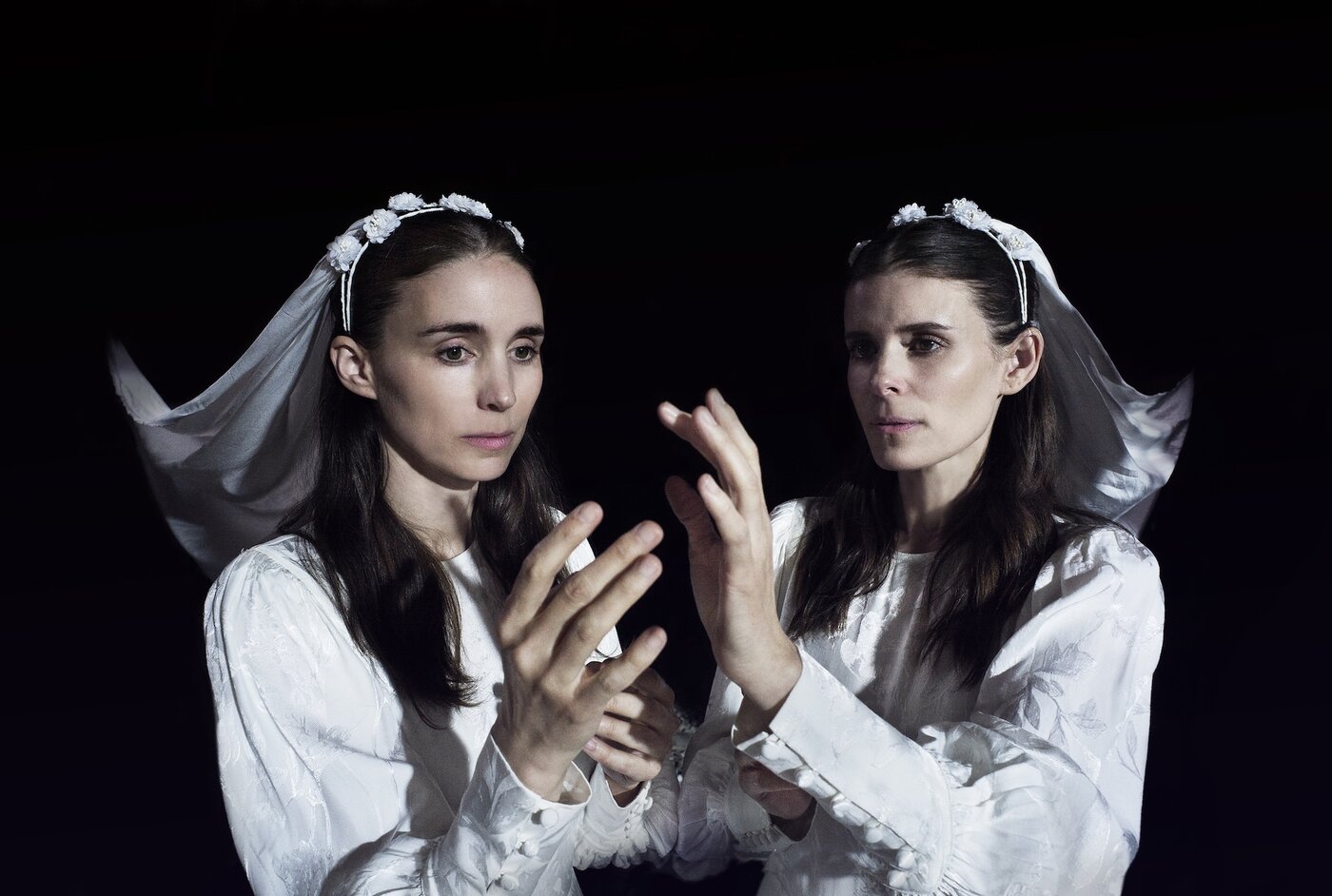
“Muscular” is a descriptor that’s long been tossed at Werner Herzog, whose Bucking Fastard was another highlight in an otherwise underwhelming official competition. In it, siblings Kate and Rooney Mara star as sisters who dress, move, and talk like one—a double act loosely inspired by the real-life case of the late Freda and Greta Chaplin, the only known twins who spoke synchronously. It’s the kind of wacky real-life story Herzog has orbited his entire career. The Chaplins rose to fame in the 1980s after they were convicted of stalking their next-door neighbor, a truck driver they’d become obsessively besotted with. In the writer-director’s riff, the man’s a wealthy Lothario played by Orlando Bloom, and the film kicks off in a surreal vein redolent of Yorgos Lanthimos before swelling into a more romantic fairytale. It’s not just the sister’s act that feels uncanny; everything does. Shot by Peter Zeitlinger, Herzog’s cinematographer since the mid-1990s, Bucking Fastard traffics in sweeping, unbroken sequences, most of them shot on a gimbal, and there’s an intoxicating effect to the floating camerawork that leaves the whole thing hanging in a kind of dream space—long before a third act that sees the siblings dig a tunnel through a mountain that legend says will lead them from rural Ireland to the faraway Orkney Islands. Herzog’s first fiction foray since 2019’s Family Romance, LLC, Bucking Fastard is often ridiculous, but it’s so committed to the bit and so earnest about its love for the eccentric duo as to become strangely hypnotic.
Possible Love (Lee Chang-dong, 2026).
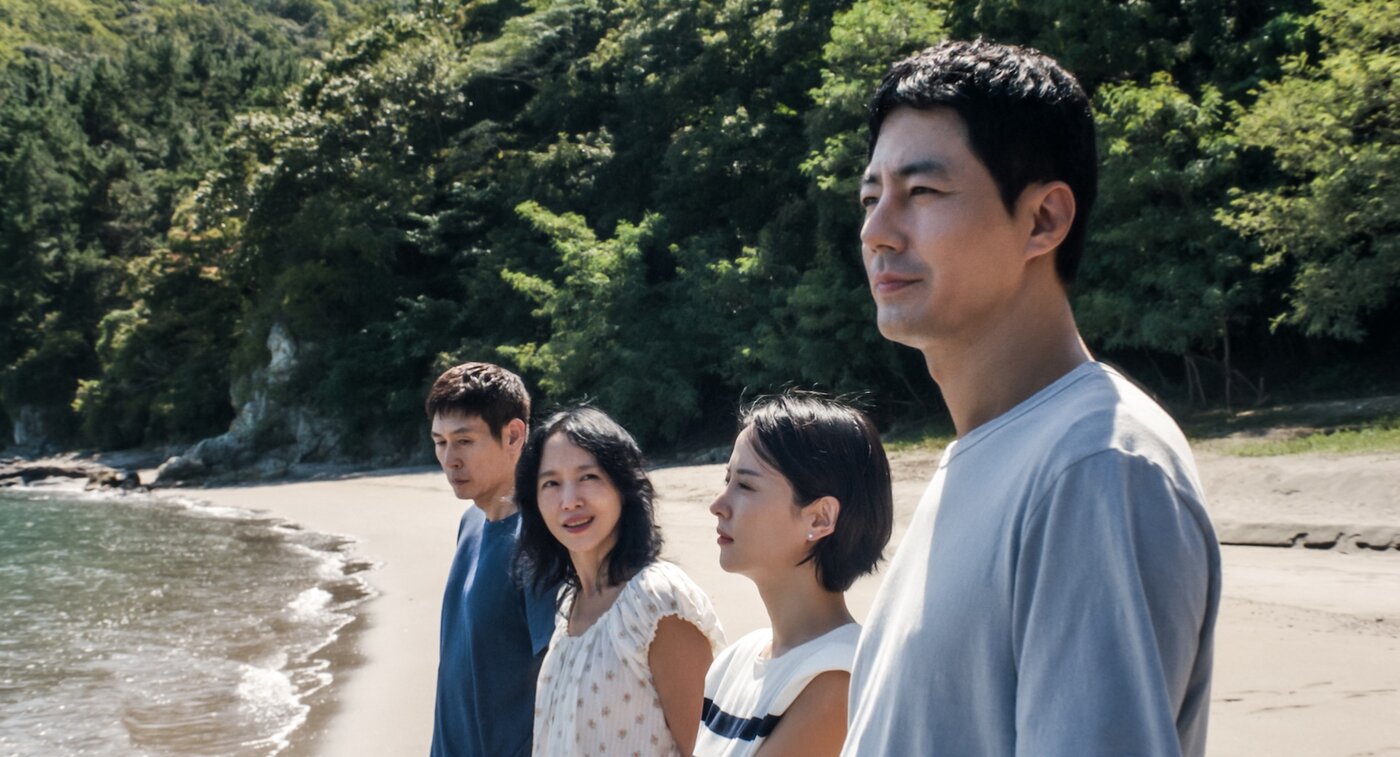
I wonder what Herzog might have to say to Ye-ji (Cho Yeo-jeong), the moneyed filmmaker who saunters into Lee Chang-dong’s Possible Love fueled by the haughty belief that “documentaries are a powerful means to inspire others.” Ye-ji is making a film about South Korea’s troubled workforce which will center on Mi-ok (Jeon Do-yeon) and her husband Ho-seok (Sul Kying-gu), a factory worker who lost his job after his company was bought by a US private equity firm. The thematic affinities with Park Chan-wook’s No Other Choice (2025) are hard to miss: together, the two features make the case for unchecked neoliberalism as a plague shattering the country’s social fabric. But where Park couched his film as a farce, Lee sustains a far more harrowing register.
So traumatized is Ho-seok by the loss of his gig he doesn’t just shudder at the idea of letting Ye-ji interview him, he cannot bring himself to join a therapy group with other former coworkers. Lee, who wrote the script with Oh Jung-mi, shows a perceptive eye for the dehumanizing effects of late-stage capitalism. Possible Love isn’t just a fierce critique of Ye-ji’s predatory project and the misery porn she’s after, but a testament to the ways the atomizing, cut-through logic so ingrained in our economic order makes it impossible to dream up alternative realities, how it renders things like “workers’ solidarity” hollow slogans. The lucky employees who kept their jobs after the restructuring are referred to as “the living,” those who didn’t “the dead,” and Ho-seok—who used to call his colleagues “brothers,” went on strike with them, and watch them turn their backs on him once the cops showed up at the picket line—is effectively grieving over the death of a family. Nothing in Possible Love is more lacerating than a therapy session in which a fellow “dead” wonders if her present sadness is the price she’s paying for a happiness she was never supposed to feel.
Still, this is no dirge, and if Lee’s film can skirt miserabilism that’s credit to Jeon’s performance. Her turn as Mi-ok—the crowning jewel in a work that towers high above anything else in this year’s official competition—suggests a woman who gradually wakes up to the malevolent schemes of her interviewer, and in the final act, as Ye-ji and her rich husband invite Mi-ok, Ho-seok, and their ten-year-old son to spend a few days at their seaside mansion, all the rage Possible Love accrued along the way finally detonates. The doc-within-the-film conceit gives cinematographer Kim Ji-yong a chance to seesaw between different coverage: static shots for Ye-ji’s footage, handheld for Lee’s; as the director lingers on Mi-ok at the climax, actress and film strike a near-molecular symbiosis: it’s as though the fervor she radiates made the frames vibrate.

Musk (Alex Gibney, 2026).
Early into Possible Love, the two couples are having dinner at a high-end restaurant when Mi-ok—class differences and social anxieties all but evaporate thanks to unhealthy amounts of soju—says Ye-ji’s husband looks like Steve Jobs. Never mind that’s patently not true: the tech guru “looked free,” she says dreamily, “like he could solve all our problems.” The words rattled around in my head all through Alex Gibney’s Musk, a near four-hour closeup that says less about the richest man on Earth than it does about our readiness to hail figures like him as prophets. The operative question here is not who is Elon Musk, but how could he assume so much power, and why did we all decide to hand it to him. Predictably, Gibney could not land a tete-à-tete with his subject, leaving Musk to summon a second-hand portrait sketched by reformed disciples and longtime skeptics. It also resorts to deep-fake technology to stage talking head-style segments where a digitally-created Musk spouts some of the deranged stuff he’s said in public, a choice that befits the fake persona he’s nurtured and opportunistically tweaked through the years.
That said, it’s hard to shake off the feeling that Musk amounts to little more than an extended newsreel, most of it familiar but no less infuriating for that. We begin in the late 1990s, when Elon was an IT dork at the helm of Zip2—a tech company that provided city guides and maps to newspapers—and wrap today, the man so immured in his obscene wealth and delusions of extraterrestrial colonialism as to look and sound like an alien himself. Gibney wants to chip away at the idea of Musk as a genius, and doesn’t need to look too hard for evidence: multiple failed launches at SpaceX, fatal bugs in Tesla’s autopilot tech, to say nothing of the cancerous results of his anti-deficit crusade as head of DOGE. Far from “the world’s greatest inventor,” as throngs of adoring Silicon Valley bigwigs insist he is, Musk suggests he might instead be the world’s greatest salesman, a fraud whose myth has been inflated by media conglomerates all too willing to kowtow to his demands.
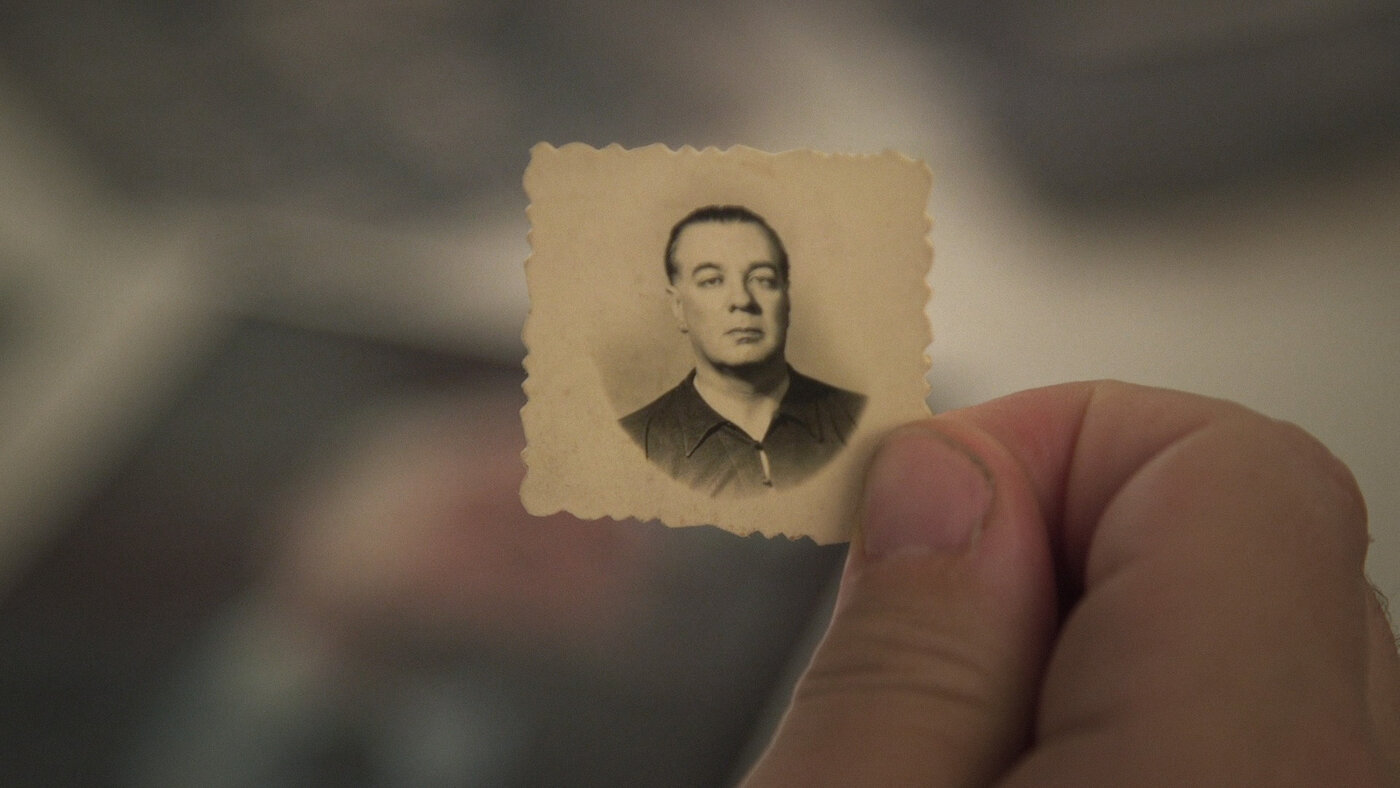
Life of Jorge Luis Borges (Mariano Llinás, 2026).
Gibney’s is a meandering and necessarily incomplete portrait, a good way to think about the festival’s best: Mariano Llinás’s Life of Jorge Luis Borges. Anyone familiar with the filmmakers collective Llinás co-founded—Pampero Cine—will know the group’s penchant for restlessly inventive, sinuous narratives. From Llinás’s magnum opus, La Flor (2018) to Laura Citarella’s Trenque Lauquen (2022) and, more recently, Alejo Moguillansky’s Endgame (2025), what unites different Pampero Cine productions is a seditious belief that films could turn into games, and viewers into co-conspirators actively partaking in their directors’ efforts to subvert storytelling conventions. Seen in this light, Llinás’s biography is not just an illuminating closeup, but a phenomenal manifesto of the collective’s idea of cinema, so open to fissures and digressions as to become, to borrow from the literary titan himself, a garden of forking paths.
As he did in La Flor, Llinás outlines the rules of his game right at the start: Life, he tells us in voiceover, came to being once a foundation handed him exclusive access to a treasure trove of relics: manuscripts, drawings, books, and all sorts of other inestimable documents that belonged to Borges. And Llinás, aided by scholar Ernesto Montequín (a Sherlock Holmes to the filmmaker’s Watson), turns to them as clues in his quest to sketch a portrait of the man. That the pursuit is hopeless is the point. Life makes no claim to coherence or completeness, as every object Llinás trains his gaze on beckons him into a maze of bizarre conjectures and coincidences, and the film—not unlike one of Borges’s short stories—becomes a kind of labyrinth, sending director and Montequín around the world in hopes to uncover more about the writer through the places that haunted him, and vice versa.
I’m not sure I could ever do justice to the extraordinary vitality Life communicates, or the contagious fever Llinás’s literary forensics transmit. (What a year this is turning out to be for book and film lovers; watching the two men work their way through Borges’s writings, convinced they might yield the most astounding secrets, I kept flashing on Kevin Walker and Jack Auen’s Chronovisor, another film that treats texts as oracles). I suspect much of that effervescence has to do with the director’s willingness to welcome mistakes and imperfections instead of shying away from them. Life is littered with scenes another filmmaker might have disposed of as errors: we hear Llinás complain, offscreen, that the shots we’re seeing are “amateurish,” “out of focus,” “corny,” “cliché”. But he still includes them, and in his hands, they give the film the rare feeling of something that’s inventing itself as you watch, and you, the spectator, the illusion to not just witness but take part in that creation.
No film I saw this year energized me quite like this. So I turned to the web for my own search. As it happens, Borges visited Venice once, in 1984, when he was already blind, an octogenarian travelling with a woman he’d fallen hopelessly in love with, and would be his wife for a few months only before his death in 1986. There’s a picture of them standing under the cloister of the former monastery in San Giorgio Maggiore, another island, like Lazzaretto, sitting between the Lido and San Marco. The convent is now home to the Giorgio Cini Foundation, a cultural center that resolved, in 2011, to honor the 25th anniversary of Borges’s passing by creating a maze inside the monastery’s walls out of 3250 boxwood plants. “This labyrinth-garden is not about getting lost,” said a review online, “but about finding a dimension of pure beauty.” I’m not sure that’s what I found when I got there. A storm was just leaving Venice; dark clouds chased each other over the lagoon and the boxwood quivered in the wind. My phone died. I wandered about trying to get a feel of the place, but it looked like an empty tourist trap. I’m not convinced Borges would have found a dimension of pure beauty there either. But in the days that followed, I kept going back to that trip, the maze—Borges’s and Llinás’s. Even now as I type, almost a week since that screening, I can feel my senses heightened, my mind agog, primed for all manner of mysteries and revelations. How rare, and how thrilling, to come across a film that can invite you to look at the world anew.