Get in touch to send in cinephile news and discoveries. To keep up with our latest features, sign up for the Weekly Edit newsletter and follow us @mubinotebook on X and Instagram.
NEWS

Talking About Trees (Suhaib Gasmelbari, 2019), the reopening film selection at Parisian cinema La Clef.
- The Parisian theater La Clef has reopened after being forced to close its doors eight years ago due to rising rent costs. Established in 1973, La Clef prided itself on fulfilling a niche of politically informed alternative cinema in the wake of the country’s May 1968 protests. Befitting the theater’s activist origins, the La Clef Revival Collective have fought tirelessly to keep the cinema and its “independent, community-run, solidarity-driven” spirit alive since 2019, including illegally occupying the theater for over three years to continue operations. The building was finally sold to the group in 2024 with the help of a dedicated endowment fund supported by the international filmmaking community, including filmmakers like Martin Scorsese and David Lynch.
- Netflix has modified its offer to purchase Warner Bros. Discovery to an all-cash deal in an effort to hasten the merger and stymie Paramount’s hostile takeover bid for the company. Earlier this month, Paramount CEO David Ellison implored WBD shareholders to accept a financially risky deal personally backed by his billionaire father Larry Ellison, which the WBD board rejected. Both companies have engaged in a PR battle by appealing to Washington, including President Trump, and the media about their respective intentions, such as Netflix CEO Ted Sarandos’s pledge to retain a 45-day theatrical window for WB films.
- Pablo Larraín and his brother Juan de Dios Larraín have launched Pijama, a new streaming service for undistributed independent films. The TVOD platform allows filmmakers to personally upload and store their work for up to two years and set their own rental pricing between $3.99 and $9.99. “Eighty percent of films never get distribution,” the Larraín brothers say in a statement, “and we see a cultural crisis rooted in the end of physical media and the current logic of the market.”
- Starting in February, Alamo Drafthouse will introduce a new digital-only system for customers to order food prior to and during screenings, replacing the company's pen-and-paper system. Alamo insists that it will maintain its strict “no talking, no texting” policy despite the necessity of phone usage to order and pay for service. CEO Michael Kustermann says that the new model will allow the Drafthouse team to “move faster and more efficiently, creating a smoother, more responsive experience without added distraction.”
REMEMBERING
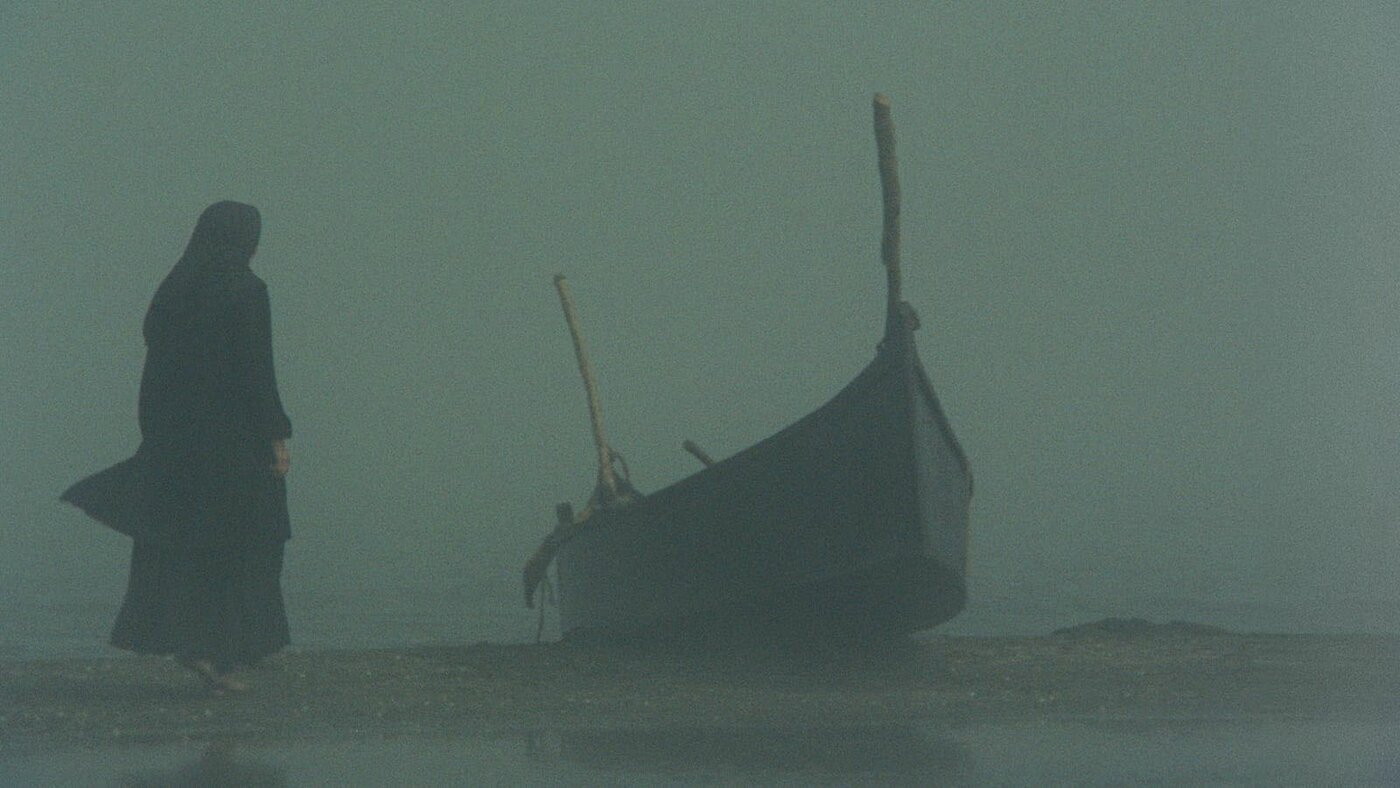
The Stranger and the Fog (Bahram Beyzaie, 1974).
- Bahram Beyzaie, one of the leading figures of the Iranian New Wave, has died at 87. A well-respected filmmaker, playwright, scholar, and historian, Beyzaie began writing plays and immersing himself in the history of Persian theater from a very young age, publishing his influential research text Theatre in Iran (1965) at the age of 27. In 1969, Beyzaie joined the faculty of the University of Tehran’s theater department, which he chaired from 1972 to 1979. During that time, Beyzaie began creating short films for Kanoon, the state institution dedicated to promoting cultural works for children, where his peer Abbas Kiarostami also got his start. Beyzaie’s debut feature Downpour (1972) was awarded the special jury prize at the Tehran International Film Festival, presided over by Satyajit Ray. Martin Scorsese’s World Cinema Project has since restored Downpour and Beyzaie’s sophomore feature The Stranger and the Fog (1974). Following the 1979 Iranian Revolution and his subsequent expulsion from the university, Beyzaie continued to write and produce films in the face of censorship, including Bashu, the Little Stranger (1986), which is widely considered one of the best Iranian films of all time. In 2010, he permanently left Iran at the invitation of Stanford University, where he was recruited to teach in the Iranian studies program; while there, he staged plays he had been prevented from performing in Iran. “He endured years of exclusion, enforced silence and exile, yet he never surrendered his voice or his convictions,” said Jafar Panahi. “Many of us, directly or indirectly, learned from him. We learned how to stand against forgetting.”
RECOMMENDED READING

Photograph by Jem Cohen, accompanying Scott Macaulay's final issue of Filmmaker Magazine.
- On January 9, editor-in-chief Scott Macaulay and director of editorial operations Vadim Rizov departed Filmmaker Magazine. Both writers reflected upon their respective extended tenures: Macaulay used his final print issue’s extended “Reflections” section to honor his 33 years at the magazine, soliciting remembrances from Ted Hope, Manohla Dargis, Brandon Harris, and more. Meanwhile, Rizov detailed his best work as a commissioning editor, such as Bingham Bryant’s heavily researched piece on contemporary color correction practices and Daniel Garber’s inquiry into the ethically dicey, rigidly produced world of true crime documentaries.
- “My husband once told a story of taking a Greyhound across Arizona: he asked the driver if they could stop so he could pray. The driver announced, ‘Folks, we’ve got a Muslim here who wants to pray—what do you say?’ Every hand went up in agreement, and the bus stopped so he could do his namaz. That would never happen today. Now you’d have ICE called on you. We’ve regressed.” For A Rabbit’s Foot, creative director Fatima Khan interviews filmmaker Mira Nair about her career, her son Zohran Mamdani’s newfound political success, and her upcoming film about the Indo-Hungarian painter Amrita Sher-Gil.
- “We have a better freedom of speech outside of the United States than in the United States…You have a situation where all the major finance groups who finance films, they don’t like to finance certain types of films because they go against the government, and they will not do it—in this period, at least—unless you change the President.” For The Film Stage, Nick Newman interviews Brazilian producer Rodrigo Teixeira about the state of world cinema, as well as his shepherding of upcoming films by James Gray and Brian De Palma.
- “But Mendonça’s work registers yet another transition in Brazilian cultural production. To the extent that he is emblematic of a generation that came of age in the 1980s, his commitment to cinema seems to have preceded his engagement with political struggle, and his relationship to popular movies has always been paramount in his sense of self.” For Film Comment, David Beal delves into an upcoming Film at Lincoln Center series programmed by Kleber Mendonça Filho, a selection of films that inspired The Secret Agent (2025). for his series at Film at Lincoln Center.
RECOMMENDED EVENTS
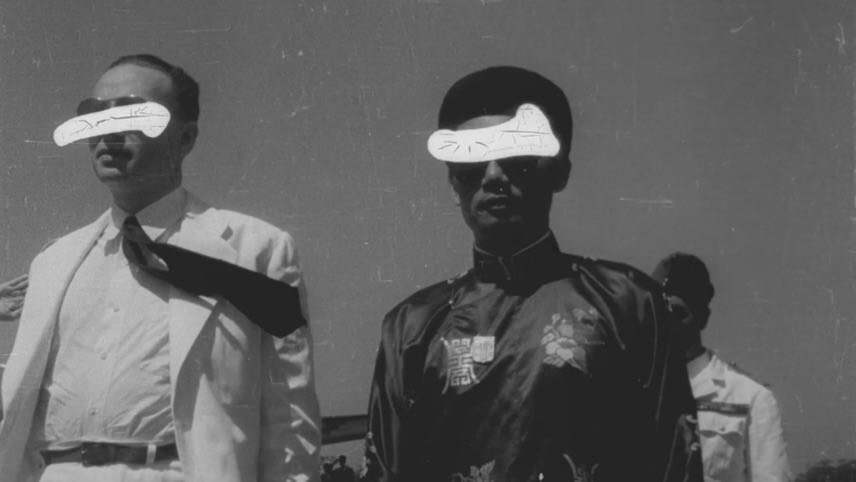
Venom and Eternity (Isidore Isou, 1951).
- New York, January 29 through February 1: Anthology Film Archives presents “Lettrist Film,” a selection of key films from the avant-garde movement founded by Isidore Isou. The series marks the 101st anniversary of Isou’s birth and is presented in association with Center for Book Arts’s exhibit Rewriting the World: Isidore Isou and the Lettrist Book.
- Paris, through March 14: Gagosian presents The House on Utopia Parkway: Joseph Cornell’s Studio Re-Created by Wes Anderson, an exhibition conceived by curator Jasper Sharp and Anderson that recreates the visual artist's New York studio in Paris. Anderson and exhibition designer Cécile Degos utilize hundreds of objects and curiosities from Cornell’s own collection to recreate the space, which can be viewed through the gallery’s street-facing window.
- Chicago, January 30 through February 24: The Siskel Film Center presents “Lo-Fi Sci-Fi,” a series dedicated to selections from the genre that embrace “big ideas with small budgets,” such as John Coney’s Space Is the Place (1974) and Shane Carruth’s Primer (2004).
- Los Angeles, February 12: Seen, a biannual film journal published by BlackStar, presents a contributors roundtable hosted at the Reparations Club to celebrate its latest issue. Moderated by editor-in-chief Heidi Saman, the roundtable will feature Maya S. Cade, Jenny Yang, and Darol Olu Kae who will discuss “Black film distribution, the experience of being a DEI hire in Hollywood, and the subversive poetics of Charles Burnett's Killer of Sheep (1978).”
RECOMMENDED VIEWING
- Filmmaker and critic Jean-Baptiste Thoret has released his documentary 86 printemps, Jean-Luc Godard (2026) on YouTube, sans English subtitles, for an unspecified period of time. The film, an extended conversation with the legendary filmmaker, was shot in 2017 and has gone unreleased due to unspecified rights issues.
- A24 presents a video episode of their podcast featuring Josh Safdie and Sean Baker in conversation. The two directors discuss production designer Jack Fisk, Baker taking edibles at the Oscars, and the wacky alternate ending to Marty Supreme (2025).
- 1-2 Special presents a trailer for Christian Petzold’s Miroirs No. 3 (2026), a psychological drama about a young piano student from Berlin who accepts the care of a suspiciously tender woman and her family after surviving a car crash in the countryside. The film will be released in select theaters on March 20.
- 1-2 Special also presents a trailer for Radu Jude’s Kontinental 25, the second 2025 festival premiere from the prolific Romanian filmmaker, which chronicles a bailiff’s feelings of guilt after her actions lead to an unhoused man’s suicide. The film will be released in select theaters on March 27.
RECENTLY ON NOTEBOOK
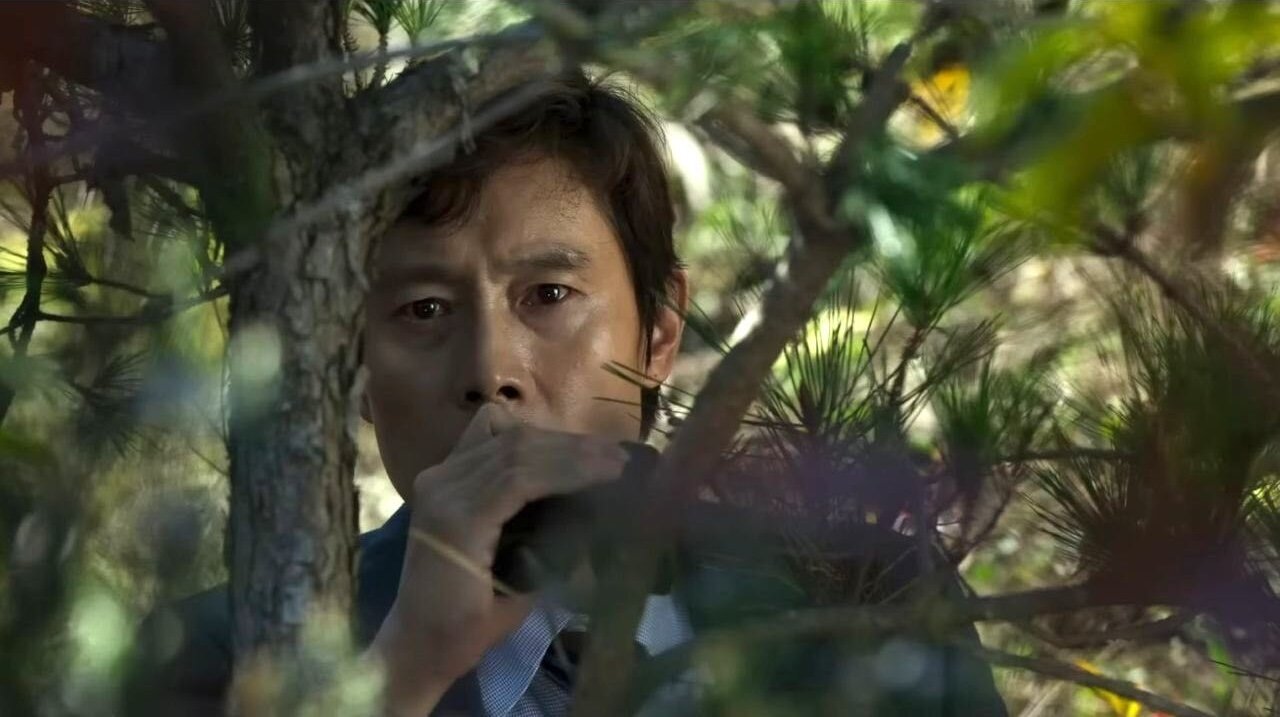
No Other Choice (Park Chan-wook, 2025).
- “By contrast, the visibility of No Other Choice’s VFX components, and our constituent awareness of them as viewers, presents the opportunity for some recognition of the material conditions that produced them.” Jadie Stillwell close-reads Park Chan-wook’s choice to foreground “obvious” visual effects, which reflects the film’s “uneasy, ambivalent relationship to specialized labor in the age of automation.”
- “The cyclical structure of [Sound of] Falling ties it to the natural rhythms of rural Altmark, and to the greater canon of agrarian literature, which finds human life at the mercy of grand-scale forces.” Robert Rubsam explores how Mascha Schilinski’s film engages with agrarian literature, including works such as Knut Hamsun’s Growth of the Soil (1917) and D. H. Lawrence’s Love Among the Haystacks (1930), and the ways that the film engages with the bitter inevitability of seasonal life.
- “The gay subtext that initially escaped many contemporaneous critics has become legible enough for Winter Kept Us Warm to be accepted within the queer canon. It is called ‘proto-queer’ because, like the characters themselves, the film remains closested.” For the third entry in our series of short essays about notable film restorations from 2025, Kevin Champoux unpacks David Secter’s 1965 campus drama and how the film’s portrayal of queerness, from a time when homosexuality was still illegal in the filmmaker’s home country of Canada, functions like negative space.
- “These parallel tongs of grief—for the person who is gone, as well as their world-building—are what make Invention so dynamic. Carrie does miss her father, despite all the ways in which she cannot ever fully understand and know him. Gone is the person who optimistically adhered to modes of belief and business models that others, such as his executor, deemed ‘paranoid and reckless.’” Hannah Bonner delves into Courtney Stephens’s debut feature and the ways that the filmmaker and her star and cowriter Callie Hernandez weave together a “machine for grieving the past” from decades-old infomercials, contemporary 16mm footage, and “kitsch debris.”
WISH LIST
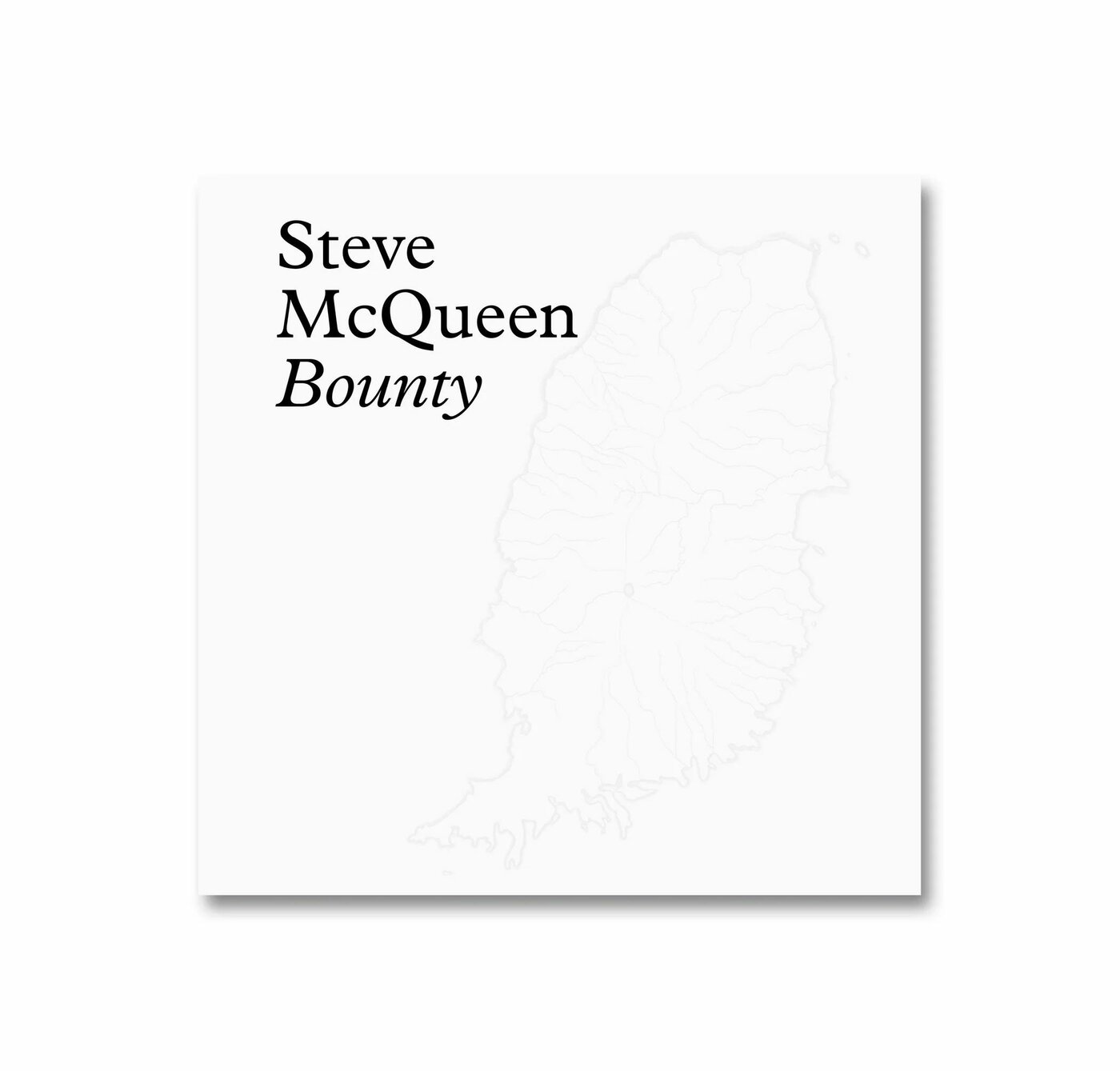
- Bounty (2026), a book from artist and filmmaker Steve McQueen, is available to preorder from MACK. The book features a collection of photographs taken by McQueen during a trip to the island of Grenada in the summer of 2024. The images of the island's flora are meant to reckon with the complex colonial history underlying the land’s beautiful plant life.
EXTRAS
- MTV Rewind, a free simulator website, recreates the experience of watching the 24/7 music channel during its heyday. While you’re treated to the original broadcast of the channel’s official launch upon initially visiting the site, the site allows you to toggle between different decade-specific playlists, which include period-specific TV ads as well.